COMED: The 'Missing Middle Ground' Between Routing and Collaboration in Multi-Model Inference

COMED uses three lightweight signals for on-demand multi-model collaboration, boosting accuracy while cutting compute costs.
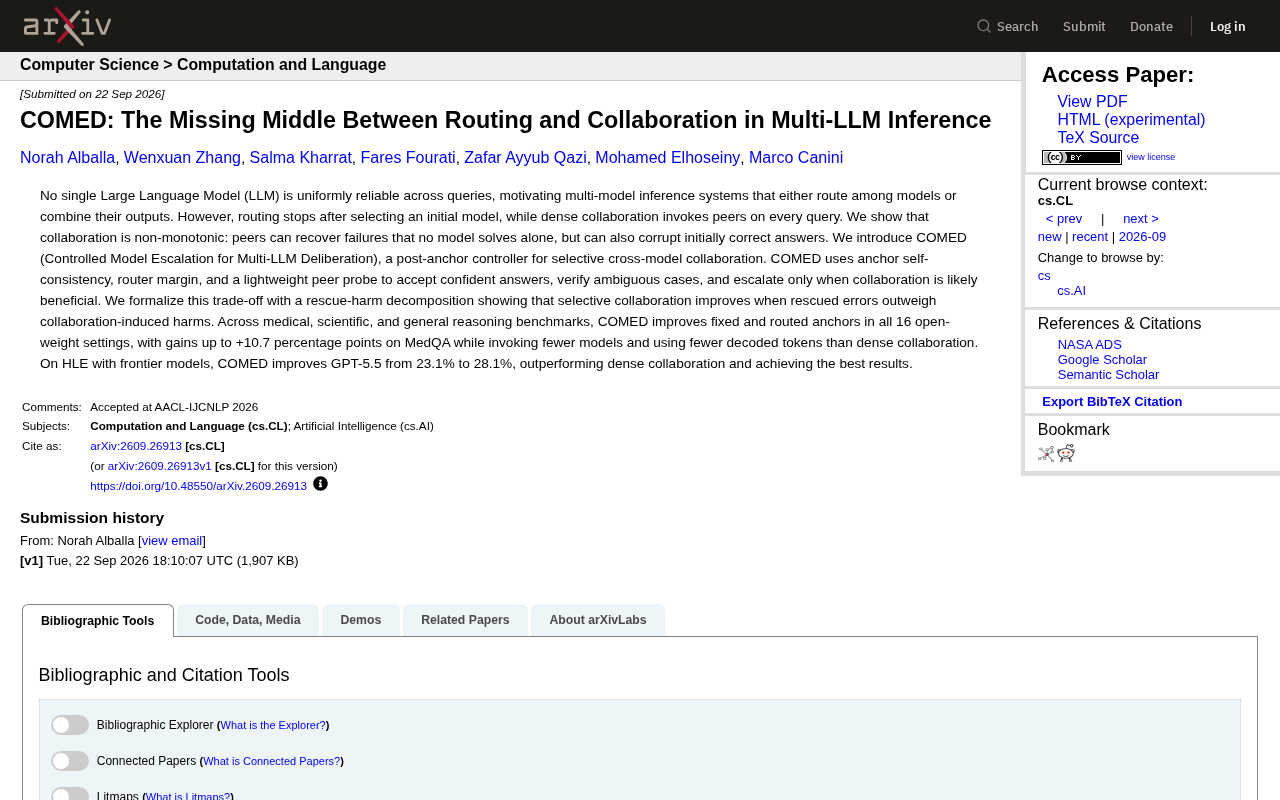
No single LLM performs reliably across all tasks, yet existing multi-model systems either rely on routing (pick one best model) or dense collaboration (involve all models), each with clear drawbacks. The proposed COMED system fills the gap: it first reveals the non-monotonic nature of multi-model collaboration — collaboration can rescue single-model errors but also corrupt correct answers. COMED then uses anchor self-consistency, router margin, and lightweight peer probes to dynamically decide whether to escalate to multi-model collaboration. Experiments show COMED outperforms baselines across all 16 open-weight settings, with up to +10.7pp on MedQA, and lifts GPT-5.5 from 23.1% to 28.1% on the challenging HLE benchmark — all while invoking fewer models and consuming fewer tokens than dense collaboration.
When a Single LLM Isn't Enough: The Trade-offs in Multi-Model Systems
No single large language model (LLM) delivers consistently reliable performance across all queries. This reality has driven the development of multi-model inference systems — ones that either route queries to the best-fit model or combine outputs from multiple models. Yet both mainstream approaches have obvious shortcomings.
Routing stops working once an initial model is selected, leaving no mechanism to correct errors downstream. Dense collaboration, on the other hand, invokes all peer models for every query — expensive and not always beneficial. A new paper on arXiv proposes a solution between these two extremes: COMED (Controlled Model Escalation for Multi-LLM Deliberation), designed to fill this "missing middle ground."
The Non-Monotonicity of Collaboration: It Can Rescue — or Corrupt
The paper's central insight is revealing the non-monotonic nature of multi-model collaboration. The authors show that peer model involvement is a double-edged sword:
- On one hand, peer models can rescue cases that a single model fails to handle on its own;
- On the other hand, they can also corrupt answers that were already correct.
This means blindly involving all models in every collaborative step isn't worthwhile. The real question is: when should other models be brought in? If the "rescue" gains from collaboration can't offset the "harm" it introduces, dense collaboration actually drags down overall performance. This trade-off is precisely the overlooked space between the two extremes of routing and dense collaboration.
Non-monotonicity here means that increasing the number of models participating in collaboration does not monotonically improve overall system accuracy — the relationship is complex, with gains and losses. This contradicts the intuitive expectation that "more model votes" is always more reliable than a single model's answer. Experiments show that when a model has already produced the correct answer, introducing other models with differing opinions can skew the result through majority voting or weighted fusion — a corruption effect. This is especially pronounced in dense collaboration systems (such as mixture-of-agents or multi-round debate frameworks), which assume "collaboration is always beneficial" while ignoring that peer models may systematically err on certain problems, propagating mistakes to an otherwise-correct anchor model. Understanding this non-monotonicity is the theoretical foundation behind COMED's "conditionally triggered collaboration" rather than "unconditional full-team participation."
How COMED Works: Controlled Escalation After the Anchor
COMED is designed as a post-anchor controller for selective cross-model collaboration. Rather than triggering collaboration on every query, it uses three signals to determine how to proceed:
Three Decision Signals
- Anchor self-consistency: Evaluates the stability of the initial model's own responses;
- Router margin: Measures the confidence gap in the routing decision;
- Lightweight peer probe: A low-cost way to probe whether other models are likely to offer a better answer.
Based on these signals, COMED applies tiered processing: directly accepting high-confidence answers, verifying ambiguous cases, and escalating to additional models only when collaboration is likely to help. This design avoids both the rigidity of routing's "one-shot" decision and the wastefulness of dense collaboration.
Self-consistency is a classic confidence estimation method in LLM reasoning: sample the same question multiple times, and if most outputs converge on the same answer, that answer is deemed highly credible; if responses are scattered, the model itself is uncertain. COMED's "anchor self-consistency" borrows this idea to assess whether the initial model's output is stable enough to avoid calling in external models. The router margin draws from the concept of confidence margins in classification routing: when a router's decision of "which model to pick" is nearly 50/50, the margin approaches zero, signaling an unreliable routing decision that warrants further verification. The lightweight peer probe is a low-overhead active sensing strategy — it samples candidate models briefly rather than running full inference, cheaply pre-assessing potential contributions and avoiding paying full multi-model inference costs for queries that don't warrant escalation.
Rescue-Harm Decomposition
To formalize this trade-off, the paper introduces a rescue-harm decomposition. The conclusion is intuitive: when the number of rescued errors exceeds the harm introduced by collaboration, selective collaboration yields a net benefit. This theoretical framework provides a quantifiable basis for deciding when to collaborate.
Results: Fewer Models, Fewer Tokens, Higher Accuracy
COMED was evaluated across multiple benchmarks spanning medicine, science, and general reasoning — with compelling results.
Across all 16 open-weight settings, COMED improved over both fixed-anchor and routed-anchor baselines. The largest gain came on the MedQA medical QA benchmark at +10.7 percentage points — while invoking fewer models and decoding fewer tokens compared to dense collaboration. In other words, it raised accuracy while reducing compute costs.
In testing with frontier models on HLE (a highly challenging benchmark akin to Humanity's Last Exam), COMED pushed GPT-5.5 from 23.1% to 28.1%, outperforming dense collaboration and achieving the best overall result. This demonstrates that the approach generalizes across scales — from small open-source models to top-tier frontier models.
MedQA is a multiple-choice QA benchmark built from the United States Medical Licensing Examination (USMLE) question bank. Its requirement for complex clinical reasoning and medical knowledge integration makes it a standard benchmark for evaluating LLM professional capabilities. HLE (Humanity's Last Exam) is a recently proposed ultra-challenging benchmark with questions contributed by top domain experts, designed to test the capability ceiling of today's strongest frontier models. Its difficulty far exceeds standard academic benchmarks like MMLU, and most models still score in low ranges — making any significant improvement on HLE particularly meaningful. COMED's improvements on both these starkly different benchmarks suggest that its selective collaboration mechanism is not an overfitted design for a specific task type, but exhibits genuine cross-domain generalization.
Significance and Outlook
COMED's value lies not just in performance numbers, but in how it reframes the design paradigm for multi-model inference. Past discussions often forced a binary choice between "pick the best single model" and "let all models work together." COMED demonstrates that a superior middle ground exists: using lightweight signals to make intelligent escalation decisions.
For real-world deployment, this approach is particularly attractive — it meaningfully controls inference costs while maintaining or improving answer quality. As LLM API costs become a critical consideration for enterprise adoption, this kind of "collaborate on demand" philosophy may well become a key direction in multi-LLM systems engineering.
It's worth noting that this article is based on summary information from a single arXiv preprint. Specific implementation details, ablation studies, and broader generalization capabilities remain to be verified upon reading the full paper.
Related articles

Chain of Thought Isn't Just for AI: How Humans Can Use CoT to Improve Thinking Quality
Chain of Thought isn't just a prompt trick for large models. Starting from a Hacker News discussion, this article analyzes why CoT works for human thinking too, breaks down actionable ways to transfer it, and highlights the key differences between human CoT and machine CoT.
Cloudflare Teams Up with OpenAI: Closi…
Cloudflare Teams Up with OpenAI: Closing the Loop from Vulnerability Discovery to Defense with AI
Cloudflare uses OpenAI Daybreak to investigate security vulnerabilities and generate reviewable remediation plans, while developers use Codex to boost coding efficiency and quality.

Orca Multi-Agent Orchestration in Practice: A Guide to Parallel Collaboration with Claude and Codex
Orca is Stable AI's free open-source agent workbench supporting 34 agents like Claude Code and Codex in parallel. Learn its Git worktree isolation, multi-model orchestration, and mobile management.