Complete AI Agent Guide for Beginners: From Concepts to Building Intelligent Agents

A 600-episode Bilibili AI Agent tutorial spans Fundamentals, Advanced, and Hands-On sections, bridging concept and engineering practice.
This article introduces a 600-episode AI Agent beginner tutorial on Bilibili. The creator argues that over 90% of Agent tutorials either stack concepts or throw code, leaving learners calling APIs without systematic understanding. The tutorial addresses this gap across three sections: Fundamentals covers the ReAct framework, planning, reasoning, and memory mechanisms with a first demo; Advanced covers LangChain, AutoGen, multi-Agent collaboration, Function Calling, RAG + Agent architecture, and security; Hands-On provides three enterprise projects. Includes source code, course materials, and a learning roadmap—ideal for learners with LLM basics but no systematic Agent knowledge.
There's a 600-episode AI Agent tutorial series on Bilibili that the creator calls "the best of 2026." The creator claims to have scoured nearly all Agent-related content on both Bilibili and YouTube, ultimately concluding that over 90% of Agent tutorials on the market either pile up buzzwords like autonomous planning and tool calling without ever getting hands-on, or they just throw code at you—learners are already calling APIs before they even understand what problems Agents solve.
This assessment actually points to a core contradiction in current AI Agent learning: the gap between conceptual understanding and engineering practice. This tutorial series attempts to bridge that gap with a "first understand how Agents think, then build one yourself" approach, progressing through three sections: Fundamentals, Advanced, and Hands-On.
Fundamentals: What's the Real Difference Between an Agent and LLM Conversation
The first section aims to establish foundational understanding. The first question the tutorial answers is: what is an Agent, and how does it differ from talking to an LLM?
This isn't just a definitional question. LLM conversation is essentially "you ask, I answer" in single or multi-turn interactions, while the core of an Agent is its ability to make autonomous decisions driven by goals—deciding when to call tools, how to plan steps, and how to adjust strategy based on feedback. The creator mentions using everyday analogies to explain concepts like the ReAct framework, planning, reasoning, and memory mechanisms, helping learners grasp them quickly.
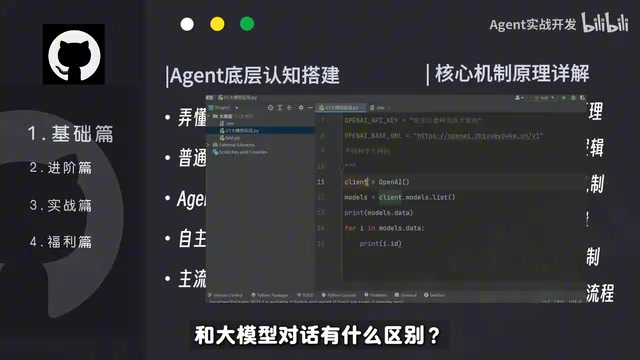
The other half of the Fundamentals section is hands-on: getting your first Agent demo running. This design approach is sound—establish a conceptual framework first, then validate your understanding with a minimal working example, avoiding the state of "I understand it but can't use it." The ReAct (Reasoning + Acting) framework, task planning, and memory mechanisms form the infrastructure of Agent capabilities. Understanding how they work together is far more important than memorizing each concept's definition individually.
The ReAct framework (Reasoning + Acting) is one of the most fundamental paradigms in the Agent field, proposed by Shunyu Yao et al. in 2022. Its core idea is to have the model alternate between "reasoning" and "acting": the model first outputs a thought explaining what should be done next; then executes an action, such as calling a search tool or calculator; then receives feedback from the environment (Observation), and enters the next round of thinking based on the new information. This cycle continues until the task is complete. Compared to having the model give an answer all at once, ReAct breaks complex tasks into traceable step chains, improving accuracy and making it easier to pinpoint where things go wrong.
Planning and memory mechanisms address two other problems. Planning refers to the Agent breaking down a large goal into an executable sequence of subtasks—common approaches include task decomposition, priority ranking, and dynamic re-planning (adjusting the subsequent path when a step fails). Memory mechanisms allow the Agent to maintain contextual coherence across multiple interactions: short-term memory is typically the conversation history, while long-term memory relies on external storage like vector databases to persist key information and retrieve it when needed. It's the combination of these three that forms the underlying capability for Agent autonomous decision-making.
Advanced: Framework Practice and Multi-Agent Collaboration
Moving into the second section, the tutorial ramps up. Topics covered include hands-on with LangChain and AutoGen frameworks, multi-Agent collaboration, Function Calling tool integration, hybrid architectures combining RAG (Retrieval-Augmented Generation) with Agents, as well as evaluation, debugging, and security boundaries.
Every section comes with companion code, reducing the risk of falling behind.
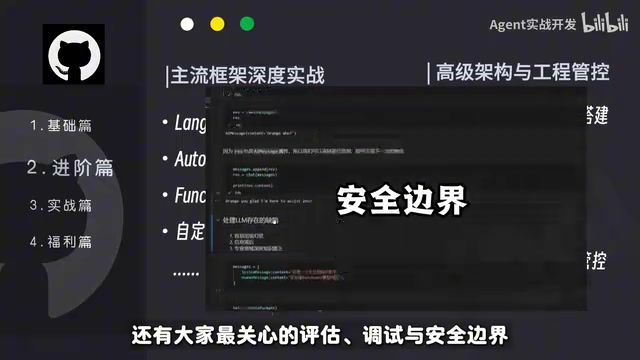
Looking at the tech stack coverage, LangChain leans toward single-Agent chain orchestration and tool integration, while AutoGen focuses more on conversational collaboration between multiple Agents. Including both in the course lets learners compare the design philosophies of different frameworks. Function Calling is the key interface for Agent interaction with the external world, and the RAG + Agent hybrid architecture is one of the most common patterns in enterprise deployment today—using retrieval to supplement the model's knowledge gaps, with the Agent deciding when to retrieve and how to process retrieval results.
Evaluation, debugging, and security boundaries are often the most easily overlooked areas when self-studying. Agent behavior is inherently uncertain, and how to quantitatively evaluate its performance and set up safety guardrails to prevent unauthorized operations directly determines whether an Agent can go from demo to production.
Function Calling is the standard interface for model interaction with the external world. Developers provide available tools (such as weather lookup, database queries, sending emails) to the model in structured descriptions, and the model outputs a standardized call request when needed, which an external program executes and returns the result back to the model. Its difference from ReAct is that Function Calling has the model directly generate structured call parameters rather than relying on text parsing, making it more stable and more suitable for engineering.
RAG (Retrieval-Augmented Generation) works by retrieving relevant documents from an external knowledge base before answering, then feeding the retrieved results as context to the model. This compensates for the model's training data limitations in timeliness and domain coverage while reducing hallucinations. When RAG is combined with an Agent, the Agent no longer passively "retrieves every time" but autonomously judges when retrieval is needed, what keywords to use, and how to handle multiple retrieved passages—achieving a balance between accuracy and efficiency.
Hands-On: Three Enterprise-Level Projects
The third section goes straight to enterprise-level projects, selecting three typical scenarios:
Intelligent Customer Service Agent System: From intent recognition to automatic ticket routing, covering the full chain of customer service scenarios. The value of this scenario lies in its relatively clear business logic, but it involves many steps—intent classification, knowledge retrieval, ticket creation and assignment—making it suitable as an introductory Agent engineering project.
Automated Data Analysis Agent: Upload an Excel file and automatically generate reports and charts. This scenario demands strong tool-calling capabilities from the Agent, requiring the chaining of data processing, visualization, and report generation across multiple steps.
Multi-Agent Collaboration Production Line: Having multiple intelligent agents divide work and collaborate like a team. This is the most complex of the three projects, testing task allocation, information transfer, and conflict resolution mechanisms between Agents.
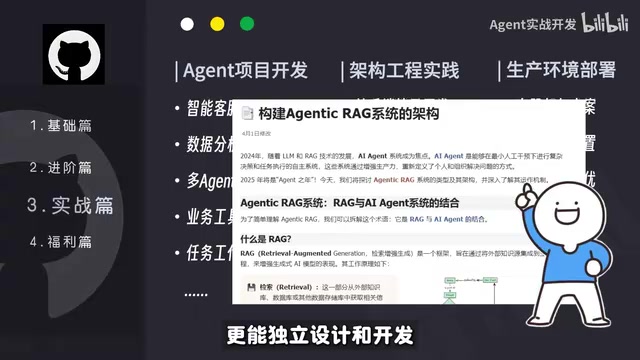
The three projects progress reasonably in difficulty from single-Agent to multi-Agent, from clear rules to collaborative decision-making. The creator also mentions including all source code, course materials, Prompt templates, and a personally curated AI Agent developer learning roadmap.
Who Is This Tutorial For
From the content design perspective, this tutorial is positioned as "from zero to independently building." Its differentiation isn't in how deeply it covers any single technology, but in its attempt to connect the complete path from conceptual understanding to project deployment.
If you already understand the basics of LLMs but lack systematic knowledge of Agents, or if you've watched a bunch of fragmented Agent tutorials but never built anything complete, this course structure progressing through three layers—"concepts, frameworks, projects"—can serve as a relatively complete learning path.
One thing to note: the 600-episode volume means information density may fluctuate. When actually studying, it's recommended to skip parts you've already mastered based on your background and focus on the hands-on coding sections. After all, in the Agent field, the gap between understanding and building is far larger than you'd imagine.
One-line Summary
A 600-episode AI Agent tutorial on Bilibili is divided into Fundamentals, Advanced, and Hands-On sections, attempting to bridge the gap between conceptual understanding and engineering practice.
Paragraph Summary
This article introduces a 600-episode AI Agent beginner tutorial on Bilibili. The creator believes that over 90% of Agent tutorials on the market either pile up concepts or just throw code, with learners calling APIs before gaining systematic understanding. The tutorial addresses this gap through three sections: Fundamentals explains the difference between Agents and LLM conversation, covering the ReAct framework, planning, reasoning, and memory mechanisms while getting the first demo running; Advanced covers LangChain and AutoGen frameworks, multi-Agent collaboration, Function Calling, RAG + Agent hybrid architecture, and evaluation, debugging, and security boundaries; Hands-On provides three enterprise-level projects: intelligent customer service, automated data analysis, and a multi-Agent collaboration production line. The tutorial includes source code, course materials, Prompt templates, and a learning roadmap, suitable for learners with LLM basics but lacking systematic Agent knowledge.
Related articles

How Big Can Stars Really Get? The Physical Limits of the Largest Stars
Red supergiants are the largest stars by volume, with radii up to 2,000 times the Sun, engulfing the inner solar system. But there is no precise upper limit on stellar size—models predict up to 15,000 solar radii. The most massive blue stars are far smaller than red supergiants—biggest and heaviest are two different things.

Apple HomeView Smart Display Full Feature Breakdown: Wall-Mount or Desktop, $299
Apple launches HomeView, a $299 smart display with wall-mount and desktop options, 12MP camera for facial recognition, smart home control, music playback, and recipe step-by-step cooking. Full breakdown of watch faces, apps, privacy, and cooking integration.

Where Did the Promised New Studio Go? Craft Computing Answers After Five Years
Craft Computing's host responds to viewer questions: the new studio promised five years ago was shelved as construction costs soared from $30,000 to $75,000, and was replaced by a 168-square-foot garage conversion.