Complete AI Comic Drama Production Tutorial: From Script to Final Video in One Night
Master AI comic drama production: from script to final video in one night with modular workflow
This comprehensive tutorial breaks down AI comic drama production into six modular stages: script creation with LLMs, image generation using Jimeng/Hailuo with style/lighting/color/composition mastery, video synthesis with Seedance 2.0 and camera movement design, voiceover consistency through audio-first workflow, editing and composition, and HD upscaling with Topaz Video AI. The key methodology is standardizing each stage into replicable steps.
Preface: The AI Comic Drama Wave Has Arrived
With AI tools like Doubao, JianYing, and Jimeng maturing, completing a comic drama in one night is no longer far-fetched. This article, based on a comprehensive hands-on tutorial shared by a Bilibili creator, systematically outlines the complete AI comic drama production workflow from zero to one—covering story scripting, image generation, video synthesis, voiceover editing, and more—helping beginners quickly master this emerging creative niche.
According to the creator's experience, once you master this workflow, "finishing a comic drama in one night and earning a month's rent in a week" is no exaggeration. The key lies in breaking down complex production processes into reusable modular steps, making every stage standardizable.
The entire AI comic drama production workflow consists of six major modules:
- Story Script Creation
- AI Image Generation
- AI Video Generation
- Voiceover and Music
- Video Editing
- HD Upscaling and Publishing
Let's break down the specific operational methods for each step.
Step One: AI Comic Drama Script Creation
Determining Theme and First Draft
Everything starts with a theme. The theme can either be determined through client communication or set independently. The tutorial uses the martial arts parody theme "Cat Battle Royale" as a demonstration example.
Once you have a theme, you can leverage large language models to write the script—DeepSeek, Doubao, and ERNIE Bot all work well. These large language models (LLMs) are essentially generative AI trained on massive text datasets, generating coherent text by predicting the most likely next word. In script creation scenarios, their core capability lies in understanding contextual semantics and outputting content in specific formats. The key is that the more specific your prompt, the closer the AI's output matches your vision—this is the essence of prompt engineering. More precise constraints (such as character settings, plot boundaries, style requirements) reduce the model's "hallucination" outputs, preventing content that deviates from expectations.
Iteratively Refining the Script with AI
Interestingly, the first draft is rarely the final version. The creator emphasizes a crucial detail: if you don't explicitly require "complete anthropomorphization, no cat elements whatsoever," AI will by default write content like "holding a fishing rod in its mouth, weapon is a fishing rod" instead of the expected martial arts plot of "fighting with swords."
Therefore, continuous dialogue is needed for guidance. For complex plots, enabling AI's "expert mode" is recommended—this typically refers to the model activating Chain-of-Thought reasoning mechanisms, displaying the reasoning process before providing answers—and paying attention to the AI's thinking process. Sometimes AI generates interesting ideas but then self-negates them; creators can capture inspiration from these moments for secondary guidance. This technique of extracting creativity from the model's intermediate reasoning states is an easily overlooked advanced play in AI-assisted creation.
Generating Storyboards and Asset Lists
Once the script is finalized, assign AI the identity of "experienced film director" and have it output video prompts and asset lists (i.e., image prompts used in the video).
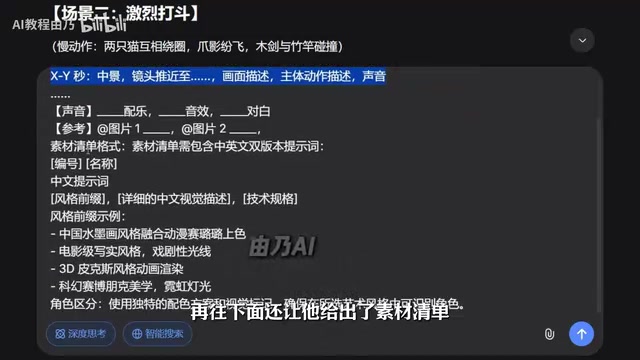
However, AI's output still requires manual review. For example, the correspondence between dialogue and visuals, transitions between shots (such as how to switch from "female lead's entrance" to "three cats sitting side by side on a roof ridge")—all of these require creators to manually add shots and modify dialogue. After receiving the script, you must carefully review it and make timely modifications where needed.
Step Two: AI Image Generation (Core of Comic Drama Visuals)
Image generation is the core element of AI comic drama aesthetics, broken down into four sub-modules: platform selection, prompt structure, character image generation, and storyboard image generation.
AI Image Generation Platform Selection
The creator currently uses Jimeng and Hailuo platforms most frequently. Jimeng is ByteDance's AI image generation platform based on proprietary models, excelling in Chinese aesthetic styles; Hailuo is a MiniMax product following a "model aggregation" approach, simultaneously integrating MJ (Midjourney) aesthetic style engines and Blender-style 3D rendering capabilities. If you have sufficient credits, Hailuo is more recommended—it integrates Jimeng, MJ, and Blender models simultaneously, and especially when modifying images or generating three-view diagrams, Hailuo's "all-purpose model" performs best, though credit consumption is slightly expensive.
SD (Stable Diffusion), while locally free, has a higher learning curve and suits advanced users. As an open-source solution, SD allows users complete control over model weights, LoRA fine-tuning, and sampling parameters—extremely flexible but requiring GPU compute resources. The essential difference between the three: cloud platforms sacrifice flexibility for usability, while local solutions do the opposite. For comic drama production scenarios requiring batch image generation with consistent styles, cloud platforms' consistency advantages are more pronounced.
Prompt Structure Design
The core prompt structure includes short phrases for subject, action, environment—AI can usually help generate this part. However, AI doesn't always write the style, color, lighting, and composition dimensions well, which creators need to master. These four dimensions actually correspond to the core visual language system in photography and film production design:
- Style: Determines the overall aesthetic tone of the image. Realistic cinematic style makes AI generate textures close to actual photography; xianxia (Chinese fantasy) ancient style emphasizes flowing Eastern aesthetics; domestic anime style incorporates traditional Chinese painting elements; 3D figurine, 3D cartoon focus on three-dimensional modeling; CG rendering simulates game engine surface materials and lighting, suitable for sci-fi or fantasy themes.
- Lighting: Directly impacts the dramatic tension of the image. Backlighting creates a halo outline around the subject, commonly used to express mystery or loneliness; silhouette completely hides details, emphasizing the narrative quality of character posture; rim light outlines character edges, adding three-dimensional depth. Noon sunlight brings high-contrast bright atmosphere, while evening light creates the warm nostalgia of golden hour effects.
- Color: Warm tones (predominantly orange and yellow) typically convey warmth, tension, or nostalgia; cool tones (predominantly blue and purple) suggest coldness, technology, or sadness; bright images give a light and cheerful feeling, while dark tones create a heavy, oppressive atmosphere. Different color combinations are the direct source of comic drama "atmosphere."
- Composition: Can be left to AI for automatic matching based on descriptions, but understanding basic composition knowledge (such as rule of thirds, symmetrical composition, leading line composition) helps provide more precise guidance in prompts.
Character Image Generation and Three-View Diagrams
First generate the overall character image, then create three-view diagrams. Three-view drawing is a classic method in industrial design and animation production, typically including front, side, and back views of the character. In AI comic drama production, the core value of three-view diagrams lies in solving "character consistency"—the biggest pain point of generative AI. Since diffusion models generate each image through independent random sampling processes, the same character may show deviations in facial features, clothing details, and body proportions across different images. When three-view diagrams are input as reference images, AI can anchor the character's visual features when generating new scenes. This method essentially borrows from the traditional animation industry's "character design sheet" workflow.
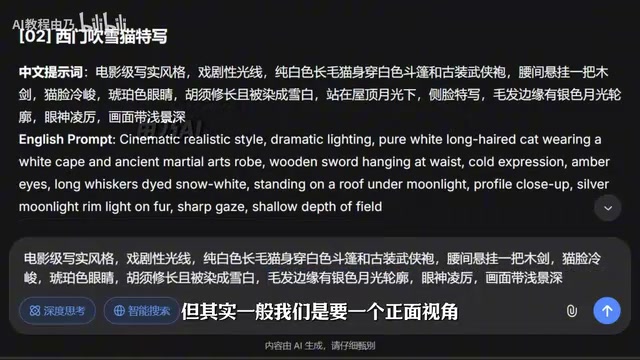
Taking the character prompt as an example, you need to adjust "side profile close-up" to "front view" and add "full shot" (character fully visible) and "solid color background" to first establish the character's appearance.
During generation, if results are unsatisfactory, you can refresh repeatedly or use the "eraser tool" to handle local imperfections (like extra claws). Once the image is finalized, using Hailuo to generate three-view diagrams is more stable—simply copy the universal prompt, upload the character image, select 16:9 ratio to get three-view and close-up images.
Storyboard Image Generation Techniques
The easiest pitfall in storyboard generation is unifying scene style with character style. For example, AI's default rooftop scene is "ink painting style," but the character is realistic cinematic style—in this case, you must delete the ink painting style description while keeping other content. This is exactly why "mastering style keywords" was emphasized earlier.
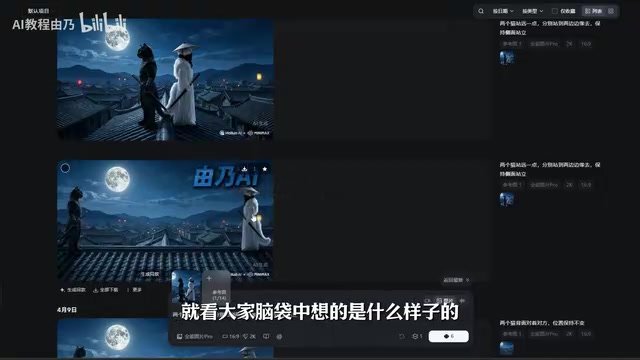
The creator also shared a practical challenge: when making two cats "stand back-to-back," AI tends to put both cats together. You need to use one image as a reference and then instruct "stand further apart, stand at the edges on both sides respectively." You must also align with the script's shot logic—if the script specifies "pushing in from behind the white cat," positioning must be designed in advance, otherwise subsequent video camera movements cannot be executed.
Step Three: AI Video Generation and Camera Movement Design
Video Generation Platforms and Camera Movement Techniques
Video generation platforms are equally diverse. The tutorial mentions Jimeng has increased prices, while Seedance 2.0 currently delivers the best results among video platforms. Seedance 2.0 is ByteDance's video generation model, representing the cutting edge of current Image-to-Video (I2V) technology. Compared to earlier video generation models (like Runway Gen-2, Pika), Seedance 2.0 shows significant improvements in motion continuity, physical realism, and frame stability. Its underlying technology is based on video diffusion models, generating continuous frame sequences by extending the image diffusion process across the temporal dimension. Local solutions like ComfyUI support open-source video generation models (such as Open-Sora, CogVideo) but struggle to match commercial platforms in model scale and training data volume, resulting in quality gaps.
The focus of video generation is camera movement, which essentially controls the virtual camera's motion trajectory when the model generates frame sequences through text prompts:
- Push-in: Camera moves toward the character's face, focusing on details or inner world, commonly used to emphasize character emotions or key props
- Pull-out: Camera pulls away, revealing the relationship between subject and environment, suitable for establishing scene context or character exits
- Pan: Guides the frame to look at an object, simulating the natural movement of human vision, commonly used for scene transitions or suspense building
Key Technique for Ensuring Voice Consistency
A crucial technique is generating audio in advance. Current mainstream TTS (Text-to-Speech) synthesis systems are neural network-based, capable of cloning specific voices with small voice samples and generating speech for any text. However, with each call, the model's random sampling may cause subtle voice drift—details like speech rate, intonation, and resonance characteristics become inconsistent.
When there are many lines, first design a voice that fits the character on an audio platform, generate speech sentence by sentence and download it, then upload the corresponding audio when generating video. This ensures complete voice consistency across each video segment—if you let Jimeng auto-generate voices, controlling consistency in the next segment becomes difficult. This "Audio-First Workflow" strategy in AI toolchains echoes traditional film post-production philosophy.
Character Reference and Modification Optimization
When generating videos, you need to @ character images and provide three-view diagrams as "character reference," especially when head-turning actions are involved—AI needs three-view references to correctly generate the character's appearance from different angles.
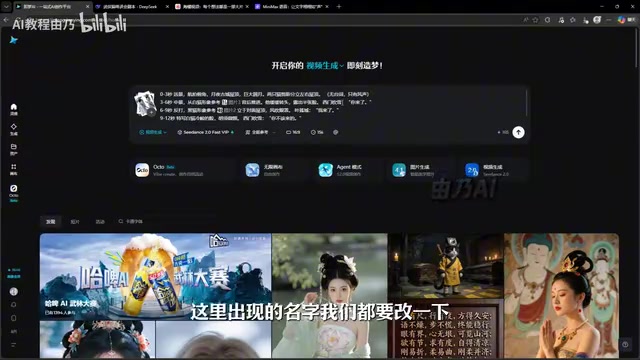
When encountering unsatisfactory footage (like too static camera movement or incorrect positioning), you can directly send the video clip to AI requesting replacement or modification. The creator suggests generating multiple video versions to select the best one, since modifying images consumes significant credits. Audio is best generated in advance and then matched.
Steps Four Through Six: Voiceover, Editing, and HD Upscaling
Voiceover and Music Processing
Jimeng's generated voiceovers are already quite good quality, and in many cases can be used directly, saving substantial work. Creators mainly need to add appropriate background music and adjust voice segments. Background music selection must match the emotional rhythm of the visuals—martial arts fight scenes suit rhythmic drum beats or ancient-style music, while dialogue scenes need ambient music that doesn't overpower.
Video Editing and Composition
Import all generated video clips into editing software for final composition, replace voiceovers, match music, use the "text recognition" feature to automatically add subtitles, then export. The core of editing isn't fancy transitions but rhythm control between shots—how long each segment stays on screen, timing differences between dialogue and visual cuts, rise and fall points of background music. These details directly determine viewer experience.
HD Upscaling Output
The final step is HD upscaling using Topaz Video AI. Topaz Video AI is currently one of the most renowned AI super-resolution tools in video post-production. Its core technology is based on deep learning image/video upsampling algorithms—unlike traditional bicubic interpolation's simple pixel enlargement, AI super-resolution models learn from massive high-low resolution video pairs, intelligently supplementing texture details, sharpening edges, and reducing noise during upscaling.
Import the final cut, select 4K output resolution, adjust corresponding parameters and export to get the final video with enhanced image quality. For AI comic drama materials, since original images and videos are typically AI-generated at limited resolutions (like 1080p or lower), after Topaz processing, character facial textures and scene details show noticeable improvement—this is especially important for publishing content on large-screen platforms (like Bilibili's 4K section).
Summary: Modularization is the Core Methodology of AI Comic Drama Creation
Looking at the entire workflow, the efficiency revolution in AI comic drama production doesn't come from any single "magic tool," but from the methodology of breaking down complex creation into standardized modules:
- Script stage: Learn to communicate precisely with AI, clarify constraints, leverage creative sparks in chain-of-thought reasoning
- Image stage: Master the four elements of style, lighting, color, and composition; use three-view diagrams to ensure character consistency; understand the random nature of diffusion models
- Video stage: Generate audio in advance to ensure voice consistency, use character references to control visuals, familiarize yourself with basic camera movement language
- Post-production stage: Leverage AI-native voiceovers, focus on background music and HD upscaling, use super-resolution technology to enhance final image quality
For newcomers wanting to enter this space, the value of this workflow lies in being "replicable"—each stage has clear tool choices and operational paths. As platforms like Seedance, Jimeng, and Hailuo continue to iterate, the barrier to entry for AI comic drama will further decrease, making it worth early positioning for content creators.
Key Takeaways
- AI comic drama production has evolved into a modularized workflow covering scripting, image generation, video synthesis, voiceover, editing, and upscaling
- Prompt engineering is crucial: the more specific your constraints (character, plot, style), the better AI outputs match your vision
- Character consistency is the biggest challenge in generative AI—three-view diagrams as references effectively solve this problem
- Master the four visual dimensions: style, lighting, color, and composition—these determine the final aesthetic quality
- Audio-first workflow ensures voice consistency across segments, avoiding the drift caused by repeated generation
- Cloud platforms (Jimeng, Hailuo, Seedance) offer better consistency and ease of use than local solutions for batch production scenarios
- Camera movement language (push, pull, pan) directly impacts narrative rhythm and viewer engagement
- AI super-resolution tools like Topaz Video AI significantly enhance final output quality, essential for platform publishing standards
Related articles
AI Agent Cost Optimization in Practice: Engineering Wisdom That Saved $1 Million in One Hour
Databricks eliminated $1M/year in wasted AI Agent spend in just one hour. Learn the root causes of Agent cost overruns and key strategies like model tiering, context pruning, and caching.
How the FDA Is Building an AI-Ready Data Foundation on Databricks
Explore how the FDA leverages Databricks for Government to build a unified Lakehouse architecture and AI-ready data foundation while meeting federal security and compliance standards.
The Power of Security Collaboration: Why Vulnerability Discovery Cannot Do Without Human Intelligence
Explore how security collaboration outperforms tool dependency, the value of vulnerability stories, cross-team knowledge sharing practices, and building stronger defenses by investing in people and collaboration.