Complete RAG System Development Guide: Data Preprocessing, Vector Retrieval, and Output Optimization in Practice

A complete guide to building production-ready RAG systems from data preprocessing to retrieval optimization.
This article provides a comprehensive walkthrough of building RAG (Retrieval-Augmented Generation) systems, covering the full pipeline from data preprocessing and text embedding to vector database selection, hybrid search, re-ranking, and output optimization. It also explores emerging trends like multimodal RAG, Graph RAG, and Agentic RAG, offering practical advice for developers building enterprise-grade AI applications.
What Is RAG? Why Does It Matter So Much?
RAG (Retrieval-Augmented Generation) is one of the most essential architectural patterns in modern LLM applications. In simple terms, it combines an external knowledge base with a large language model, enabling the model to retrieve relevant private documents when answering questions — resulting in more accurate, targeted responses.
For enterprises, RAG addresses two critical pain points of large language models: the timeliness of training data, and the inability of general-purpose models to cover proprietary enterprise knowledge. By building a RAG system, organizations can give AI the ability to answer domain-specific questions without fine-tuning the model.
RAG vs. Fine-Tuning: A Technical Comparison
RAG has become the go-to approach for enterprise AI deployment, largely because of how it compares to the alternative — model fine-tuning. Fine-tuning involves retraining a pre-trained model's parameters on domain-specific data to build specialized capabilities. However, fine-tuning comes with significant drawbacks: high costs (requiring GPU compute and labeled data), slow updates (every knowledge update requires retraining), and the risk of catastrophic forgetting. RAG, by contrast, injects external knowledge into the generation process in a plug-and-play fashion — no model parameter changes needed, and updating knowledge is as simple as swapping out documents. In practice, the two approaches aren't mutually exclusive. Many advanced applications combine RAG with fine-tuning: fine-tuning improves the model's domain comprehension, while RAG provides real-time, accurate knowledge support.
From an architectural perspective, RAG follows the classic Input → Processing → Output three-stage pipeline. Understanding the mechanics and optimization strategies for each stage is the key to mastering RAG development.
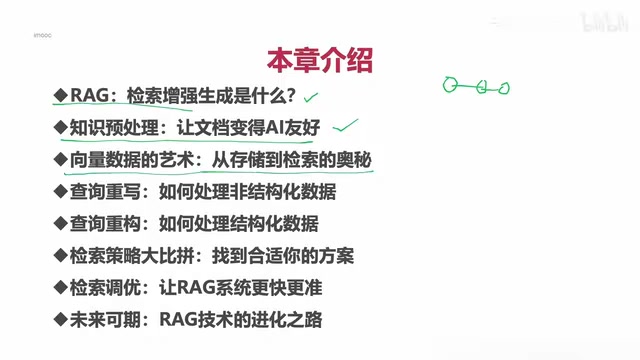
Data Preprocessing: The Foundation of RAG System Quality
Why Data Preprocessing Makes or Breaks Your System
The first step in a RAG system is knowledge preprocessing — transforming enterprise documents of various formats (PDF, Word, web pages, databases, etc.) into a format the model can understand and retrieve. While this may seem straightforward, it is in fact the cornerstone of overall system quality.
One key principle to remember: The quality of your input determines the quality of your output. In real-world enterprise RAG applications, many projects underperform not because of issues at the model or algorithm level, but because things went wrong at the data input stage.
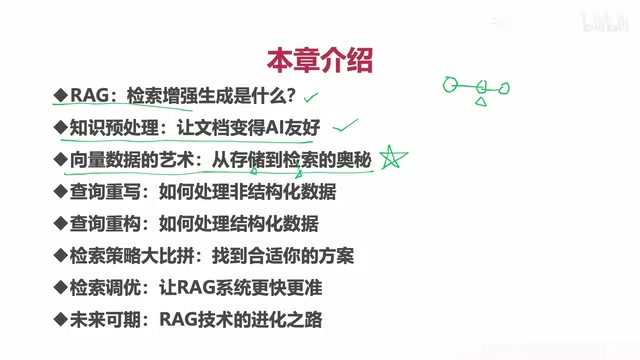
Real-World Challenges with Enterprise Data
Here's a thought-provoking reality: many enterprises attempting to deploy RAG systems discover that their business data hasn't even completed digital transformation. Without structured historical data, without standardized document management systems — sometimes without even basic digitization — they rush to launch AI projects.
In such cases, RAG system performance will inevitably suffer. Data governance is a prerequisite for AI deployment, and this is especially evident in RAG scenarios.
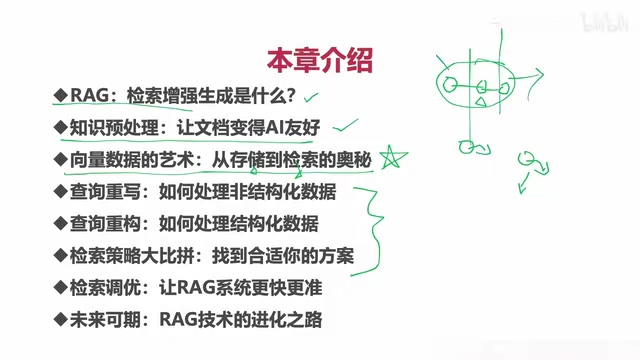
Data Preprocessing Components in LangChain
Within the LangChain framework, data preprocessing involves several tool components:
- Document Loaders: Support loading documents in multiple formats, including PDF, Word, HTML, CSV, and other common file types
- Text Splitters: Split long documents into appropriately sized chunks
- Metadata Processing: Attach metadata to document chunks for downstream retrieval filtering
A well-designed text splitting strategy (such as choosing the right chunk size and overlap settings) directly impacts retrieval precision — this is an area that requires iterative tuning in practice.
LangChain is an open-source framework created by Harrison Chase in late 2022, designed to simplify the development of LLM-powered applications. It provides a standardized abstraction layer that encapsulates common patterns — LLM calls, prompt management, chain composition, memory management, tool usage, and retrieval — into composable modules. In RAG scenarios, LangChain's LCEL (LangChain Expression Language) allows developers to orchestrate retrieval-generation pipelines declaratively. Its ecosystem also includes LangSmith (an observability platform for debugging and monitoring LLM applications), LangGraph (for building stateful multi-step Agent workflows), and LangServe (for deploying chains as REST APIs). Despite some criticism for excessive abstraction layers, LangChain remains the mainstream entry point for RAG prototyping and learning.
Vector Databases and Vector Retrieval: The Core Engine of RAG
From Text Embedding to Vector Storage
The core processing pipeline of a RAG system revolves around vector data and involves three key steps:
- Embedding: Use an embedding model to convert text chunks into high-dimensional vector representations. Popular embedding models include OpenAI's text-embedding series and the open-source BGE series. Choosing the right embedding model has a direct impact on retrieval quality.
Text embedding is the process of mapping natural language text into a high-dimensional vector space. The core idea stems from the distributional semantics hypothesis — words with similar meanings are close together in vector space. Modern embedding models are based on the Transformer architecture and use training methods like contrastive learning to teach the model to map semantically similar texts to nearby vector positions. For example, OpenAI's text-embedding-3-small outputs 1536-dimensional vectors, while BGE-large-zh outputs 1024-dimensional vectors. Higher dimensions generally mean greater expressiveness but also larger storage and computational overhead. Similarity between vectors is typically measured using cosine similarity or inner product. When selecting an embedding model, consider language support, dimensionality, inference speed, and performance on benchmarks like MTEB.
- Vector Storage: Store the generated vectors in a dedicated vector database. Popular vector databases include Chroma, FAISS, Milvus, and Pinecone, each with its own use cases and performance characteristics.
Vector databases are database systems specifically designed for storing high-dimensional vectors and performing approximate nearest neighbor (ANN) searches. Traditional database indexes like B-Tree or Hash cannot efficiently handle high-dimensional vector retrieval. Vector databases employ specialized indexing algorithms such as HNSW (Hierarchical Navigable Small World), IVF (Inverted File Index), and PQ (Product Quantization) to achieve millisecond-level similarity searches. Among mainstream options, FAISS is Meta's open-source vector search library, suitable for local development and small-to-medium scale scenarios; Chroma is lightweight and easy to use, ideal for rapid prototyping; Milvus is a cloud-native distributed vector database supporting billion-scale vectors, suitable for production environments; and Pinecone is a fully managed SaaS service that eliminates operational overhead. When making a selection, consider data scale, query latency requirements, persistence needs, deployment mode (local/cloud), and compatibility with your existing tech stack.
- Vector Retrieval: When a user asks a question, the query is also vectorized, and a similarity search is performed in the vector database to find the most relevant document chunks.
All three steps have complete implementations in LangChain. The framework provides unified abstract interfaces, allowing developers to flexibly switch between different embedding models and vector databases.
The Fundamental Difference Between Vector Retrieval and Keyword Matching
Vector retrieval is essentially about finding the most semantically similar text in high-dimensional space. Unlike traditional keyword matching, vector retrieval can understand similarity at the semantic level. For example, if a user asks "What is the company's leave policy?" vector retrieval can correctly match documents that use the term "annual vacation policy" — even though the exact keywords differ.
This semantic understanding capability is the core advantage of RAG systems over traditional search engines.
Retrieval Optimization Strategies: The Key to Better RAG Output
Retrieval optimization is the stage most worth investing effort in within a RAG system, as it directly determines the quality of the final output. Put simply, retrieval optimization is the key to RAG output quality.
Hybrid Search
Combine vector-based semantic retrieval with traditional BM25 keyword retrieval to leverage the strengths of both. Semantic retrieval excels at understanding user intent, while keyword retrieval excels at precisely matching proper nouns and technical terms. Combining the two significantly improves both recall and precision.
BM25 (Best Matching 25) is a classic information retrieval algorithm proposed by Stephen Robertson and colleagues in the 1990s, and it remains the core ranking algorithm in search engines like Elasticsearch. BM25 calculates the relevance score between a query and a document based on term frequency (TF), inverse document frequency (IDF), and document length normalization, making it highly effective for exact keyword matching. In hybrid search implementations, the system simultaneously performs BM25 keyword retrieval and vector semantic retrieval, then merges and re-ranks the two result sets using fusion strategies such as Reciprocal Rank Fusion (RRF) or weighted summation. This approach is particularly well-suited for enterprise scenarios — when user queries contain product model numbers, regulation codes, or proprietary terminology, BM25 delivers precise hits; when queries are vague or use synonyms, semantic retrieval compensates for keyword matching limitations.
Re-ranking
After the initial retrieval produces candidate documents, use a dedicated re-ranking model (such as Cohere Rerank or BGE-Reranker) to perform a second-pass ranking, improving the relevance of the document chunks ultimately fed to the LLM.
Query Rewriting
Rewrite or expand the user's original question to generate multiple retrieval queries, recalling relevant documents from different angles and improving recall. This is especially effective when user queries are vague or overly brief.
Context Compression
Compress the retrieved document chunks by removing irrelevant information and retaining only the parts most relevant to the question, reducing noise that could interfere with the LLM's generation.
Future Directions for RAG Technology
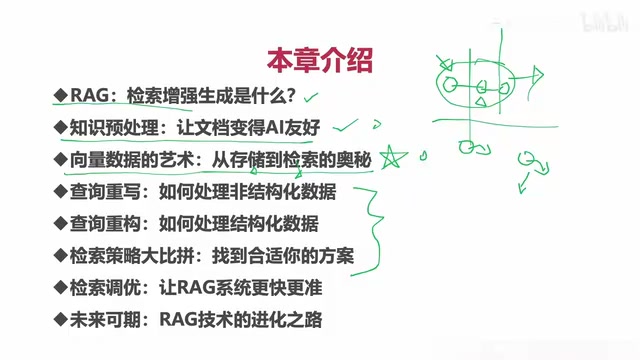
Based on current industry practices, RAG technology is rapidly evolving in several directions:
- Multimodal RAG: Processing not just text, but also retrieving and understanding images, tables, audio, video, and other multimodal data
- Graph RAG: Combining knowledge graphs with vector retrieval to introduce structured knowledge associations, enhancing reasoning capabilities for complex questions
Graph RAG is an enhanced RAG architecture proposed by Microsoft Research in 2024. Its core idea is to augment traditional vector retrieval with the structured association capabilities of knowledge graphs. Traditional RAG struggles with complex questions that require cross-document reasoning and multi-hop associations — for example, "Which companies' boards has Company A's CEO served on, and what are those companies' core businesses?" requires chaining multiple entities and relationships. Graph RAG first uses an LLM to extract entities and relationships from documents to build a knowledge graph, then applies community detection algorithms (such as the Leiden algorithm) to perform hierarchical clustering on the graph, generating community summaries at different granularities. During retrieval, the system can perform structured traversal on the graph and leverage community summaries to provide global-level answers — something pure vector retrieval cannot achieve.
- Agentic RAG: Combining RAG with Agent architectures, giving the system the ability to autonomously decide when to retrieve and what to retrieve
- Adaptive Chunking: Automatically selecting optimal chunking strategies based on document structure and semantics, replacing manual parameter tuning
Practical Advice for RAG Development
For developers looking to get started with RAG development, here's a recommended step-by-step learning path:
- First, understand the fundamental principles and complete pipeline of RAG
- Use LangChain to build a minimal document Q&A demo
- Gradually optimize each component: experiment with different chunking strategies, embedding models, and vector databases
- Focus your efforts on retrieval optimization — this is where you'll get the highest return on investment
- Perform end-to-end tuning based on your actual business scenarios
Remember one core principle: Garbage in, garbage out. Before chasing algorithmic optimizations, make sure your data quality is up to par. This isn't just a technical issue — it's a matter of data governance and business processes.
Key Takeaways
Related articles
Spotit: Turn Every Mac App into a Real-Time Interactive Tutorial
Spotit is an AI-powered interactive tutorial tool for Mac. Press a shortcut, ask in plain language, and it highlights exactly where to click next — guiding you through any Mac app as you learn by doing.
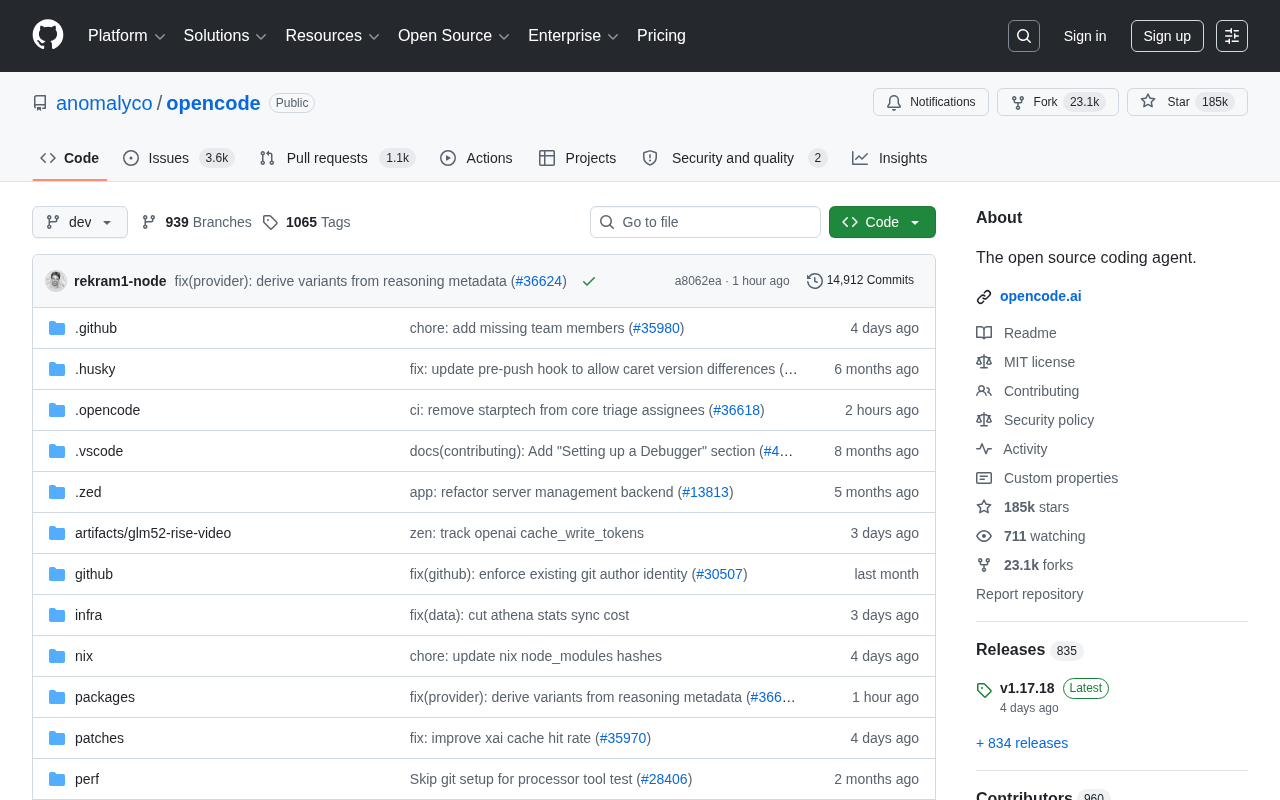
OpenCode: The Open-Source Coding Agent That Hit 150K GitHub Stars
OpenCode is an open-source TypeScript coding agent with 150K+ GitHub stars. Learn about its features, advantages, and use cases for AI-powered development.
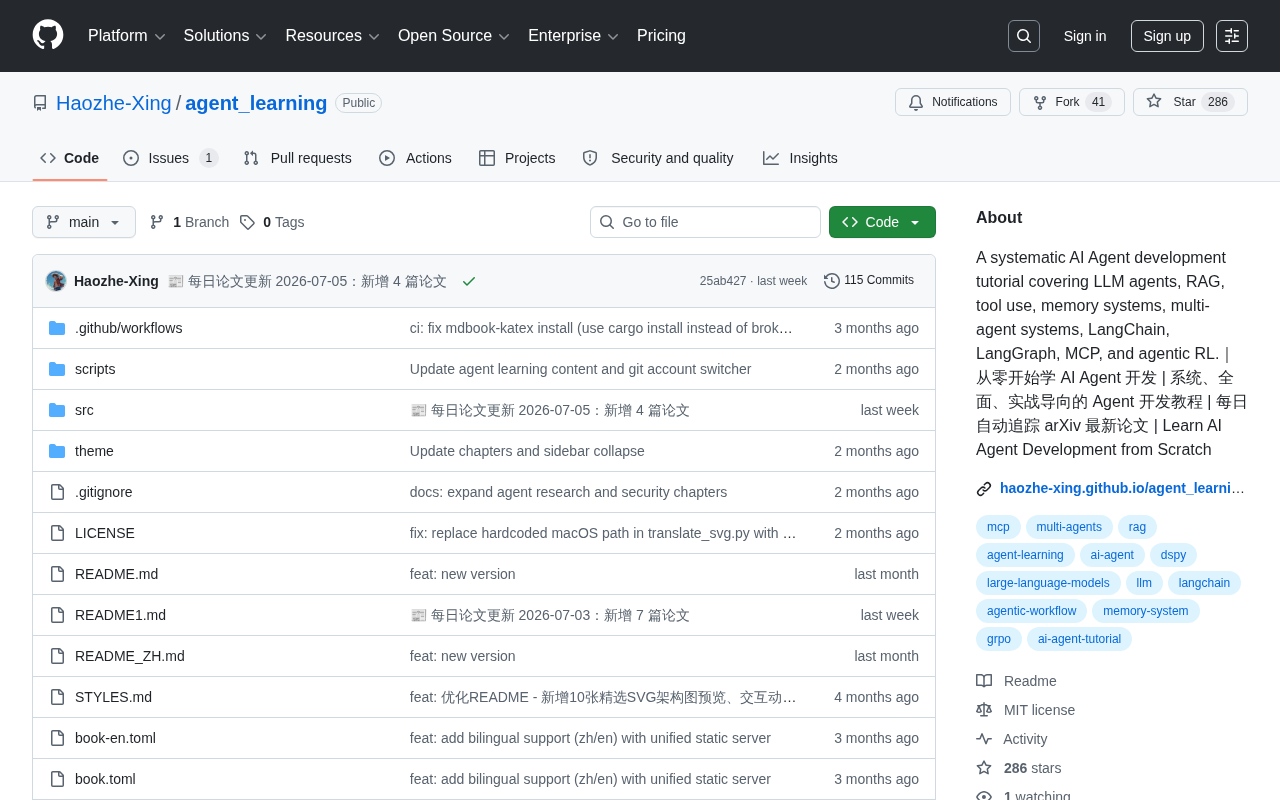
Learning AI Agent Development from Scratch: An Open-Source Tutorial Worth Bookmarking
Haozhe-Xing/agent_learning is a systematic, hands-on open-source tutorial for learning AI Agent development from scratch, with daily arXiv paper tracking built in.