Compressed Simulation-Based Inference: Low-Dimensional Sketches Make Neural Posterior Estimation More Efficient

Replacing summary statistics with low-dimensional random sketches enables efficient neural posterior estimation with matching performance.
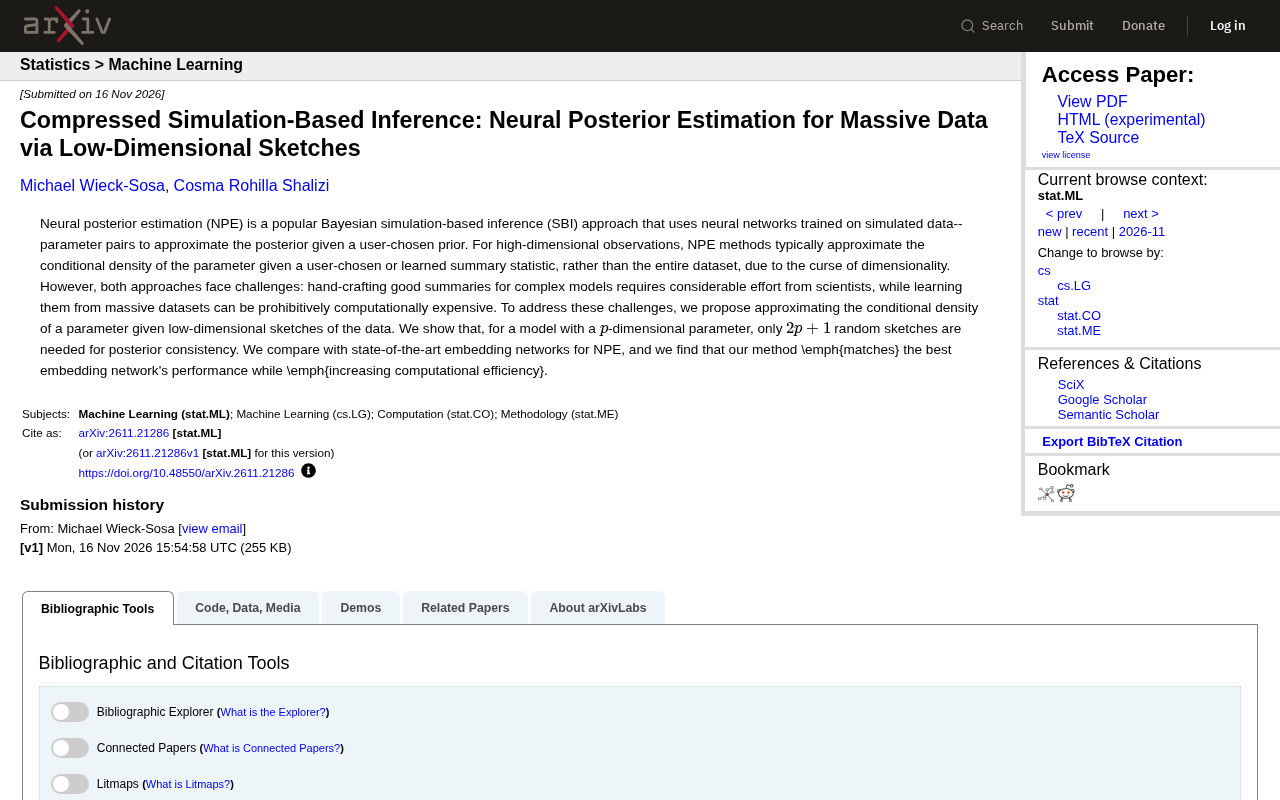
Neural Posterior Estimation (NPE) faces a dilemma with high-dimensional observed data: handcrafted summary statistics rely on expert experience and generalize poorly, while learned embedding networks are computationally expensive. This research proposes modeling the conditional density of parameters given low-dimensional random sketches of the data. It theoretically proves that for p-dimensional parameters, only 2p+1 sketches are needed to achieve posterior consistency, decoupling sketch dimension from data dimension. Experiments show the method matches the best embedding networks while improving computational efficiency. This provides a new path for large-scale simulation-based inference, especially suited for scientific problems with large data scales, moderate parameter dimensions, and difficulty in manually designing statistics.
Neural Posterior Estimation (NPE) is a mainstream method in Bayesian Simulation-Based Inference (SBI). It trains neural networks on simulated data-parameter pairs to approximate the posterior distribution under a given prior. When dealing with high-dimensional observed data, NPE typically does not directly model the conditional density of the entire dataset. Instead, it resorts to modeling hand-selected or learned summary statistics to avoid the curse of dimensionality. However, both approaches have significant pain points: designing high-quality summary statistics for complex models by hand requires substantial effort from scientists, while learning summary statistics from massive data can incur prohibitively high computational costs.
When NPE Meets Big Data: Both Paths Are Difficult
Handcrafted Summary Statistics: Dependent on Expert Experience
In traditional SBI workflows, researchers often need to manually construct low-dimensional summary statistics for specific models—such as power spectra in astronomical observations or event shape variables in particle physics. Such statistics embody domain knowledge, but the design process is time-consuming and labor-intensive, and difficult to generalize to new models.
Learned Embedding Networks: High Computational Cost
Another approach is to use embedding networks to automatically learn summary representations from raw data. Although this eliminates manual design, the embedding network itself needs to be trained on large-scale simulated data, and its parameter count and computational load grow rapidly with data dimensionality. For massive datasets with millions of samples, this training cost often becomes a bottleneck.
Embedding network refers to a class of neural networks that map high-dimensional inputs to low-dimensional representation spaces, typically trained jointly with the posterior estimation network in SBI. Its goal is to preserve as much parameter-inference-relevant information as possible in the low-dimensional representation, thereby replacing manually designed summary statistics. Common embedding architectures include fully connected networks, convolutional networks, and recurrent networks for sequential data. During joint training, the embedding network and the density estimation network share a loss function, and the embedding part is automatically adjusted through gradient backpropagation. This end-to-end approach improves automation, but the parameter count and training sample requirements of the embedding network grow with input dimensionality, and the training process may be unstable and sensitive to hyperparameters.
Core Idea: Replacing Summary Statistics with Low-Dimensional Random Sketches
To address the above dilemma, this research proposes a compromise: neither directly modeling the raw data nor relying on carefully designed summary statistics, but instead modeling the conditional density of parameters given low-dimensional sketches of the data.
A sketch refers to a representation obtained by compressing high-dimensional data into a low-dimensional space through random projections. The research provides a key theoretical guarantee: for a $p$-dimensional parameter model, only $2p+1$ random sketches are needed to achieve posterior consistency. This means that the sketch dimension depends only on the parameter dimension, not on the raw data dimension—no matter how large the data, the compressed representation remains within a controllable range.
This property is quite attractive: it shifts the "curse of dimensionality" from the data dimension to the parameter dimension, and in practical applications the parameter dimension is usually much smaller than the observation dimension.
Posterior consistency is a theoretical property in Bayesian nonparametrics and high-dimensional inference, referring to the convergence in probability of the posterior distribution to the true parameter value as the amount of data (or simulations) tends to infinity. In the SBI context, posterior consistency means that the inference method will not systematically deviate from the true value due to dimensionality reduction or approximation. For sketch-based NPE, proving posterior consistency requires showing that random projections preserve sufficient parameter information and that the sketch dimension grows with the parameter dimension rather than the data dimension. The $2p+1$ sketches mentioned in the original text represent a sufficient condition for achieving this property, with intuition similar to the distance-preserving property of random projections in the Johnson–Lindenstrauss lemma, but targeting information preservation for posterior inference.
Performance Comparison: Matching the Best Embedding Networks with Higher Efficiency
The authors compared the proposed method with state-of-the-art NPE embedding networks. Results show that the compressed simulation-based inference method matches the performance of the best embedding networks while improving computational efficiency.
The significance of this result lies in the fact that researchers can bypass the heavy training costs of embedding networks without sacrificing inference accuracy. For scientific scenarios requiring repeated simulation-based inference—such as cosmological parameter estimation and epidemiological model calibration—this efficiency advantage will be further amplified.
However, it should be noted that the original abstract does not disclose details such as specific experimental settings, dataset scales, or speedup ratios, which require further verification in the full text.
Implications for SBI Practitioners
The value of this work lies not only in the method itself but also in the new trade-off perspective it provides. In practical deployment of simulation-based inference, accuracy, cost, and engineering complexity often pull against each other: handcrafted statistics offer controllable accuracy but depend on experts; embedding networks offer high automation but are expensive to train; random sketches attempt to find a balance between the two.
For scientific problems with massive data scales, moderate parameter dimensions, and difficulty in manually designing summary statistics, the low-dimensional sketch approach is worth prioritizing. For models with inherently high parameter dimensions, however, the $2p+1$ sketch count guarantee may lose its advantage, and one may still need to return to embedding networks or other dimensionality reduction strategies.
As simulation-based inference continues to expand its applications in scientific discovery, how to control computational costs while maintaining statistical rigor will become an increasingly core engineering issue. Compressed simulation-based inference offers a direction worth watching.
Background
Bayesian Simulation-Based Inference (SBI) is a class of methods for performing Bayesian inference without explicitly writing out the likelihood function. When scientific models can only generate data through computer simulation and the likelihood function is difficult to compute analytically, SBI indirectly learns the posterior distribution through a large number of simulated "parameter-data" pairs. Common implementations include Approximate Bayesian Computation (ABC) and neural network-based density estimation methods. Neural Posterior Estimation (NPE) belongs to the latter, training a conditional density network to directly approximate the posterior $p(\theta \mid x)$. After training, posterior samples can be quickly drawn for new observations $x$ without re-running the simulator. The accuracy of NPE depends on the coverage of simulated data and network capacity. When observation data dimensions are very high, directly modeling the conditional density encounters the curse of dimensionality, so dimensionality reduction is often applied first in practice.
One-line Summary
Replacing summary statistics with low-dimensional random sketches enables efficient neural posterior estimation with matching performance.
Related articles

Prompt Engineering for Beginners: From Writing Prompts to Engineering Thinking
Starting from the essence and four functions of prompts, this article systematically explains the six-step process, four success criteria, learning value, and practical limitations of prompt engineering to help you build a complete understanding.

Anthropic Launches Nasdaq IPO: AI Giant's Listing and Risk Disclosures
Anthropic officially launches its Nasdaq IPO under ticker ANT, with market valuation expected to potentially exceed SpaceX's record. The prospectus devotes nearly 100 pages to AI risks, while first-half revenue grew over 14x but net losses widened sharply, reigniting the AI bubble debate.

Rust cURL Clone Uses 4,832 unsafe Blocks—Is the Memory Safety Myth Broken?
A Rust cURL clone uses 4,832 unsafe keywords, challenging Rust's memory safety narrative. We analyze what unsafe really means, compare Fil-C, and examine rewrite motives.