Concept-Guided Prompting: Boosting LLM Recipe Diversity by 47%

Concept-guided prompting generates thematic concepts before content, significantly boosting LLM recipe semantic diversity.
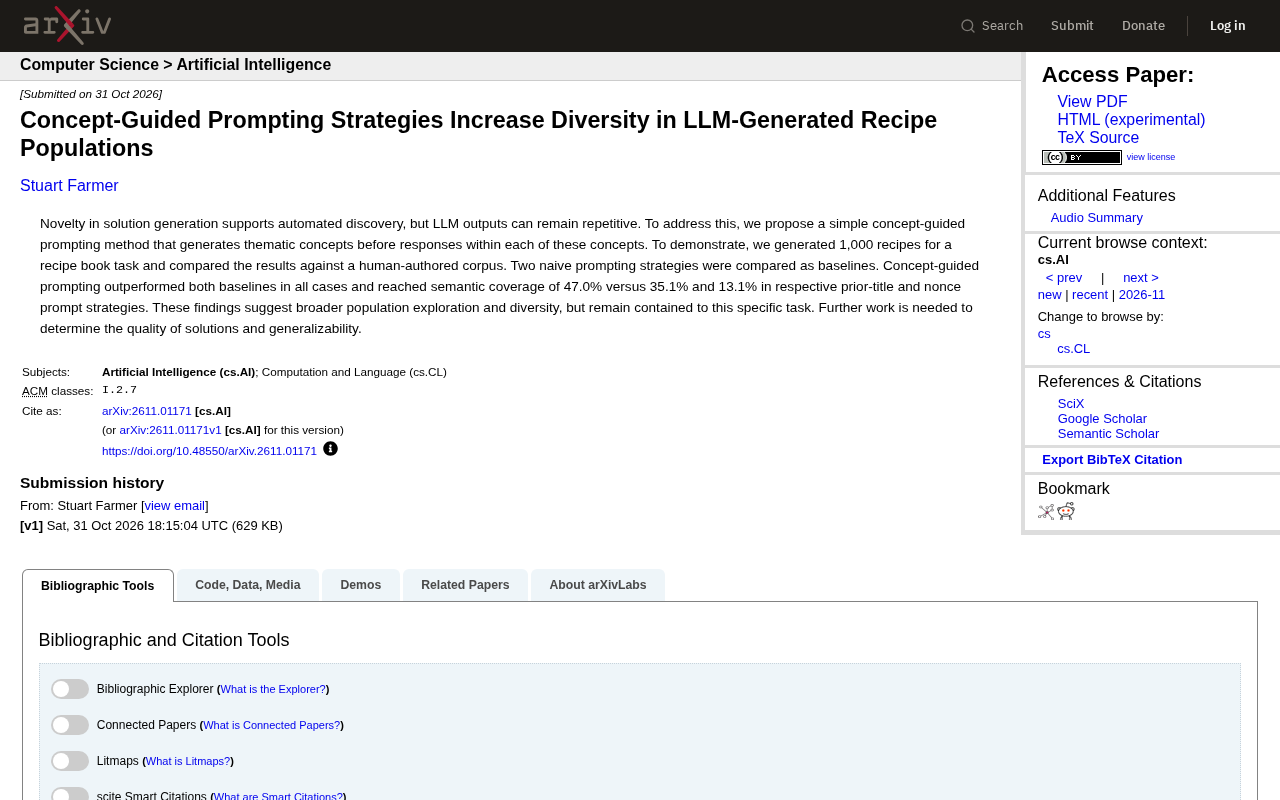
The article introduces a study tackling high repetitiveness in LLM-generated content with concept-guided prompting: first generate a set of thematic concepts, then generate content for each. In recipe generation with 1,000 samples compared to a human corpus, the method achieves 47.0% semantic coverage versus 35.1% for prior-title prompting and 13.1% for nonsense prompting. The authors frame it as hierarchical generation that avoids local optima, while noting the study is limited to recipes and hasn't assessed content quality or cross-domain generalization; concept generation quality is a key future direction. It offers a practical 'list concepts first, then expand' trick for AI content creation.
Why Are LLM-Generated Recipes Always the Same?
Large language models excel at automated discovery and content generation, but high output repetitiveness has always been a pain point. For example, when asked to generate recipes, the model may repeatedly produce similar ingredient combinations and cooking steps, lacking true creative diversity. A recent study proposes a simple but effective solution: Concept-Guided Prompting, which first generates thematic concepts and then generates content within those concepts, significantly improving the diversity of the generated population.
The study uses recipe generation as an example, generating 1,000 recipes and comparing them with a human-written corpus. Results show that concept-guided prompting achieves a semantic coverage rate of 47.0%, while two baseline strategies achieve only 35.1% (prompting based on prior titles) and 13.1% (nonsense prompting). This means the concept-guided method enables the model to explore a broader conceptual space, thereby producing more diverse results.
Core Method: Think of Concepts First, Then Write Content
The concept-guided prompting approach is straightforward: before asking the model to generate the final answer, first require it to generate a set of thematic concepts (such as "fusion cuisine," "vegetarian desserts," "street food" in recipes), and then generate content for each concept separately. The purpose is to force the model out of its most familiar generation paths and cover more of the potential solution space.
The researchers compared this method with two naive prompting strategies:
- Prior title prompting: Using existing titles as prompts to guide generation of similar content.
- Nonsense prompting: Using random or irrelevant prompt words without clear guidance.
In all comparisons, concept-guided prompting achieved better semantic coverage. A 47.0% coverage rate means the generated recipes semantically cover a broader range of thematic areas, while baseline methods concentrate in a narrower range.
Hierarchical generation draws on classical probabilistic modeling ideas: first sample a high-level variable at an abstract level (here, a "concept"), then generate specific content conditioned on that variable. In the LLM context, this is equivalent to splitting one-shot conditional generation into a two-stage conditional chain: first sample concept c, then sample content x~p(x|c). The benefit is spreading probability mass from the most frequent patterns across multiple concept branches, reducing the risk of mode collapse. Similar ideas appear in prompting strategies such as planning an outline before writing the main text, or generating character settings before writing dialogue—the essence is using explicit intermediate representations to constrain the decoding path.
Semantic Coverage: A New Perspective on Measuring Diversity
The study uses semantic coverage as a diversity metric, measuring the breadth of distribution of generated content in semantic space. Higher coverage indicates that the generated population explores richer semantic regions. Concept-guided prompting's 47.0% is significantly higher than prior title prompting's 35.1% and nonsense prompting's 13.1%.
This improvement is not accidental. Concept guidance is essentially a hierarchical generation strategy: first determine the thematic direction at a high level, then fill in details at a low level. This prevents the model from falling into local optima—always generating the most statistically common patterns. For tasks requiring creative diversity (such as recipes, stories, design inspiration), this method has direct application value.
Semantic coverage is typically measured by mapping each generated item into a high-dimensional vector space using sentence embeddings, then using density estimation or cluster coverage to measure how much "effective semantic region" these vectors occupy. Common practice uses kernel density estimation (KDE) or distance-based coverage functions to count the proportion or breadth of generated samples falling within the support set of the human reference corpus's semantic distribution. It differs from simple deduplication rates or lexical diversity (such as distinct-n), which only look at surface-form differences, whereas semantic coverage can capture "pseudo-diversity" where phrasing changes but meaning remains similar. Therefore, higher coverage indicates that the model has genuinely expanded the output space at the conceptual level rather than merely at the wording level.
Limitations and Future Directions
The researchers also candidly point out limitations: current results are limited to the recipe generation task, and generalization to other domains has not been verified. Additionally, the study focuses on diversity, but the quality of generated content (such as recipe feasibility and tastiness) has not been evaluated. Whether diversity improvements come at the cost of quality still requires further experiments.
Another direction worth exploring is the quality of concept generation. If the concepts themselves lack novelty or are repetitive, diversity gains may be limited. How to automatically generate high-quality, diverse concepts is a key direction for future research.
Mode collapse was originally a term in generative adversarial networks, referring to the generator producing only a few kinds of samples and losing other modes of the data distribution. In LLM prompt generation, it manifests as the model tending to repeatedly return to the "safe" answers with the highest probability in the training distribution. Concept-guided prompting is equivalent to artificially injecting random high-level seeds, forcing the model into different conditional branches, thereby mitigating this collapse. Understanding this mechanism helps determine the applicable boundaries of the method: when the task's conceptual space is narrow, or when the concept generator itself also collapses, the gains will noticeably diminish.
Implications for AI Content Creation
For those using LLMs for content creation, this research provides a practical trick: don't directly ask the model to write the final answer; first have it list multiple different angles or themes, then expand on each separately. This not only improves diversity but may also inspire unexpected creative combinations. In scenarios such as marketing copy, product naming, and story creation, concept-guided prompting can serve as a low-cost, high-benefit optimization technique.
Although the research is still in its preliminary stage, it points to a clear direction: guiding models through prompt engineering to explore a broader solution space is an effective way to improve generation diversity. In the future, combined with quality assessment and cross-task validation, concept-guided prompting is expected to become one of the standard practices for LLM creative generation.
One-line Summary
Concept-guided prompting first generates thematic concepts and then generates content, significantly improving the semantic diversity of LLM recipe generation.
Paragraph Summary
The article introduces a study addressing the high repetitiveness of LLM-generated content, proposing concept-guided prompting: before generating final content, first have the model produce a set of thematic concepts, then generate separately for each concept. Using recipe generation as an example, 1,000 samples were generated and compared with a human corpus; the method achieved a semantic coverage rate of 47.0%, higher than prior title prompting's 35.1% and nonsense prompting's 13.1%. The authors explain it as a hierarchical generation strategy that avoids local optima, while noting the study is limited to the recipe task and has not evaluated content quality or cross-domain generalization; concept generation quality is also a key future direction. It offers a practical trick for AI content creation: "list concepts first, then expand."
Related articles

AI Coding Enters the Team Collaboration Era: Interpreting Three Major Moves from Meta, GitHub, and Mistral
Meta acquires Conductor, GitHub Copilot Fusion becomes available, Mistral opens Large 4 weights—three moves show AI coding shifting from code generation to organizing development workflows. This article explains task orchestration, model collaboration, and cost control for developers.

Building a RAG Assistant with Dify: A Practical Guide to Knowledge Bases, Workflows, and Agent Nodes
How should knowledge bases, workflows, and Agent nodes connect in a Dify RAG assistant? We break down the division of labor and wiring logic for a shippable app.
 Tech Frontiers
The AI Industry Doesn't Lack Marketing—It Lacks Good Products
AI faces market selloffs and public skepticism—is marketing really the problem? This analysis of market signals and product experience argues the core困境 is incomplete products and a gap between promises and experience; the only way to change perceptions is to ship better products.