Conformal Prediction under Partial Verification: Up to 82% Reduction in Calibration Cost

Partial calibration verification reproduces full conformal prediction results at up to 82% lower cost.
Conformal prediction provides coverage guarantees without strong distributional assumptions, but its calibration phase requires costly label verification at scale. This paper introduces "partial verification" via "calibration certificates" — identifying the minimal verified information that determines the conformal threshold — and coordinates verification order to check critical candidates first. The result is prediction sets identical to full verification, with costs provably bounded at twice the theoretical optimum and empirical savings of 15–82% across retrieval, math verification, and configuration evaluation tasks.
The Real Bottleneck in Conformal Prediction: Calibration Cost
Conformal Prediction has attracted significant attention in recent years as a method for uncertainty quantification. Its greatest appeal lies in providing finite-sample guarantees — that is, constructing prediction sets whose coverage of true labels meets a preset confidence level, without requiring strong distributional assumptions. This makes it an ideal tool for deploying machine learning models in high-stakes settings.
In practice, however, conformal prediction has a commonly overlooked pain point: the calibration phase requires a large number of verified labels. Label verification is often expensive, whether it involves manual annotation, running costly solvers, or executing complex configuration evaluations — all of which demand considerable time and resources. When the calibration set is large, the cost of fully verifying every sample can make the entire pipeline impractical.
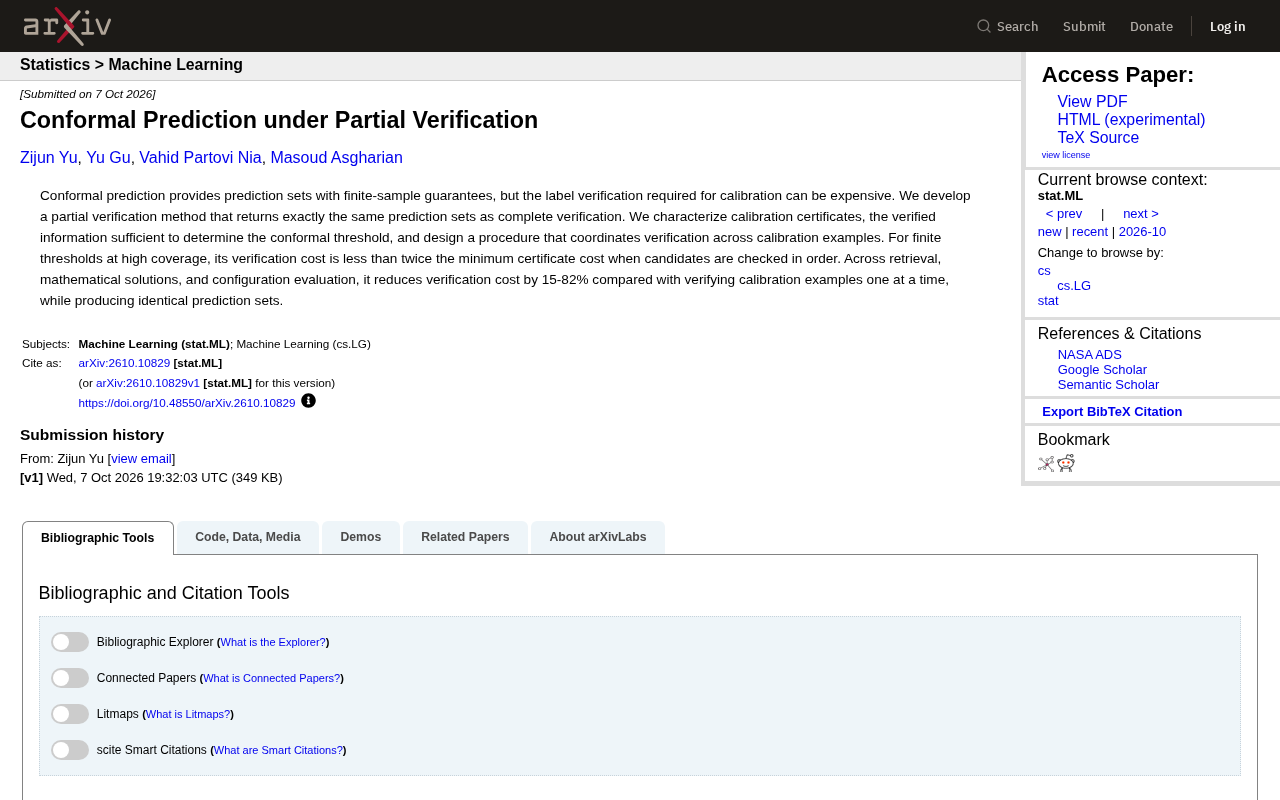
This arXiv paper addresses precisely this problem: can we verify only a subset of calibration samples and still obtain results identical to full verification?
The basic framework of conformal prediction relies on the assumption of "exchangeability" — that calibration and test samples come from the same distribution and are order-independent. In the standard split conformal prediction pipeline, the model is first trained on a training set, then nonconformity scores (e.g., the error between the true label and the predicted value) are computed for each sample in a separate calibration set. The final threshold is set at a specific quantile of these scores, guaranteeing that test-time coverage is at least $1-\alpha$ (e.g., 90%). This guarantee is finite-sample and distribution-free, requiring no normality or parametric assumptions. Since the pipeline depends entirely on the true labels of every calibration sample to compute nonconformity scores, complete verification of the calibration set becomes a necessary prerequisite — and this is the root of the high-cost bottleneck.
Core Idea: Partial Verification Yields the Same Prediction Sets
The paper's central contribution is a partial verification framework that returns exactly the same prediction sets as full verification. This is crucial — it is not an approximation that trades accuracy for efficiency, but a method that reduces verification overhead while guaranteeing identical results.
The key to understanding its mechanism lies in the concept of "calibration certificates" introduced in the paper. The authors define these as the minimum verified information sufficient to determine the conformal threshold. In other words, not every calibration label is decisive for the final threshold; once the "critical information" that truly influences the threshold has been verified, the same threshold as full verification can be uniquely determined.
Building on this insight, the paper designs a procedure that coordinates the verification order across calibration samples. Rather than verifying samples in isolation one by one, it orchestrates the sequence, prioritizing candidates most likely to contribute critical information, thereby avoiding redundant verification.
Theoretical Guarantee: A Cost Upper Bound
The paper provides rigorous theoretical analysis. In the finite-threshold, high-coverage regime, when candidates are inspected sequentially, the method's verification cost is at most twice the minimum certificate cost. This provides a provable upper bound on the method's efficiency, meaning that even in the worst case, the overhead is strictly bounded to within twice the theoretical optimum.
The concept of "calibration certificates" can be intuitively understood from the perspective of quantile computation. The conformal threshold is essentially a specific quantile of the calibration set's nonconformity scores (e.g., the $\lceil (n+1)(1-\alpha) \rceil / n$-th largest value). With $n$ calibration samples, only the handful of samples whose scores fall near the threshold position actually determine this quantile; the precise score values of other samples have no effect on the final threshold. Therefore, as long as we can identify which samples have scores above the threshold and which fall below — without precisely computing every score — we have enough information to reconstruct the same threshold. A calibration certificate is the formal characterization of this "minimal verified information in terms of ordering relations" — capturing the structure of the smallest verified subset sufficient to uniquely determine the conformal threshold.
The "minimum certificate cost" serves as the efficiency baseline: among all possible verification subsets, it refers to the lowest-cost verification scheme that can uniquely determine the conformal threshold. Since this optimal scheme depends on unknown true scores, no practical algorithm can directly achieve it — but the paper proves the proposed method's cost never exceeds twice this value. This "2-approximation" guarantee is a classical result within the competitive analysis framework, analogous to how online algorithms approximate the optimal offline solution. Notably, the two-times bound is a worst-case guarantee; the empirical savings observed in experiments (15%–82%) indicate the method often performs far better than this theoretical bound on average.
Experimental Validation: Cost Savings Across Three Task Types
The paper validates the method across three substantially different application scenarios:
- Information retrieval
- Mathematical solution verification
- Configuration evaluation
These three tasks represent typical cases where label verification is expensive — retrieval tasks require relevance judgments, mathematical solutions require correctness checking, and configuration evaluation involves running tests.
Results show that compared to the naive approach of verifying calibration samples one by one, the proposed method reduces verification cost by 15% to 82% while producing exactly the same prediction sets. This range demonstrates that while the gains vary across tasks, the method delivers substantial cost reductions in every setting without sacrificing any accuracy guarantees.
Value and Application Prospects
The significance of this work lies in directly addressing a key barrier to large-scale practical deployment of conformal prediction. As expensive systems such as large language models become more widespread, providing reliable uncertainty quantification for model outputs grows increasingly important — and verification cost is one of the primary bottlenecks.
The property of "returning exactly the same prediction sets" deserves particular emphasis. Many efficiency optimization methods introduce approximation errors, forcing users to trade off speed against guarantees. The partial verification approach here is lossless — the theoretical guarantees are entirely unaffected, and users can adopt it with confidence.
For researchers and engineers looking to apply conformal prediction in scenarios such as retrieval-augmented generation, automated mathematical reasoning, and system configuration tuning, this method offers a viable path to reducing deployment costs. It demonstrates that strict statistical guarantees and affordable computational overhead need not always be in irreconcilable tension.
As a note, this article is based on the abstract of a single preprint paper. For more detailed algorithmic implementation, experimental setup, and boundary conditions, please refer to the full paper.
Related articles

Chain of Thought Isn't Just for AI: How Humans Can Use CoT to Improve Thinking Quality
Chain of Thought isn't just a prompt trick for large models. Starting from a Hacker News discussion, this article analyzes why CoT works for human thinking too, breaks down actionable ways to transfer it, and highlights the key differences between human CoT and machine CoT.
Cloudflare Teams Up with OpenAI: Closi…
Cloudflare Teams Up with OpenAI: Closing the Loop from Vulnerability Discovery to Defense with AI
Cloudflare uses OpenAI Daybreak to investigate security vulnerabilities and generate reviewable remediation plans, while developers use Codex to boost coding efficiency and quality.

Orca Multi-Agent Orchestration in Practice: A Guide to Parallel Collaboration with Claude and Codex
Orca is Stable AI's free open-source agent workbench supporting 34 agents like Claude Code and Codex in parallel. Learn its Git worktree isolation, multi-model orchestration, and mobile management.