Content Theft Is Rampant on Social Media: AI-Powered Tweet Scraping at Scale — How Can Original Creators Protect Themselves?

AI tools have industrialized text content theft on social media, posing serious challenges for originality protection.
Mass text content scraping has emerged on platforms like Twitter, with the same tweet copied by 10+ accounts. AI-powered LLMs and automation scripts have driven the cost of content theft to near zero, creating an industrialized plagiarism ecosystem. Compared to video scraping, text-based theft is harder to detect and faster to execute, while platforms lack governance motivation due to structural incentive misalignment. Original creators must build moats through personal branding and audience trust.
The Same Content Reposted by 10+ Accounts — Plagiarism Has Become the Norm
Recently, a user publicly called out a troubling pattern on Twitter: why were more than 10 different accounts posting the exact same content within just a few days? The phenomenon has been described as "the text version of video content theft" — much like the large-scale video piracy previously exposed by @nikitabier, written tweets are now suffering the same fate.
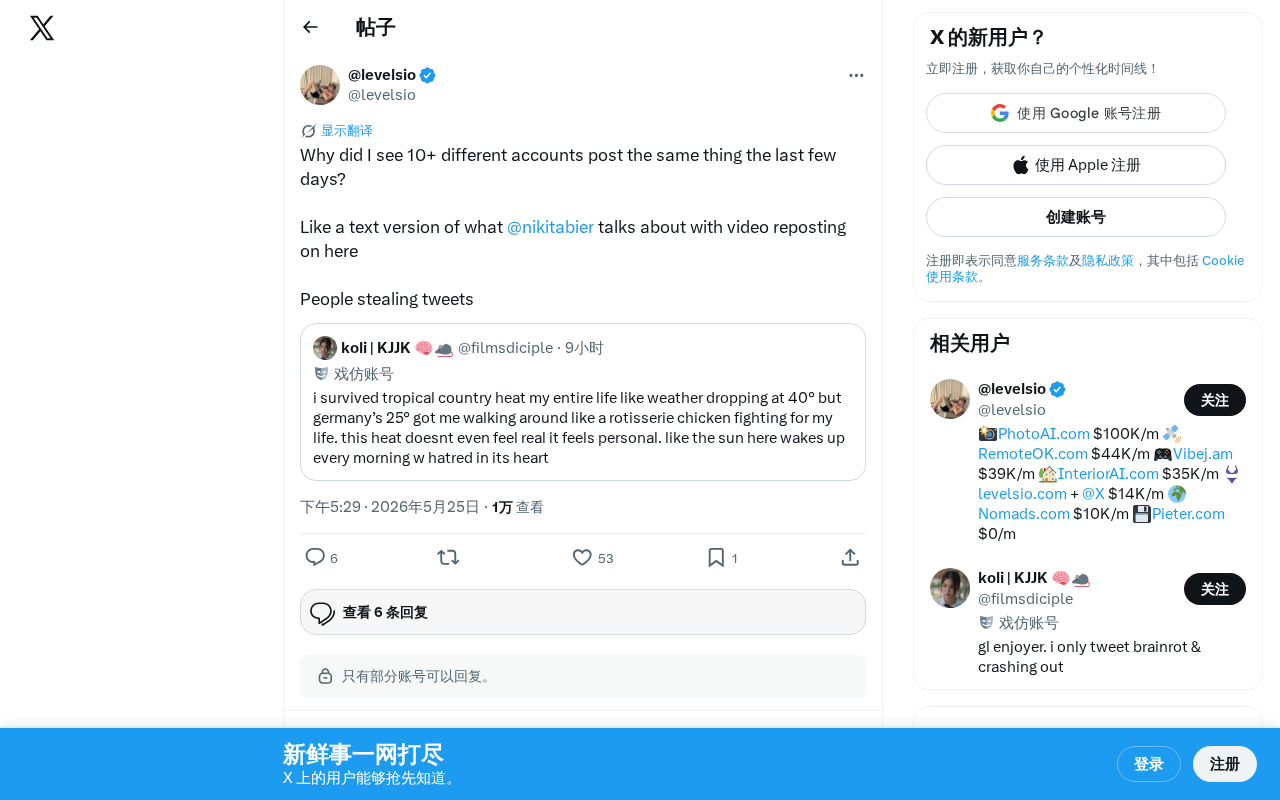
This is far from an isolated incident. More and more users are discovering that their carefully crafted tweets get copied verbatim by multiple accounts within minutes, or slightly reworded and republished. This practice of "stealing tweets" is escalating rapidly on social platforms, evolving from occasional incidents into a systematic content theft problem.
The Attention Economy and AI Tools: A Two-Pronged Engine Behind Rampant Content Theft
Monetizing Traffic Creates a Gray Market
Social media recommendation algorithms naturally favor high-engagement content. Notably, Twitter's For You algorithm, TikTok's recommendation system, and other mainstream recommendation engines are fundamentally ranking systems based on engagement signals like like rates, repost rates, and dwell time. Their core design objective is to maximize user engagement — not to verify content originality. This means a piece of "viral content" that has already been market-validated can still trigger the algorithm's positive feedback loop when reposted, creating what amounts to "traffic arbitrage" — scrapers reap the traffic dividends proven by the original creator without investing any creative effort.
This has spawned a complete gray-market pipeline:
- Mass account registration: Using automation tools to create large numbers of seemingly authentic accounts
- Content scraping and copying: Monitoring trending tweets in real time and reposting them immediately
- Monetization after building followers: Profiting through ads, affiliate marketing, or selling the accounts outright
AI Has Reduced the Barrier to Content Theft to Virtually Zero
Before AI tools became widely available, large-scale content scraping at least required a certain amount of manual labor. Now, with the help of Large Language Models (LLMs) and automation scripts, a single person can operate dozens of accounts simultaneously — automatically scraping trending content, lightly rewriting it to evade detection, and scheduling posts — with the entire workflow running almost fully autonomously.
Large Language Models are generative AI systems built on the Transformer architecture and trained on massive text corpora. Leading examples include GPT-4 and Claude. These models possess extremely powerful text rewriting capabilities — while preserving the original meaning, they can perform synonym substitution, sentence restructuring, and tone adjustment in seconds, making the rewritten text appear superficially distinct from the original. This easily bypasses traditional text detection tools based on cosine similarity or edit distance. Combined with automation scripts written in Python and other programming languages, the entire "scrape-rewrite-publish" pipeline can run fully unattended.
This means original creators are no longer facing individual plagiarists, but an industrialized content theft system. As AI drives the cost of content scraping toward zero, both the scale and speed of content theft are growing exponentially.
From Video to Text: The Content Theft Problem Escalates Across the Board
Previously, video content theft had already attracted widespread attention. Notable entrepreneurs like Nikita Bier have publicly discussed on multiple occasions how platforms like TikTok and Instagram Reels are flooded with videos that have been stripped of watermarks and re-uploaded. Now, this problem is spreading comprehensively into the text domain.
Compared to video scraping, text-based content theft is significantly harder to detect and prevent:
| Comparison | Video Scraping | Text Scraping |
|---|---|---|
| Detection method | Visual fingerprinting; relatively mature technology | Verifying originality of short text is extremely difficult |
| Rewriting cost | Requires editing, dubbing, etc. | AI can rephrase in seconds |
| Speed of spread | Limited by file size | Small file size, fast to publish; copying completed in minutes |
| Difficulty of enforcement | Visual evidence available for comparison | Hard to prove plagiarism after rewriting |
There are deep technical reasons behind this gap. Video fingerprinting technology (such as YouTube's Content ID system) extracts audio-visual features to generate unique hash values, enabling millisecond-level copyright matching — a fairly mature solution. Short text (like tweets), however, has low information entropy and a limited feature space. AI rewriting fundamentally alters the word vector distribution, rendering traditional hash-based matching completely ineffective. Simple text comparison tools are nearly useless against AI-rewritten content, making the protection of text originality an even more intractable challenge.
Why Platform Governance Can't Keep Up with Content Scrapers
Limitations of Existing Moderation Systems
Content moderation on major social platforms currently focuses primarily on policy-violating content (such as hate speech, misinformation, etc.), with relatively limited investment in detecting "content duplication" or verifying "originality." While Twitter/X's reporting mechanism allows users to file plagiarism complaints, processing speed falls far behind the pace of scraping — by the time the platform responds, the scraped content has typically already harvested its traffic.
This lag is not merely a technical issue; it reflects a deeper structural incentive misalignment. For ad-driven social platforms, scraped content generates page views and ad impressions just as effectively — the platform doesn't directly lose out at the traffic level. Building a comprehensive originality detection system would require massive engineering investment and could trigger creator complaints due to false positives. This structural contradiction of "externalized benefits, internalized costs" is the fundamental reason platform governance chronically lags behind. Meanwhile, existing copyright law has gray areas when it comes to protecting short-form text, further weakening the external pressure on platforms to act proactively.
Promising Directions Worth Exploring
To fundamentally curb content theft, platforms need to take action across multiple dimensions simultaneously:
- Content fingerprinting technology: Generate a unique identifier for each piece of original content and automatically detect subsequent copying and rewriting. The academic community is exploring similarity detection approaches based on Semantic Embedding — mapping text into high-dimensional vector spaces and calculating semantic distance. This can identify content with a common origin even after AI rewriting, but the computational cost of large-scale real-time deployment remains a challenge.
- First-publication timestamp certification: Establish trusted records of when content was first published, giving original creators clear evidence for enforcement. Blockchain-based timestamp technology is viewed by some researchers as a potential infrastructure solution, offering tamper-proof proof of publication chronology, though it has yet to be adopted by mainstream platforms.
- Recommendation algorithm intervention: Reduce the recommendation weight of content identified as scraped, cutting off the problem at the traffic distribution level
- Creator monitoring tools: Provide original creators with proactive monitoring capabilities to quickly detect and one-click report content theft
These solutions are not technically infeasible — the key question is whether platforms have sufficient motivation to push them into production.
How Original Creators Can Build a Moat in the Age of Content Theft
With platform governance still far from adequate, original creators cannot afford to wait for protective mechanisms to mature. Instead, they need to proactively build stronger personal brand barriers.
Relying solely on "great content" is no longer enough, because great content can be copied instantly. The three things that are truly hard to steal are: the ability to consistently produce output, a distinctive personal style, and the trust relationship built with your audience. When readers follow "you as a person" rather than just "something you wrote," scrapers may copy your words, but they can never copy your influence.
This content theft arms race ultimately reflects a fundamental contradiction in the social media ecosystem: platforms need massive volumes of content to sustain user activity, yet lack sufficient incentive mechanisms to protect the true creators of that content. As AI continues to drive down the cost of content scraping, this contradiction will only grow sharper — and those who ultimately pay the price are the content creators who still insist on being original.
Key Takeaways
- Large-scale text content scraping has emerged on Twitter, with the same tweet copied verbatim by 10+ accounts
- AI tools and automation scripts have reduced the barrier to content theft to near zero, creating an industrialized theft ecosystem
- Compared to video scraping, text-based content theft is harder to detect, cheaper to rewrite, and faster to spread
- Current platform moderation focuses on policy violations with insufficient investment in originality detection, compounded by deep structural incentive misalignment
- Original creators need to build moats that are resistant to scraping by establishing personal brands and maintaining consistent creative output
Related articles
Meta Muse Hits 900K Downloads in Six D…
Meta Muse Hits 900K Downloads in Six Days: The AI Agent Era Has Officially Arrived
Meta's AI agent Muse hit 902K downloads in 6 days, topping US App Store and Google Play charts above ChatGPT and Claude. A deep dive into Muse's capabilities and the AI Agent race.
 Industry Insights
IRS Fully Embraces Claude AI, Accelerating Federal Government's AI Adoption
The IRS is recruiting staff with 24/7 Claude AI access, marking Anthropic's breakthrough into the federal government. Explore the strategic implications and tax use cases.
 Industry Insights
The IRS Mobile App Debate: A Trust Crisis in Government Digital Transformation
The IRS's proposed mobile app has sparked heated debate. This article analyzes the core arguments, exploring data security, privacy, and the trust crisis in government digital transformation.