Context Engineering Explained: From Prompt Engineering to Information Architecture Design for AI Agents

Context engineering is the new paradigm for building reliable AI agents beyond simple prompt crafting.
As AI evolves from simple LLM interactions to complex agent systems, the focus is shifting from prompt engineering to context engineering — the practice of deliberately organizing all information a model sees. This article explains why more context doesn't mean better performance (context rot), outlines the four pillars of good context (relevance, structure, timing, compression), and demonstrates through a medical appointment assistant example how proper context engineering produces dramatically better AI outcomes.
From Prompt Engineering to Context Engineering
In the past, it was widely believed that the key to building more powerful AI systems lay in crafting the perfect prompt. You've probably heard of "Prompt Engineering" — its core question is: How should I phrase things to get the desired results from a large language model?
However, with the rapid development of large language models (LLMs) and AI Agents, the industry's focus is shifting from prompt engineering to a new paradigm — Context Engineering. According to IBM's definition, context engineering is "the deliberate practice of organizing and optimizing the information passed to an LLM or agent to produce more accurate and relevant outputs."
It's important to understand the fundamental difference between LLMs and Agents. An LLM is essentially a text prediction engine — it takes input text and outputs the most likely continuation. An AI Agent, on the other hand, is a more advanced system built on top of an LLM, capable of autonomous planning, tool invocation, environment perception, and multi-step decision-making. A typical agent operates in a loop: perceive the environment → reason → take action → observe results → reason again, iterating until the task is complete. It's precisely this multi-step, multi-turn interaction that transforms context management from a "nice-to-have" into a "mission-critical" core capability.
One important nuance: prompt engineering hasn't disappeared — it's simply become one component of context engineering. When we shift from "how to ask questions" to "how to construct the entire information environment the model sees," this distinction becomes especially critical when building AI agents.
Why Context Engineering Matters So Much
Starting with Human Working Memory
IBM uses a very apt analogy in their explanation. Research shows that when humans process tasks, working memory can hold and manipulate only about 3 to 5 items at a time, lasting roughly 20 seconds. When we multitask, cognitive overload sets in and efficiency actually declines. To cope, we habitually "chunk" information, breaking it down into smaller sub-tasks.
This analogy has a solid foundation in cognitive psychology. The "3 to 5 items" figure comes from classic research on working memory capacity. In 1956, psychologist George Miller proposed the famous "magical number 7±2" theory, which was later revised by researchers like Nelson Cowan in 2001 to a more conservative 3 to 5 chunks. Working memory differs from long-term memory — it's the cognitive space where we actively manipulate information for real-time reasoning, comprehension, and decision-making. Chunking is a strategy for combining multiple discrete pieces of information into meaningful units, such as segmenting a phone number for easier recall. This analogy maps precisely onto an LLM's context window — it is the model's "working memory," limited in capacity and requiring careful management.
AI models process large tasks in a remarkably similar way. Unlike traditional Q&A where the model just answers a single question, an agent needs to reason across multiple steps, invoke tools, retrieve information, and update memory to make decisions. Just like human working memory, an AI model's context is finite.
More Context ≠ Better Performance: Beware of Context Rot
Some might ask: Don't modern models already support massive context windows? With 2 million+ token capacities, do we really need to design context so carefully?
First, let's explain the technical principles behind context windows. A Context Window refers to the maximum number of tokens an LLM can process in a single inference pass. A token is the basic unit of text processing for the model — one English word typically corresponds to 1 to 2 tokens, and one Chinese character also typically maps to 1 to 2 tokens. Early GPT-3 had a context window of only 4,096 tokens, but by 2024–2025, Claude's context window reached 200K tokens, and Gemini even claims support for up to 2 million tokens. However, expanding the context window doesn't mean the model can attend equally to all the information within it. Research has shown that LLMs exhibit a "Lost in the Middle" phenomenon — the model pays more attention to information at the beginning and end of the context, while its ability to process information in the middle noticeably degrades.
The answer is: Yes, and even more so. IBM explicitly states that more context does not mean better performance — in fact, performance can degrade as context bloats. Researchers call this phenomenon "Context Rot" — too much irrelevant information, poor structure, or missing data all lead to worse reasoning and more hallucinations.
The concept of context rot is corroborated by multiple academic studies. A 2023 research paper from Stanford University and UC Berkeley, Lost in the Middle: How Language Models Use Long Contexts, systematically demonstrated that when relevant information is placed in the middle of a long context, the model's retrieval and reasoning accuracy drops significantly. Furthermore, injecting irrelevant information triggers an "attention dilution" effect — the self-attention mechanism in the Transformer architecture computes association weights across all tokens, and when a large volume of irrelevant tokens is added, the attention weights allocated to critical information get diluted, directly degrading reasoning quality and increasing hallucinations. This provides a technical explanation for why carefully selecting and organizing context is far more important than simply expanding the context window.
Here's an analogy: if I give you a one-page guide to complete a task like "onboard a new colleague," you can get it done quickly. But if I dump 4,000 pages of Slack messages, emails, and scattered notes on you, you wouldn't know where to start. This is exactly what context engineering is about — the goal isn't to give the model more information, but to provide the right information in the right format.

What Good Context Consists Of
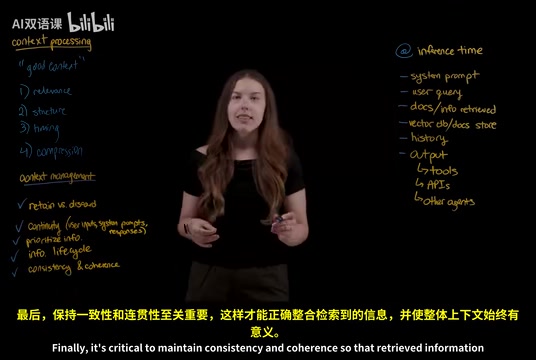
Context is everything the model can see during inference. For an LLM, context includes:
- System Prompt
- User Query
- Externally retrieved information: documents from vector databases or document stores
- Interaction history: past conversations and responses between the LLM and the user
- Additional system outputs: tool outputs, API responses, results from other agents
Among these, the System Prompt is the most fundamental yet often underestimated component of context engineering. It's a hidden instruction injected before the conversation begins, defining the model's role, behavioral boundaries, output format, and core rules. In modern AI systems, system prompt design has evolved from a few simple sentences into complex structured documents that may include modules for role definition, operational guidelines, tool usage instructions, safety constraints, output format specifications, and more. Companies like OpenAI even treat system prompts as a form of "software configuration" in their internal practices, requiring version management and continuous iteration. A well-designed system prompt can significantly reduce the amount of supplementary context needed in subsequent interactions.
The "externally retrieved information" component involves one of the most important technical architectures in current AI applications — Retrieval-Augmented Generation (RAG). The core idea of RAG is: rather than cramming all knowledge into the prompt, dynamically retrieve the most relevant information fragments at runtime based on the user's query. Vector databases (such as Pinecone, Weaviate, Milvus, etc.) convert text into high-dimensional mathematical vectors (embeddings) and use cosine similarity or Euclidean distance calculations to quickly find the most semantically similar content. This technology is the practical implementation of the "relevance" and "timing" principles in context engineering — it ensures the model receives the most relevant external knowledge when needed, rather than loading all potentially useful information at once.
While that's a lot of information, good context has several key characteristics:
Four Core Characteristics of Context Quality
- Relevance: Every piece of information included should help the model complete its task. Irrelevant content must be removed.
- Structure: Information should be clearly organized, often with labels or formatting, to help the model distinguish between different types of information.
- Timing: Especially in agent systems, context should be introduced only when needed, avoiding premature loading of unnecessary data.
- Compression: Rather than dumping raw data wholesale into the prompt, summarize or filter out the most useful details.
Regarding compression, there are multiple implementation approaches in practice. The most straightforward method is summary generation — using the LLM itself to summarize long texts, compressing thousands of tokens into a few hundred tokens of key information. More advanced methods include: selective retrieval (extracting only the paragraphs most relevant to the query from a document), recursive summarization (hierarchically summarizing long conversation histories, preserving recent conversations in full while keeping only summaries of older ones), and information distillation (converting structured data into natural language key fact statements). Recently, learning-based context compression techniques have also emerged, such as the LLMLingua framework, which can remove redundant tokens while preserving semantics, compressing prompt length to one-fifth or less of the original while keeping performance loss to a minimum.
This series of transformation steps produces usable context — a process called Context Processing.
Context Management: The Art of Continuous Maintenance
Processing is only the first step. Next comes Context Management — the ongoing process of maintaining the information contained in a model's context across interactions and over time. It involves several key aspects:
Deciding What to Keep and What to Discard
Determining which information should be retained and which should be removed, ensuring relevant information is maintained while unnecessary or outdated information is removed or minimized. This step directly determines how efficiently the context window is utilized.
Maintaining Conversational Continuity
In conversational systems, this means tracking relevant user inputs, system instructions, and prior responses so the model can respond consistently and maintain awareness of earlier context.
Prioritizing Information
Not all information is equally important. Context management assigns priority to specific data based on relevance, recency, or importance to the task.
Managing the Information Lifecycle
Updating context when new information arrives, invalidating outdated data, and ensuring the context reflects the most accurate and current state of knowledge. This is especially critical in dynamic environments where information changes over time.
Finally, it's essential to maintain consistency and coherence, ensuring that retrieved information is properly integrated and the overall context remains logically sound.
Practical Example: Building a Medical Appointment Assistant with Context Engineering
IBM provides a very compelling real-world example. Imagine you're building an AI assistant for a healthcare facility to help patients schedule appointments.
With just a simple prompt — "Schedule an appointment for this patient" — there's enormous room for error. The model doesn't know the clinic's rules, the doctor's availability, or the patient's medical history.
With context engineering applied, the system provides:
- Clinic scheduling policies: such as appointment types and durations
- Doctor's real-time availability
- Patient preferences: e.g., "mornings only"
- Relevant medical history
- Tool outputs: such as available time slots retrieved via a scheduling API
Now, when the model generates a response, it's no longer "guessing" — it's reasoning over complete, structured context. Instead of just saying "Here are some available slots," it can say: "You need a follow-up visit. Dr. [Name] has an opening at 10 AM on Wednesday, which aligns with your morning preference. Here are a few morning appointment options — would you like me to book one for you?"
The difference is night and day.
An Essential Skill for the Age of Agents
Whether you're building AI agents, experimenting with automated workflows, or simply trying to understand where the field is heading, context engineering is becoming one of the most important skills. It marks a shift in AI application development from "crafting a single sentence" to "designing an entire information ecosystem." As agents increasingly take on complex multi-step tasks, those who can better organize, manage, and optimize context will be the ones building more reliable and intelligent AI systems.
Key Takeaways
Related articles

Python 3.15 New Feature: Is the sentinel Type Better Than None?
Python 3.15 adds the sentinel type, using named unique sentinel objects to replace None and bare object(), resolving confusion among missing values, explicit emptiness, and invalid input while avoiding type hint failures.

Deep Learning's Three Architectures and the Universal Approximation Theorem: A Complete Guide to MLPs, CNNs, and Transformers
Explaining the inductive bias differences among MLP, CNN, and Transformer, the existence meaning of the Universal Approximation Theorem (UAT), and the role of Taylor expansion in approximation analysis, while clearing up common misconceptions.

GitLab Emergency Patch Release: Analysis of Critical Security Fixes
GitLab releases critical patch 19.5.1, sparking 355 points of discussion on Hacker News. This article analyzes the background, upgrade steps for self-hosted instances, and verification points to help DevOps teams respond quickly to security updates.