Context Goblin: A Review Tool for Global Context Quality Assurance in AI-Generated Code
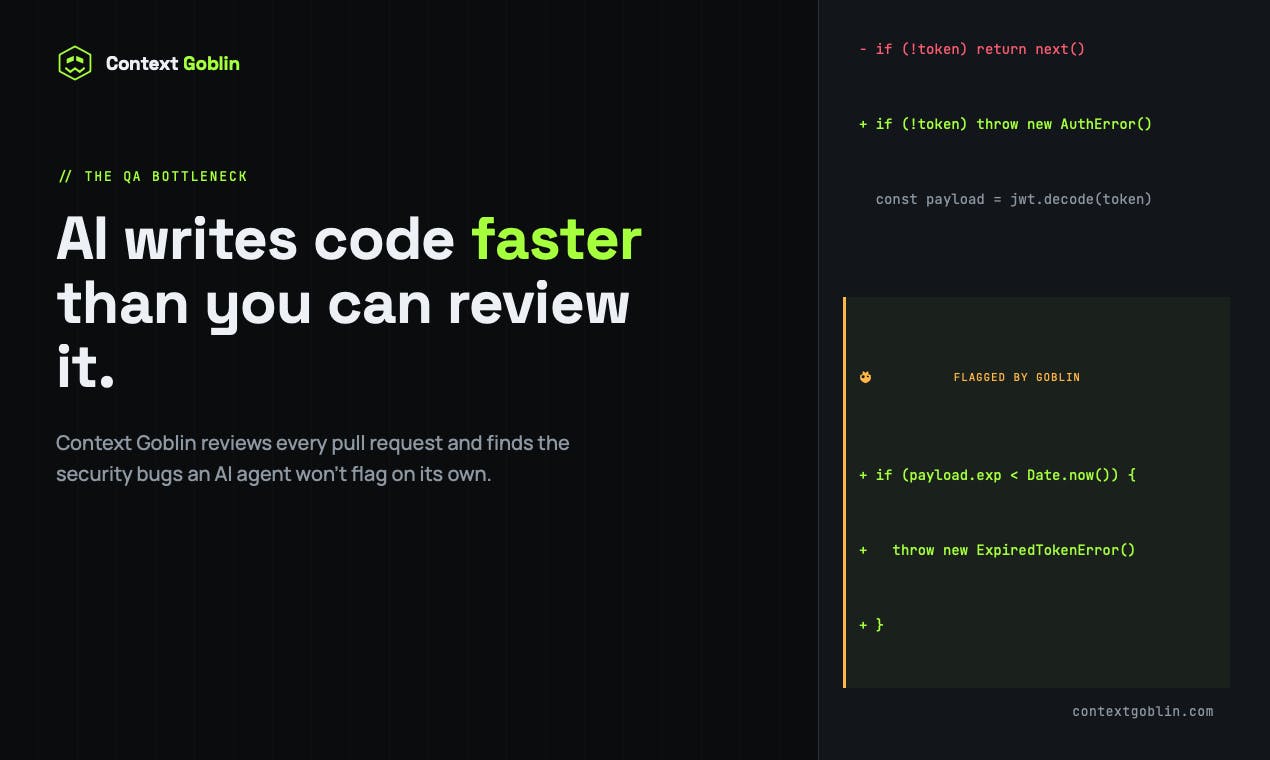
Context Goblin: AI code reviewer with codebase memory that reviews changes, not just diffs
Context Goblin is an AI-powered code review tool designed to ensure quality in AI-generated code by maintaining global codebase context. Unlike traditional tools that only review diffs, it understands call chains and service dependencies to assess the full impact of changes—acting as a quality 'immune system' for AI programming.
In the Era of AI-Written Code, Who Ensures Quality?
With the widespread adoption of AI programming tools like GitHub Copilot, Cursor, and Claude Code, an increasing amount of code is being generated by AI. Developers' roles are shifting from 'writing line by line' to 'reviewing and integrating.' However, this brings a new challenge: AI-generated code is often locally correct but may overlook contextual dependencies across the entire codebase—it doesn't know who calls a function or which downstream modules would be affected by modifying a service.
The Rise of AI Programming Tools
GitHub Copilot, Cursor, and Claude Code represent three mainstream categories of AI programming assistance tools. GitHub Copilot, jointly developed by GitHub and OpenAI, is trained on massive code repositories and can automatically complete code snippets based on comments and context. Cursor is an IDE focused on conversational AI programming, allowing developers to generate code through natural language descriptions. Claude Code is a programming assistant launched by Anthropic, emphasizing safety and interpretability.
These three represent the evolution of current AI programming tools from 'code completion' to 'conversational generation' to 'safe and controllable.' According to GitHub's 2024 developer survey, over 92% of developers are already using some form of AI programming tool, marking a fundamental shift in software development paradigms. Against this backdrop, ensuring the quality of AI-generated code has become an urgent industry challenge.
A new tool recently featured on Product Hunt, Context Goblin, targets precisely this pain point. Its positioning is crystal clear: The quality check for AI-built software. In the Software Engineering and GitHub categories, the product currently has 11 votes, 3 comments, and ranks 13th.
Product Hunt Platform and Product Validation
Product Hunt is the world's largest new product discovery community, showcasing hundreds of new products daily for users to vote on and comment. Products are organized by category (such as Developer Tools, Artificial Intelligence) with daily, weekly, and monthly rankings. Vote counts reflect early adopter attention, but require careful interpretation: 11 votes indicate an early stage, possibly meaning the product just launched or has a narrow audience.
For software tools, typically 100+ votes are needed to reach the top 5 on the daily leaderboard for significant exposure. Comment count (3) better reflects actual usage feedback, but the sample size is too small to draw conclusions. Product Hunt is primarily a product validation and early user acquisition channel, not a maturity indicator. Context Goblin's current metrics suggest it's in the early stages of market validation.
Not Just Reviewing Diffs, But Reviewing 'The Change Itself'
Context Goblin's core selling point can be captured in one sentence from its official description:
"An AI code reviewer with a senior engineer's memory of your codebase. It knows who calls what and which service depends on it, so it reviews the change, not just the diff."
In other words: An AI code reviewer with a senior engineer's level of codebase memory. It knows who calls what and which services depend on what, so it reviews 'the change,' not just 'the difference.'
The Evolution of Code Review: From Diff to Change
Traditional code review relies mainly on manual line-by-line inspection, focusing on code style, logical errors, security vulnerabilities, etc. With the proliferation of static analysis tools (like SonarQube, ESLint), some mechanical checks have been automated. But these tools are primarily based on rule matching and syntax tree analysis, lacking deep understanding of code semantics and business logic.
'Diff review' refers to the traditional method of focusing only on code change differences (git diff), while 'change review' requires understanding the impact scope of modifications across the entire system—including call chain analysis, dependency tracking, interface compatibility checking, etc. This demands that review tools possess 'global view' capabilities, not just stay at the local code snippet level.
This statement contains a key product philosophy difference. Traditional code review tools (including many AI Review plugins) essentially look at diffs—which lines changed in this commit. They can spot syntax issues, obvious logical bugs, even some security risks. But they typically lack global understanding of the entire project structure.
The Essential Difference Between 'Diff Review' and 'Change Review'
For example: you modify the return structure of a utility function formatUserData(). Looking at the diff alone, this change might be perfectly reasonable and logically sound. But if this function is called by 12 different modules in the system, with 3 downstream services having strong dependencies on its output format, then a review tool that only looks at diffs won't catch the potential crash risk.
Context Goblin claims it maintains 'memory' of the codebase—understanding call relationships (who calls what) and service dependencies (which service depends on it). This means it can evaluate the impact surface by placing a local change within the entire system's dependency graph. This is exactly how senior engineers approach code review: not looking at what characters you changed, but what chain reaction your change will trigger.
Technical Implementation of Dependency Graphs and Call Chain Analysis
Dependency relationships in a codebase can be abstracted as a directed graph: nodes represent functions, classes, or modules, and edges represent calls or dependencies. Building an accurate dependency graph requires combining static analysis (parsing import statements, function calls) and dynamic analysis (runtime tracing of actual execution paths).
Call chain analysis builds on this graph to assess impact surface: when function A is modified, all code paths that directly or indirectly call A must be traced to evaluate potential breaking impacts. This is especially important in microservice architectures—an interface change in a foundational service might ripple through dozens of upstream services. Industry tools like Dependabot (dependency updates) and Sourcegraph (code search) already exist for dependency analysis, but deeply integrating them with AI code review remains frontier exploration.
Why Context-Aware Code Review Deserves Attention
The 'context-aware review' direction that Context Goblin represents holds significant importance as AI programming scales.
Quality Challenges in AI-Generated Code
Large language models face several inherent limitations when generating code: 1) context window constraints (typically 4K-128K tokens), unable to 'see' an entire large codebase; 2) training data timeliness, potentially generating outdated code or code not compliant with project conventions; 3) hallucination issues, where models may fabricate non-existent APIs or libraries; 4) security vulnerabilities, such as hardcoded keys or SQL injection flaws.
Research shows that AI-generated code has a bug rate approximately 1.5-2 times that of manually written code, with a greater tendency toward logical errors rather than syntax errors. Therefore, multiple layers of quality assurance are needed: unit testing, integration testing, static analysis, human review, and the 'context-aware review' represented by Context Goblin—these constitute a complete quality assurance chain for the AI programming era.
The scale of AI-generated code is exploding. When a significant percentage of PRs merged daily by a team come from AI, human review bandwidth becomes a bottleneck. What's needed then is not more manpower, but automated review capabilities that 'understand the whole picture' just as well.
The typical flaw in AI-generated code is precisely context deficiency. AI typically can only see a limited context window when generating code, making it difficult to grasp the intricate call chains and dependencies in a large codebase. Using a tool that understands the global picture to review a generator that only sees locally is logically complementary.
Dependency-awareness capability is a differentiating moat. There are many AI code review tools on the market, but most remain at the diff level. Products that can build and maintain codebase dependency graphs and perform impact analysis based on them have higher technical barriers and are more likely to form product moats.
Early-Stage Product Still Requires Cautious Observation
As an early-stage product, Context Goblin has areas that need continuous validation.
Accuracy and timeliness of contextual memory is the biggest technical challenge. Codebases continuously evolve, and call relationships and dependencies constantly change. Whether the tool can maintain this 'dependency map' in real-time and accurately directly determines the reliability of review conclusions. Once the memory becomes outdated, it not only fails to discover real issues but may produce misleading review opinions.
False Positive Rate: The Life-or-Death Line for Quality Tools
False positive rate is a key metric for security and quality tools, referring to the proportion of cases where the tool incorrectly flags normal situations as problems. High false positive rates lead to 'alert fatigue'—when developers frequently receive false warnings, they gradually ignore all warnings, including real issues.
Research shows that when the false positive rate exceeds 50%, a tool's actual value approaches zero. In code review scenarios, balancing sensitivity (catching real problems) and specificity (avoiding false positives) is especially difficult: being too conservative misses critical bugs, being too aggressive drowns developers. Excellent review tools need to continuously tune decision boundaries through machine learning and provide explainable warning rationales, allowing developers to quickly judge warning validity.
If Context Goblin frequently issues 'may affect downstream' warnings for harmless changes, developers will quickly fall into 'alert fatigue' and ultimately choose to ignore it—rendering the tool useless. Whether Context Goblin can achieve an industrially viable false positive rate requires long-term validation on large-scale codebases.
Judging from the current early-stage traction of 11 votes, Context Goblin is still in the market validation phase, and actual effectiveness requires longer-term usage by more users to verify.
AI Programming Ecosystems Need Supporting 'Immune Systems'
The emergence of Context Goblin reflects a signal that the AI programming ecosystem is maturing: when code generation becomes cheap, the value of code validation is actually rising.
The 'Immune System' Metaphor for Software Quality Assurance
Comparing quality assurance mechanisms to an 'immune system' is a classic metaphor in software engineering. Just as biological immune systems identify and eliminate pathogens, software quality tools intercept 'viruses' (bugs) before they spread. This analogy encompasses multiple layers of defense: compilers are the first line of defense (syntax checking), unit tests are adaptive immunity (targeting known issues), while tools like Context Goblin resemble 'pattern recognition receptors'—able to identify structural risks rather than merely responding to known threats.
In scenarios where AI generates code at scale, traditional defense mechanisms may be insufficient: AI can rapidly generate large volumes of code, with 'infection speed' far exceeding human review capacity. Therefore, review tools with AI capabilities are needed to achieve 'offensive-defensive balance,' forming a dynamic equilibrium similar to an arms race.
If AI code generators solve the 'write fast' problem, then context-aware review tools like Context Goblin attempt to solve the 'change safely' problem. It plays the role of an 'immune system' in software engineering—not preventing you from writing code, but intercepting potential risks before they spread.
For teams introducing AI programming at scale, deploying an automated quality assurance mechanism with global contextual understanding capabilities may become standard infrastructure in the development process, just like CI/CD. The direction Context Goblin represents—using AI to review AI-generated code, combined with dependency graphs for impact analysis—is likely an important component of future software quality assurance systems.
Key Takeaways
- Context Goblin positions itself as a quality assurance tool for AI-generated code, with core capabilities in 'change review' based on codebase dependency graphs, rather than traditional 'diff review'
- The product is currently in early Product Hunt validation stage (11 votes, 3 comments), with actual effectiveness awaiting verification through longer-term usage by more users
- Context-aware review addresses a typical flaw in AI-generated code: AI is limited by context windows, making it difficult to understand global dependency relationships in large codebases
- Technical challenges lie in the accuracy and timeliness of dependency graphs, and false positive rate control—high false positive rates lead to 'alert fatigue,' rendering tools worthless
- Such tools represent a maturity signal for AI programming ecosystems: when code generation becomes cheap, validation and quality assurance value actually rises, forming a dynamic balance of 'generation-review'
Related articles
OpenAI's Staggering $38.5 Billion Loss: The Financial Truth and Capital Game Before Its IPO
OpenAI faces a reported $38.5B loss before its IPO. This deep dive analyzes compute costs, strategic logic, IPO timing, and what it means for the generative AI industry.
Gemini 3.7 Flash In-Depth Review: Speed, Quality, and Multi-Model Collaboration
In-depth analysis of Google Gemini 3.7 Flash model's core advantages: extreme generation speed, high-quality code and game generation, multi-model collaboration mechanisms, and multimodal understanding potential, with real-world test cases.
PyTorch and Hugging Face Bangalore Tech Summit: In-Depth Recap
Bangalore PyTorch and Hugging Face tech summit recap: 170+ developers explore large-scale inference optimization, reinforcement learning practices, and open-source community building, analyzing India's AI ecosystem trends and technical innovation.