Context Poisoning: Why Long-Context Models Get Derailed by Distractors

Paper proves long-context retrieval degrades based on effective distractor count, not context length.
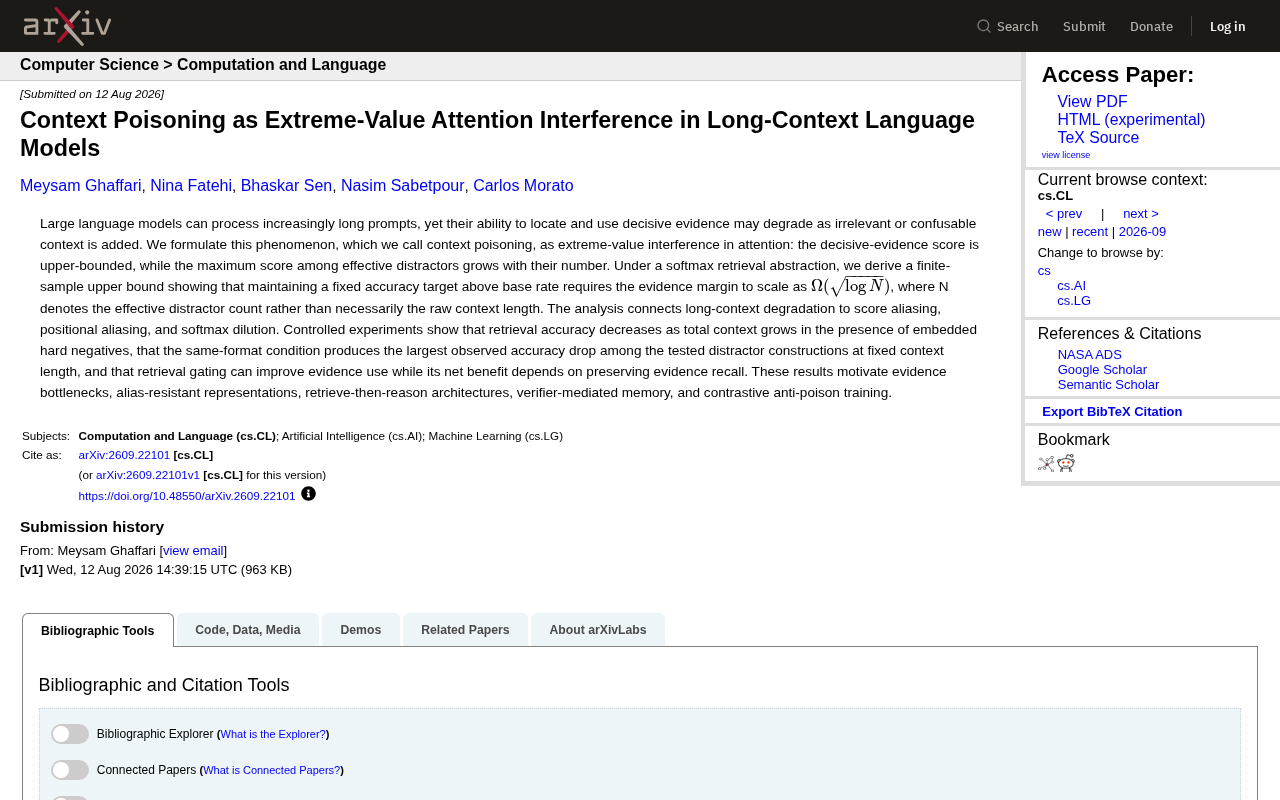
This arXiv paper formalizes long-context performance degradation in LLMs as an extreme-value interference problem in attention, coined "context poisoning." The core theoretical finding is that the evidence attention margin required to maintain fixed retrieval accuracy must grow at Ω(√logN) with N effective distractors — not raw context length. The paper attributes degradation to score aliasing, positional aliasing, and softmax dilution, with experiments confirming same-format distractors cause the largest accuracy drops. Proposed mitigations include evidence bottlenecks, alias-resistant representations, retrieve-then-reason architectures, and contrastive anti-poison training.
The Hidden Problem with Long-Context Capabilities
Large language models are rapidly improving at handling extremely long prompts — but a subtle problem has emerged alongside this progress: when inputs contain large amounts of irrelevant or confusable content, a model's ability to locate and use key evidence degrades significantly. A paper published on arXiv names this phenomenon context poisoning and offers a systematic explanation grounded in the mathematical structure of the attention mechanism.
Counter to intuition, the root cause isn't simply how long the context is — it's the number of "effective distractors" within it. In other words, packing in more characters isn't always what makes things worse; what's truly dangerous is distractor content that closely mimics the format and semantics of the real evidence.
Formalizing the Problem as Extreme-Value Interference
The paper's central contribution is abstracting context degradation into a problem of extreme-value interference within attention.
The Asymmetric Competition Between Evidence and Distractors
The authors identify an asymmetric structure: there is an upper bound on the attention score of the key evidence, while the maximum score among all effective distractors grows as the number of distractors increases. This means that as more distractors are added, some distractor's score will eventually approach or even exceed the true evidence score — this is the mathematical root cause of the model being "led astray."
The concept of "effective distractors" is central to this paper. It refers to distractor content that is semantically or structurally similar enough to the true evidence to pose a real threat in the attention competition — as opposed to random noise or obviously irrelevant text. The attention mechanism is fundamentally a softmax-normalized competition among all tokens: each token's final weight depends on its similarity score relative to all other tokens. When the score distribution of distractors overlaps with that of the evidence, the softmax output becomes "averaged out," preventing the truly useful evidence from receiving sufficiently high attention weight. Extreme-value statistics tells us that the expected maximum of N i.i.d. random variables grows at roughly $\sqrt{\log N}$ — this is the intuition behind the $\Omega(\sqrt{\log N})$ margin requirement: the evidence score must outrun the "lucky" distractor.
The $\Omega(\sqrt{\log N})$ Evidence Margin
Within an abstract framework of softmax retrieval, the authors derive a finite-sample upper bound: to maintain a fixed accuracy target above the baseline rate, the margin of the evidence score over distractors must grow at $\Omega(\sqrt{\log N})$, where N is the number of effective distractors — not the raw context length.
This result is significant: it shifts attention away from the coarse narrative of "context is too long" toward the more precise metric of "number of effective distractors."
Three Failure Mechanisms
The paper links long-context degradation to three specific mechanisms:
- Score aliasing: distractor attention scores become indistinguishable from those of true evidence;
- Positional aliasing: positional encodings become ambiguous over long sequences;
- Softmax dilution: attention weights are spread thin across too many candidates, leaving the genuinely important evidence without sufficient weight.
These three mechanisms together explain why models in long-context settings can "see" key information but still fail to use it.
Positional aliasing deserves further elaboration. Modern large models commonly use Rotary Position Embeddings (RoPE) or similar relative positional encoding schemes, which inject positional information into attention score calculations via rotational transforms. However, when sequences are extremely long, the rotational angle differences between distant positions tend to overlap periodically, making encoding vectors at different positions difficult to distinguish in high-dimensional space — and so the model's ability to perceive "where in the context this piece of evidence lives" degrades. This is also the encoding-level explanation for the "lost in the middle" phenomenon: models perceive positions at the beginning and end of context more clearly, while positions in the middle are further obscured by positional encoding ambiguity, compounding the effects of score aliasing and softmax dilution.
What the Experiments Confirmed
The authors ran a series of controlled experiments to validate their theory. Key findings include:
- When hard negatives are embedded in context, retrieval accuracy degrades as total context length increases;
- At a fixed context length, same-format distractors caused the largest accuracy drop among all distractor types tested — meaning distractors that match the format of the target evidence are the hardest to filter out;
- Retrieval gating improves evidence utilization, but its net benefit depends on whether evidence recall can be maintained.
The second finding is especially worth noting for practitioners: the more a distractor "looks like" the correct answer, the more easily the model is misled — a direct challenge for how retrieval results are structured in RAG systems.
"Hard negatives" in information retrieval refers to candidates that are highly relevant to the query but are not the correct answer — a common construction technique for training retrieval models. In this paper's experimental context, hard negatives are inserted into context as distractors, simulating real-world RAG scenarios where a retriever returns relevant but inaccurate documents. These distractors are particularly dangerous precisely because they sit close to the correct evidence in representation space, triggering the score aliasing described above. It's worth noting that "same-format distractors" and hard negatives are two distinct dimensions: the former emphasizes structural similarity (e.g., the same table format or Q&A format), while the latter emphasizes semantic proximity — and when the two are combined, the confusion effect on the model is strongest.
Implications for System Design
Based on this analysis, the paper proposes several potential mitigation directions, offering architectural guidance for long-context and retrieval-augmented systems:
- Evidence bottlenecks: actively narrow the information channel entering the reasoning stage;
- Alias-resistant representations: make true evidence and distractors more separable in representation space;
- Retrieve-then-reason architecture: decouple retrieval from reasoning;
- Verifier-mediated memory: introduce a verification mechanism to filter memory contents;
- Contrastive anti-poison training: use contrastive learning to improve model robustness against distractors.
The "retrieve-then-reason" architecture differs from the mainstream RAG pipeline in how isolated the reasoning stage is. Standard RAG typically concatenates all retrieved documents directly into the prompt, asking the model to simultaneously "find evidence" and "reason from evidence" in a single forward pass — this is precisely where context poisoning occurs. The decoupled approach first uses a lightweight retrieval or reranking module to compress the candidate set to a very small range (the evidence bottleneck), then feeds the refined evidence to the reasoning module. This reduces the number of effective distractors the reasoning stage faces at the architectural level, rather than relying on the model to sift through large amounts of mixed content on its own. This complements the "verifier-mediated memory" direction: the former reduces the probability of distractors entering reasoning, while the latter applies a second-pass verification to outputs after reasoning.
Why This Research Matters
As model context windows continue to expand, the industry often defaults to the assumption that "stuffing in more context" will improve performance. This paper offers a sobering theoretical perspective: what truly determines retrieval quality is not raw length, but the quantity and similarity of effective distractors. For engineering teams building RAG systems, long-document Q&A, and agent memory systems, this means the optimization focus should shift from "how much can we fit" to "how do we reduce and defend against confusable distractors."
It should be noted that the paper's conclusions are built on a softmax retrieval abstraction and controlled experiments — real-world large model behavior may be more complex. But the measurement lens it proposes and the mitigation directions it outlines carry clear engineering value.
Related articles

Felix Rieseberg Personal Homepage
Felix Rieseberg's personal homepage sparks attention on Hacker News. This article covers the Slack engineer's technical background, the rise and fall of nativefier, and the value of a developer homepage as a tech calling card.

@ai-sdk/vue 3.0.306 Patch Release Syncs with [email protected] Update
@ai-sdk/vue 3.0.306 released, synced with [email protected]. A routine patch release for the Vercel AI SDK ecosystem with no public API changes; the Vue adapter layer stays version-aligned with the core package.

Gemini 4 Argon API Launches: The Era of Million-Token Output Begins
Google launches Gemini 4 Argon with sparse MoE architecture, up to 1M output tokens, and a 68.90% Vals Index score, available across API, AI Studio, and the Gemini app.