Continuum: A Private Team Memory App for Managers with Local-Only Storage

Continuum is a local-only Mac app helping managers privately track what they know about each team member.
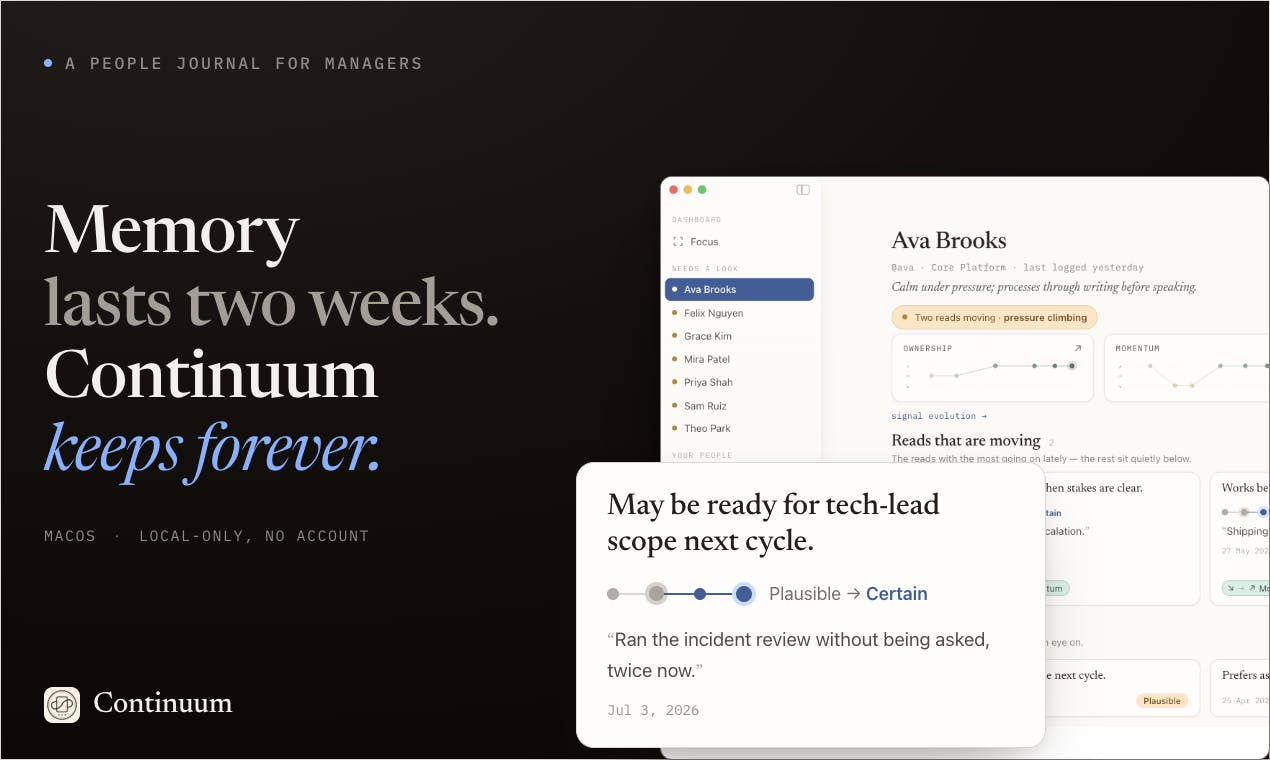
Continuum is a Mac app by indie developer Roland Leth that helps managers remember everything about their direct reports. It offers structured note-taking for 1:1 meetings with a strict privacy-first approach: no scores, no reports, and all data stays local on your Mac. It targets frontline managers who value continuous one-on-one conversations and want to track team members' growth over time without the pitfalls of quantified performance systems.
A Private Memory Tool Built for Managers
In an era where management workflows are increasingly dominated by SaaS platforms and performance review systems, a Mac app called Continuum has taken a decidedly different path. Its positioning is crystal clear: help managers remember everything they know about each person they manage—with a strong emphasis on privacy. All data stays on your Mac. Nothing gets uploaded, no reports are generated, and no scores are assigned.
Built by independent developer Roland Leth, Continuum landed on Product Hunt and received 95 upvotes, ranking 10th that day across the Mac, Productivity, and Meetings categories. While the vote count isn't explosive, the pain point it addresses—"manager memory"—is remarkably real.
The Problem It Solves: A Manager's "Memory Overload"
Anyone who has led a team knows that the most mentally draining part of management often isn't technical decision-making—it's remembering each person's situation. Who mentioned wanting to transfer teams last week? Who expressed concerns about the project during a 1:1? Who's been visibly struggling lately? When you have five, ten, or more direct reports, this information scattered across daily conversations is nearly impossible to retain purely from memory.
This challenge has solid backing in cognitive psychology. Psychologist George Miller's 1956 "magical number 7±2" theory demonstrated that human working memory has extremely limited capacity—we can only process about 7 chunks of information at once. Yet managers need to track information far exceeding this threshold: each report's career aspirations, emotional state, project progress, personal life context, and more—creating an enormous cognitive burden. Daniel Kahneman also noted in Thinking, Fast and Slow that when cognitive resources are overextended, people fall back on heuristic judgments and become prone to bias. This means that without external tools to aid memory, managers are likely to form incomplete or even distorted impressions of their reports.
Continuum's core philosophy is to help you capture and preserve these things "you believe, you observe." Its workflow breaks down into three steps:
- Write down your impressions of each person: Your understanding, expectations, and concerns about each team member can all be recorded
- Tag things during 1:1s: Mark and archive the details you notice during one-on-one conversations
- Let your views evolve over time: Your assessment of someone isn't static—Continuum allows these "cognitions" to naturally update in the record
These three steps form a closed loop for continuously tracking personal perceptions, which is exactly what its name "Continuum" reflects—management is a continuous, dynamic process.
The Restrained Design Philosophy of "No Scores, No Reports"
What's most noteworthy about Continuum are the three clear boundaries it draws: no scores, no reports, and nothing that leaves your Mac.
This design philosophy creates a striking contrast with today's landscape. Most team management software is racing toward "collaboration," "transparency," and "data-driven" approaches—performance scores, team dashboards, auto-generated evaluation reports. Continuum goes in the opposite direction, positioning itself as a manager's personal, private notebook.
There's clear product logic behind this:
Privacy Is the Prerequisite for Trust
A manager's honest assessments of their reports are often sensitive. If these records exist in company systems where HR or others could access them, managers won't dare write honestly. Only a fully local, non-exportable design allows people to confidently record their genuine thoughts.
Continuum's commitment to keeping data entirely local is part of the broader "Local-First Software" movement that has gained traction in developer communities in recent years. This philosophy was systematically articulated by the Ink & Switch lab in their 2019 paper of the same name. The core thesis: user data should belong to users, software should perform primary computation locally, and network connectivity should only be an optional enhancement. This stands in stark contrast to the SaaS model, which stores data centrally on cloud servers where users essentially only "rent" access to their own data. Representative Local-First products include Obsidian (notes) and Linear's offline mode. For a use case like management that involves sensitive personnel information, local-first means data won't leak due to corporate account revocation, vendor shutdowns, or security breaches.
Avoiding the "Quantification Trap"
The deliberate absence of a scoring system prevents reducing people to numbers. Real interpersonal perception is complex and fluid—a single number actually distorts judgment. What Continuum preserves is textual, evolvable "readings" rather than cold metrics.
This design choice touches on a profound issue in management theory: the perversion of quantitative metrics. British economist Charles Goodhart's Law states: "When a measure becomes a target, it ceases to be a good measure." In performance management, this phenomenon is extremely common—once managers start rating reports on a 1-5 scale, the score itself distorts observation. Managers unconsciously seek evidence confirming existing ratings (confirmation bias) or ignore real changes to avoid score fluctuations. Google abolished its famous "stack ranking" forced ranking system in 2019, and Netflix has long refused to use numerical performance scores—these practices all confirm the damage that over-quantification inflicts on genuine interpersonal understanding.
Use Cases and Boundaries
From a product standpoint, Continuum's target user is very clear: frontline managers or technical leads running small teams, especially those who value 1:1 meetings and want to track each report's growth over time.
The 1:1 (one-on-one meeting) is one of the most championed management tools in modern practice. Andy Grove defined 1:1s in his classic High Output Management as "a manager's most important leverage activity," arguing that a weekly 30-60 minute 1:1 investment produces management returns far exceeding its time cost. Ben Horowitz stated even more bluntly in The Hard Thing About Hard Things: "A manager who doesn't do 1:1s is essentially not managing." However, the value of 1:1s is highly dependent on continuity—if a manager can't remember what was discussed last time or what requests were made, 1:1s devolve into formulaic status updates, losing their core function of building trust and enabling deep dialogue. This is precisely the gap Continuum aims to bridge.
Its value primarily manifests in:
- Long-term, structured preparation for 1:1 meetings
- Avoiding repeated questions or missed important signals due to forgetfulness
- Observing how a person's situation and your perception of them change over time
But it also has clear limitations. Due to its commitment to being purely local, non-collaborative, and report-free, it's not suitable for scenarios requiring team-level data sharing or upward reporting. If your organization requires syncing 1:1 records with HR or producing formal evaluations, this tool won't help. Additionally, being a Mac-only app means Windows and mobile users are currently out of luck.
An Indie Developer's Differentiation Strategy
From a broader perspective, Continuum represents a typical approach indie developers use to find differentiation in the productivity space dominated by giants: rather than pursuing breadth, go deep on a specific pain point and establish differentiation through clear values (privacy-first, restrained design).
At a time when AI meeting transcription and auto-summary tools are everywhere, Continuum returns to the origin point of "a person's own thinking and memory." It doesn't analyze for you, doesn't judge for you—it simply helps you capture and organize scattered perceptions. This philosophy of "tools serving human judgment rather than replacing it" feels somewhat precious in an age of AI proliferation.
Of course, whether it can survive long-term remains uncertain. A single-function, purely local product with no network effects faces challenges in monetization and user retention. But as an exploration of the overlooked need for "manager memory," Continuum undoubtedly provides a valuable case study.
Key Takeaways
Related articles

Chain of Thought Isn't Just for AI: How Humans Can Use CoT to Improve Thinking Quality
Chain of Thought isn't just a prompt trick for large models. Starting from a Hacker News discussion, this article analyzes why CoT works for human thinking too, breaks down actionable ways to transfer it, and highlights the key differences between human CoT and machine CoT.
Cloudflare Teams Up with OpenAI: Closi…
Cloudflare Teams Up with OpenAI: Closing the Loop from Vulnerability Discovery to Defense with AI
Cloudflare uses OpenAI Daybreak to investigate security vulnerabilities and generate reviewable remediation plans, while developers use Codex to boost coding efficiency and quality.

Orca Multi-Agent Orchestration in Practice: A Guide to Parallel Collaboration with Claude and Codex
Orca is Stable AI's free open-source agent workbench supporting 34 agents like Claude Code and Codex in parallel. Learn its Git worktree isolation, multi-model orchestration, and mobile management.