Contrastive Prototype Structures: A New Classifier-Free Approach to LLM Jailbreak Detection

JDPI builds harmful/benign prototypes via contrastive learning and detects jailbreaks by prototype distance, with no extra classifier.
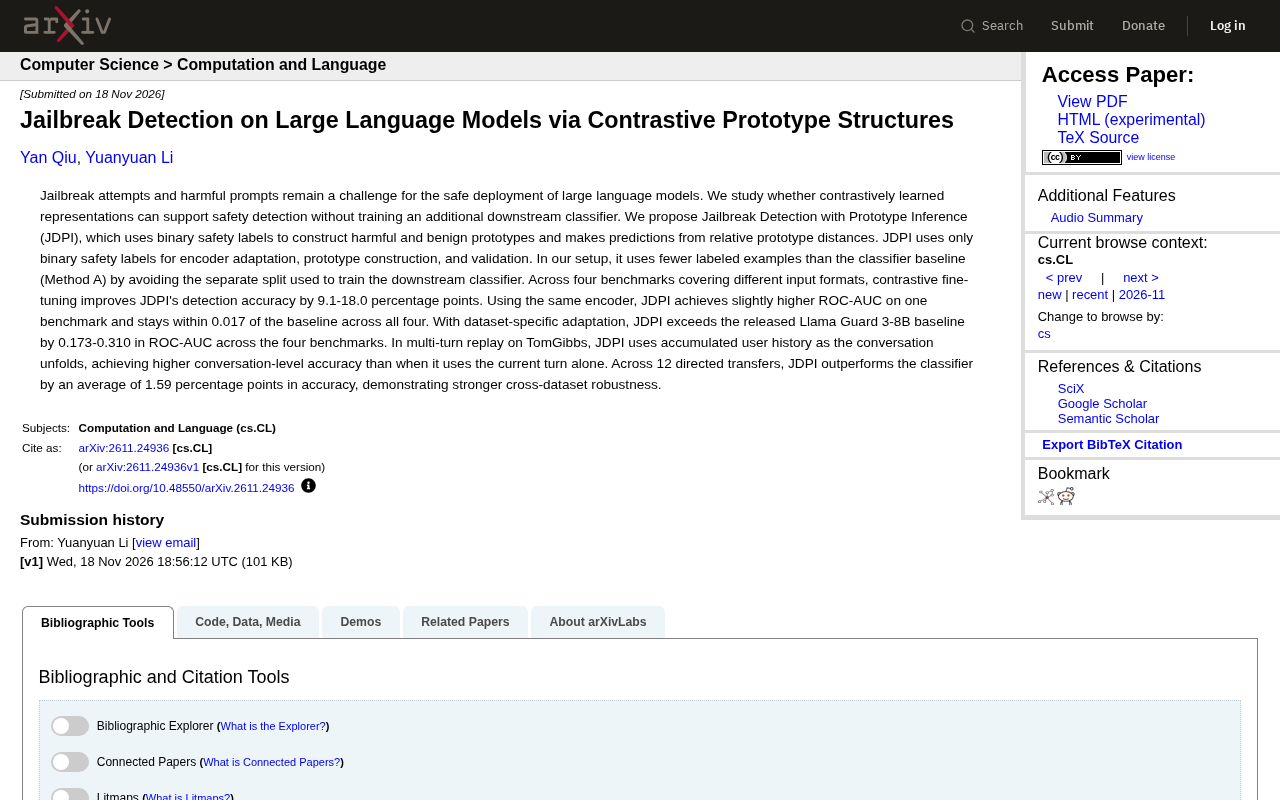
JDPI is a new LLM jailbreak detection method that abandons the traditional "encoder + downstream classifier" paradigm and instead uses binary safety labels to build harmful and benign prototypes, making judgments by comparing the relative distance between input representations and the two prototypes. It requires only binary labels to complete encoder adaptation, prototype construction, and validation, can use more samples under the same labeling budget, and contrastive fine-tuning brings accuracy gains of 9.1-18.0 percentage points. Experiments show its ROC-AUC gap with the classifier baseline is within 0.017; after dataset adaptation it surpasses Llama Guard 3-8B by 0.173-0.310, and it shows stronger robustness in multi-turn conversation history accumulation and 12 transfer tasks.
Jailbreak attacks and harmful prompts against large language models (LLMs) remain persistent challenges for safe deployment. Conventional approaches typically rely on training an additional downstream classifier to identify malicious inputs, but this requires large amounts of labeled data and offers limited generalization. A recent paper proposes a new method called JDPI (Jailbreak Detection with Prototype Inference) that performs jailbreak detection through contrastive representation learning and prototype reasoning, without training an extra classifier. The method performs strongly across multiple benchmarks and even surpasses baselines such as Llama Guard 3-8B.
Core Idea: Replacing the Classifier with Prototype Distance
JDPI's key innovation is abandoning the traditional two-stage "encoder + classifier" paradigm. It uses binary safety labels to construct two prototypes: a harmful prototype and a benign prototype. For each input, the encoder maps it into representation space, and predictions are made by comparing the relative distance between that representation and the two prototypes. If the input is closer to the harmful prototype, it is judged a jailbreak attempt; otherwise, it is treated as benign.
This approach requires only binary safety labels to complete encoder adaptation, prototype construction, and validation, avoiding the extra data split needed to train a downstream classifier. As a result, under the same labeling budget, JDPI can use more samples for training. The paper notes that compared with the classifier baseline (Method A), JDPI uses fewer labeled samples yet achieves higher detection accuracy.
Prototype Inference is a classification paradigm based on metric learning, with roots in Prototypical Networks from few-shot learning. Unlike traditional classifiers that must learn a decision boundary, prototype methods average the support samples of each class in representation space to obtain class prototypes; at prediction time, they compute the distance from the query sample to each prototype (usually Euclidean or cosine distance) and assign it to the class of the nearest prototype. This turns "classification" into "distance comparison," so the model only needs to learn a good representation space rather than training an additional classification head. In JDPI, there is one prototype each for the harmful and benign classes, and contrastive fine-tuning of the encoder aims to make same-class samples cluster together and different-class samples separate in representation space, thereby increasing the distance between the two prototypes and improving discriminative robustness. Prototype methods are naturally lightweight and interpretable, and they also make it easy to incrementally update prototypes when new samples arrive.
Contrastive Fine-Tuning Brings Significant Gains
The paper evaluates JDPI on four benchmarks covering different input formats. Experiments show that contrastive fine-tuning improves JDPI's detection accuracy by 9.1 to 18.0 percentage points. This magnitude of improvement indicates that adjusting the encoder representation through contrastive learning can more effectively capture discriminative features between harmful and benign inputs.
Interestingly, even with the same encoder, JDPI's ROC-AUC on one benchmark is slightly higher than the classifier baseline, and the gap across all four benchmarks is within 0.017. This means JDPI maintains performance comparable to the classifier while significantly reducing the need for labeled data and model complexity.
Contrastive Learning is a class of self-supervised/supervised methods that learn discriminative representations by constructing positive and negative sample pairs, with representative works including SimCLR and SupCon. Its core is to pull positive pairs closer in representation space and push negative pairs farther apart, commonly implemented with InfoNCE or contrastive loss. In JDPI, contrastive fine-tuning uses binary safety labels to construct positive and negative pairs: same-class pairs (harmful-harmful or benign-benign) are treated as positive pairs, and different-class pairs as negative pairs, thereby adjusting the encoder so that harmful and benign representation clusters are more separable. This explains the 9.1-18.0 percentage point improvement in the paper—contrastive fine-tuning directly optimizes the representation geometry on which prototype distance depends, rather than merely performing ordinary cross-entropy fine-tuning. It is worth noting that contrastive learning is sensitive to temperature coefficients, batch size, and data pairing strategies, and these hyperparameters affect the tightness of representation clustering.
Surpassing Llama Guard 3-8B
After adaptation to specific datasets, JDPI's ROC-AUC on the four benchmarks is 0.173 to 0.310 higher than the open-source Llama Guard 3-8B baseline. Llama Guard 3-8B is a safety classification model released by Meta and is generally regarded as a strong baseline for jailbreak detection. That JDPI can achieve such a large lead in a more lightweight manner suggests that prototype reasoning has unique advantages for safety detection tasks.
Llama Guard 3-8B is a safety guardrail model released by Meta alongside the Llama 3 series, an input-output content moderation model fine-tuned from Llama 3.1-8B instruction-tuned. It uses a classification-like prompt format and outputs a "safe/unsafe" label along with the corresponding hazard category (such as violence, hate, self-harm, etc.), covering standard hazard taxonomies such as MLCommons. Because it is fine-tuned from an 8B-parameter large model, Llama Guard has strong semantic understanding and zero-shot generalization ability and is often used as an out-of-the-box strong baseline. However, its inference cost is higher and latency is greater. JDPI achieves higher ROC-AUC with a lighter encoder plus prototype distance, indicating that in specific dataset adaptation scenarios, parameter count is not the determining factor for detection performance; at the same time, note that Llama Guard is a general zero-shot baseline, whereas JDPI has been adapted to the target dataset, so the comparison should be understood in light of the deployment scenario.
Cumulative Historical Advantage in Multi-Turn Conversations
Jailbreak attacks often occur in multi-turn conversations, where attackers gradually guide the model to break safety restrictions. JDPI uses accumulated user history as context when the conversation unfolds. In multi-turn replay experiments on the TomGibbs dataset, its conversation-level accuracy is higher than methods that use only the current turn. This indicates that incorporating historical information into prototype distance calculation can more effectively identify progressive jailbreak behavior.
Stronger Cross-Dataset Robustness
Across 12 targeted transfer tasks, JDPI's accuracy is on average 1.59 percentage points higher than the classifier baseline, showing stronger cross-dataset robustness. This advantage may stem from the constraints the prototype method imposes on representation space, allowing it to maintain stable discriminative ability under different data distributions.
ROC-AUC (Area Under the Receiver Operating Characteristic Curve) is a metric for the overall performance of a binary classifier, ranging from 0 to 1, representing the probability that when one positive sample and one negative sample are randomly drawn, the model scores the positive sample higher than the negative sample. Compared with accuracy, ROC-AUC does not depend on a specific threshold and can comprehensively evaluate the model's ranking ability across different decision thresholds, making it more informative for tasks such as jailbreak detection where positive and negative samples may be imbalanced and thresholds need to be adjusted by scenario. An AUC of 0.5 is equivalent to random guessing, and values closer to 1 are better. The gaps mentioned in the paper, such as 0.017 and 0.173-0.310, are all measured by ROC-AUC and reflect JDPI's overall discriminative advantage under different threshold settings. Note that a high AUC does not directly equate to business performance at a fixed threshold; in actual deployment, an appropriate threshold still needs to be chosen by considering both false positive and false negative rates.
Limitations and Outlook
JDPI currently relies on binary safety labels, and prototype construction requires a certain amount of labeled data. Future work could explore semi-supervised or self-supervised approaches to further reduce labeling requirements. In addition, the adaptability of prototype methods to novel jailbreak attacks remains to be verified.
Overall, JDPI provides a new path for LLM safety detection that does not rely on an additional classifier. By combining contrastive learning with prototype reasoning, it strikes a balance among accuracy, efficiency, and robustness. For researchers and engineers concerned with AI safety, this method is worth exploring in depth.
One-line Summary
JDPI uses contrastive learning to build harmful/benign prototypes and performs jailbreak detection via prototype distance, without an additional classifier.
Paragraph Summary
JDPI is a new LLM jailbreak detection method that abandons the traditional two-stage "encoder + downstream classifier" paradigm and instead uses binary safety labels to construct two prototypes, harmful and benign, making judgments by comparing the relative distance between the input representation and the two prototypes. The method requires only binary labels to complete encoder adaptation, prototype construction, and validation, can use more samples under the same labeling budget, and contrastive fine-tuning brings accuracy improvements of 9.1-18.0 percentage points. Experiments show that its ROC-AUC gap with the classifier baseline is within 0.017; after dataset adaptation it surpasses Llama Guard 3-8B by 0.173-0.310, and it shows stronger robustness in multi-turn conversation history accumulation and 12 transfer tasks.
Related articles

From 0 to 1: Vibe Coding an AI Knowledge Base — A Practical Retrospective and Tech Stack Breakdown
A retrospective on building the AI knowledge base OilBook from scratch with Vibe Coding: Next.js+Neon stack, Oil Dev Skill workflow, Stripe paywall security, interview-style writing, AI-flavor control, and Vercel deployment.

GLM-5.4 Hands-On: Native Vision Meets a New Vibe Coding Workflow
Hands-on with Zhipu GLM-5.4: native vision tested across a 3D product demo, pure-code video generation, and remote-control Vibe Coding, compared with GPT-6.2 and Gemini Neon.

AI and Humans Claim to Prove the Riemann Hypothesis: Machine-Verified, Yet Nobody Can Understand It
Anthropic mathematician and AI Claude claim to prove the Riemann Hypothesis with 17 million lines of Lean code, machine-verified but unreadable by humans. This article analyzes the event, the zero proportion record from 41.6% to 67.2%, and the gap between machine verification and human understanding.