CoopUQ: Uncertainty-Aware Multi-Robot Collaborative Navigation

CoopUQ uses uncertainty-aware collaborative occupancy prediction to constrain reinforcement learning, improving multi-robot navigation safety.
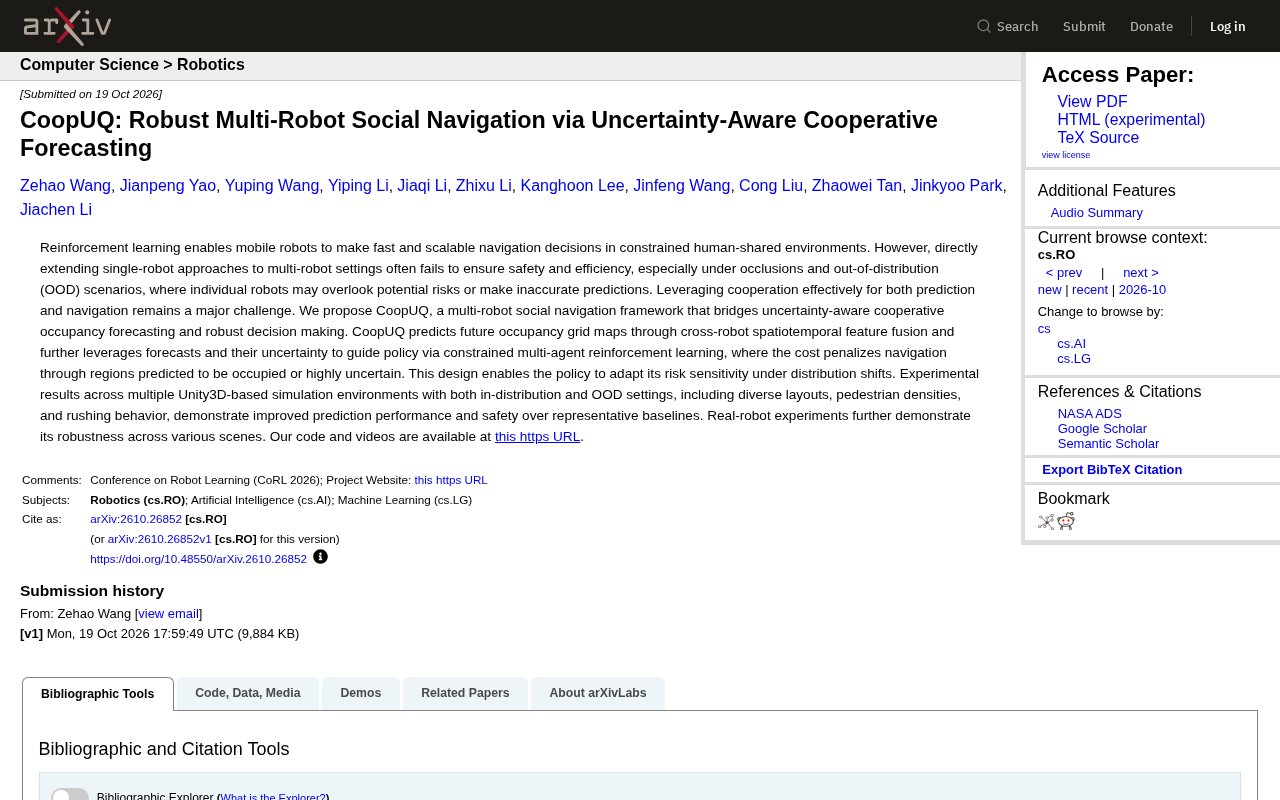
CoopUQ is a collaborative framework for multi-robot social navigation that addresses the safety shortcomings of single-agent reinforcement learning policies in occlusion and out-of-distribution scenarios. Its core design includes two coupled modules: a cross-robot spatiotemporal feature fusion occupancy prediction network that integrates multi-view local maps via attention while outputting prediction uncertainty, and mapping uncertainty into reinforcement learning cost constraints so the policy automatically adopts conservative behavior when information is insufficient. In Unity3D simulations and real-robot experiments, CoopUQ outperforms baselines in prediction accuracy and navigation safety, demonstrating risk sensitivity adaptation under distribution shift. The work elevates uncertainty from auxiliary information to a first-class citizen of decision-making, offering a tightly-coupled new approach for multi-robot collaborative navigation.
Multi-robot systems navigating in human-shared environments are moving from single-agent intelligence toward collaborative intelligence. However, directly applying single-robot reinforcement learning solutions often exposes safety shortcomings in occlusion and out-of-distribution (OOD) scenarios. The recently proposed CoopUQ framework attempts to bridge the gap between prediction and decision-making using "uncertainty-aware collaborative occupancy prediction."
Problem Background: Why Single-Agent Policies Fail in Multi-Robot Scenarios
Single-robot navigation policies typically assume that dynamic obstacles (such as pedestrians) in the environment can be fully observed by the robot's own sensors. However, in multi-robot collaboration scenarios, mutual occlusion between robots, communication delays, and the limitations of local viewpoints mean that each individual can only obtain partial truth about the environment.
When multiple robots run their own policies simultaneously, prediction errors amplify each other. If a robot cannot perceive a pedestrian occluded by a teammate, it may make risky path choices; and if each robot independently underestimates risk, the overall system may experience collisions or deadlocks in crowded areas. The original paper points out that this problem is particularly prominent in OOD scenarios (such as unseen layouts, sudden increases in pedestrian density, or abrupt pedestrian behavior).
The core contradiction is: the information redundancy brought by multiple robots should improve prediction accuracy, but without an effective collaboration mechanism, redundant information may instead introduce inconsistent predictions and increase decision-making risk.
Out-of-distribution (OOD) scenarios refer to situations where the test data distribution differs significantly from the training data distribution. In robot navigation, common distribution shifts include: environment layouts not seen during training, pedestrian densities far exceeding the training range, and sudden changes in pedestrian motion patterns (such as sudden running or stopping). Deep reinforcement learning policies perform well in-distribution, but when faced with OOD inputs, neural networks have limited extrapolation capability and tend to output high-confidence yet incorrect predictions, leading to dangerous decisions. Therefore, OOD generalization capability is a key dimension for measuring navigation policy safety, and it is also the direct motivation for CoopUQ's introduction of uncertainty estimation.
CoopUQ's Core Design: Bidirectional Coupling of Prediction and Decision-Making
The CoopUQ framework revolves around two key modules: cross-robot spatiotemporal feature fusion prediction, and uncertainty-driven constrained reinforcement learning policies.
Collaborative Occupancy Prediction: Fusing Multi-View Spatiotemporal Features
Each robot maintains a local occupancy grid map and extracts temporal features. CoopUQ uses a cross-robot feature fusion network to align and integrate local maps observed by different robots, outputting future occupancy grid predictions.
This fusion is not simple averaging or concatenation, but a learned attention mechanism—robots adaptively weight the information provided by teammates based on the confidence of their own viewpoints. The original paper emphasizes that this design aims to simultaneously improve prediction accuracy and the quality of prediction uncertainty estimation.
Occupancy Grid Map is an environment representation method that discretizes the environment into a 2D grid, where each cell stores the probability or state of that location being occupied by an obstacle. In dynamic scenarios, temporal occupancy prediction further utilizes historical frame information to infer the occupancy state of each cell at future time steps. Compared to raw sensor point clouds, occupancy grid maps have the advantages of regular structure, ease of processing by convolutional networks, and cross-robot alignment, making them a commonly used intermediate representation in multi-robot collaborative perception. CoopUQ uses local occupancy grid maps as input and extracts dynamic features through temporal models.
Uncertainty as a Decision Constraint
The prediction module not only outputs "where will be occupied" but also outputs the prediction uncertainty for each grid cell location. CoopUQ maps these uncertainties into cost penalties in reinforcement learning: when planning paths, the policy considers both "areas predicted to be occupied" and "areas predicted with high uncertainty."
This means the robot does not blindly pursue the shortest path, but learns to adopt conservative strategies when information is insufficient. This risk sensitivity is adjustable—in in-distribution scenarios, the policy can be more aggressive; in OOD scenarios, increased uncertainty automatically triggers more conservative behavior.
Constrained Reinforcement Learning introduces constraints on certain costs beyond the standard reinforcement learning objective of "maximizing cumulative reward," typically formalized as optimizing reward subject to expected cost being below a threshold. This framework is suitable for safety-critical scenarios: behaviors such as collisions and entering high-risk areas are defined as costs, and the policy learns to trade off between reward and cost. CoopUQ maps prediction uncertainty into additional cost penalties, essentially treating "insufficient information" as a risk source to be avoided, thereby allowing the policy to automatically become conservative near uncertain regions.
Experimental Validation: Consistent Evidence from Simulation and Real Robots
CoopUQ was evaluated in multiple Unity3D-based simulation environments, covering in-distribution and OOD settings, including different layouts, pedestrian densities, and abrupt pedestrian behaviors. Compared with representative baselines, CoopUQ shows improvements in both prediction performance and navigation safety.
Real-robot experiments further validated its robustness across various scenarios. The research team open-sourced the code and demonstration videos, and the project page provides detailed experimental configurations and results.
It is worth noting that the original paper specifically mentions "risk sensitivity adaptation under distribution shift"—this suggests that CoopUQ's value lies not only in average performance improvement but also in coverage of edge cases. The safety bottlenecks of multi-robot systems often appear in long-tail scenarios, and uncertainty awareness provides an interpretable degradation mechanism.
Implications for Multi-Robot Navigation
CoopUQ's approach points to a broader trend: elevating prediction uncertainty from "optional supplementary information" to "a first-class citizen of decision-making." In single-robot systems, uncertainty is typically used for fault detection or sensor fusion; in multi-robot collaboration, uncertainty becomes a natural signal for coordinating risk and efficiency.
Another noteworthy design is the tight coupling of collaborative prediction and reinforcement learning. Many existing works train prediction and planning separately and then concatenate them at inference time; CoopUQ jointly optimizes both through cost constraints, enabling the policy to dynamically adjust behavior based on prediction quality. This coupling approach may be generalizable to more complex multi-agent tasks, such as collaborative transport or search and rescue.
Of course, practical deployment of the framework still faces engineering challenges such as communication bandwidth, heterogeneous robot teams, and dynamic topologies. But CoopUQ provides a clear starting point: using uncertainty-aware collaborative prediction to build more reliable safety boundaries for multi-robot social navigation.
For more details, visit the project page: https://coopuq.github.io/
Tight coupling vs. loose coupling are two typical paradigms for the relationship between prediction and planning in multi-robot systems. In the loosely coupled approach, prediction and planning modules are trained independently and called sequentially at inference time; prediction errors cannot be fed back to the planner, and the planner cannot adjust behavior based on prediction quality. Tight coupling embeds prediction outputs (including uncertainty) directly into the decision optimization objective for joint training, enabling the policy to perceive prediction reliability and dynamically adjust risk preferences. CoopUQ's cost-constrained coupling belongs to the latter, with the advantage that the policy can automatically degrade to conservative behavior under distribution shift, but at the cost of higher training complexity and more sensitive inter-module interface design.
One-line Summary
CoopUQ uses uncertainty-aware collaborative occupancy prediction to constrain reinforcement learning, improving multi-robot navigation safety.
Paragraph Summary
CoopUQ is a collaborative framework for multi-robot social navigation, designed to address the safety shortcomings of single-agent reinforcement learning policies in occlusion and out-of-distribution scenarios. Its core design comprises two coupled modules: first, a cross-robot spatiotemporal feature fusion occupancy prediction network that integrates multi-view local maps through attention mechanisms while outputting both predicted occupancy and prediction uncertainty; second, mapping uncertainty into reinforcement learning cost constraints so that the policy automatically adopts conservative behavior when information is insufficient. In Unity3D simulations and real-robot experiments, CoopUQ outperforms baselines in both prediction accuracy and navigation safety, and demonstrates risk sensitivity adaptation under distribution shift. This work elevates uncertainty from auxiliary information to a first-class citizen of decision-making, providing a new tightly-coupled approach for multi-robot collaborative navigation.
Related articles

Chain of Thought Isn't Just for AI: How Humans Can Use CoT to Improve Thinking Quality
Chain of Thought isn't just a prompt trick for large models. Starting from a Hacker News discussion, this article analyzes why CoT works for human thinking too, breaks down actionable ways to transfer it, and highlights the key differences between human CoT and machine CoT.
Cloudflare Teams Up with OpenAI: Closi…
Cloudflare Teams Up with OpenAI: Closing the Loop from Vulnerability Discovery to Defense with AI
Cloudflare uses OpenAI Daybreak to investigate security vulnerabilities and generate reviewable remediation plans, while developers use Codex to boost coding efficiency and quality.

Orca Multi-Agent Orchestration in Practice: A Guide to Parallel Collaboration with Claude and Codex
Orca is Stable AI's free open-source agent workbench supporting 34 agents like Claude Code and Codex in parallel. Learn its Git worktree isolation, multi-model orchestration, and mobile management.