CoreWeave Bond Yield Tops 16%, Signaling Credit Stress in AI
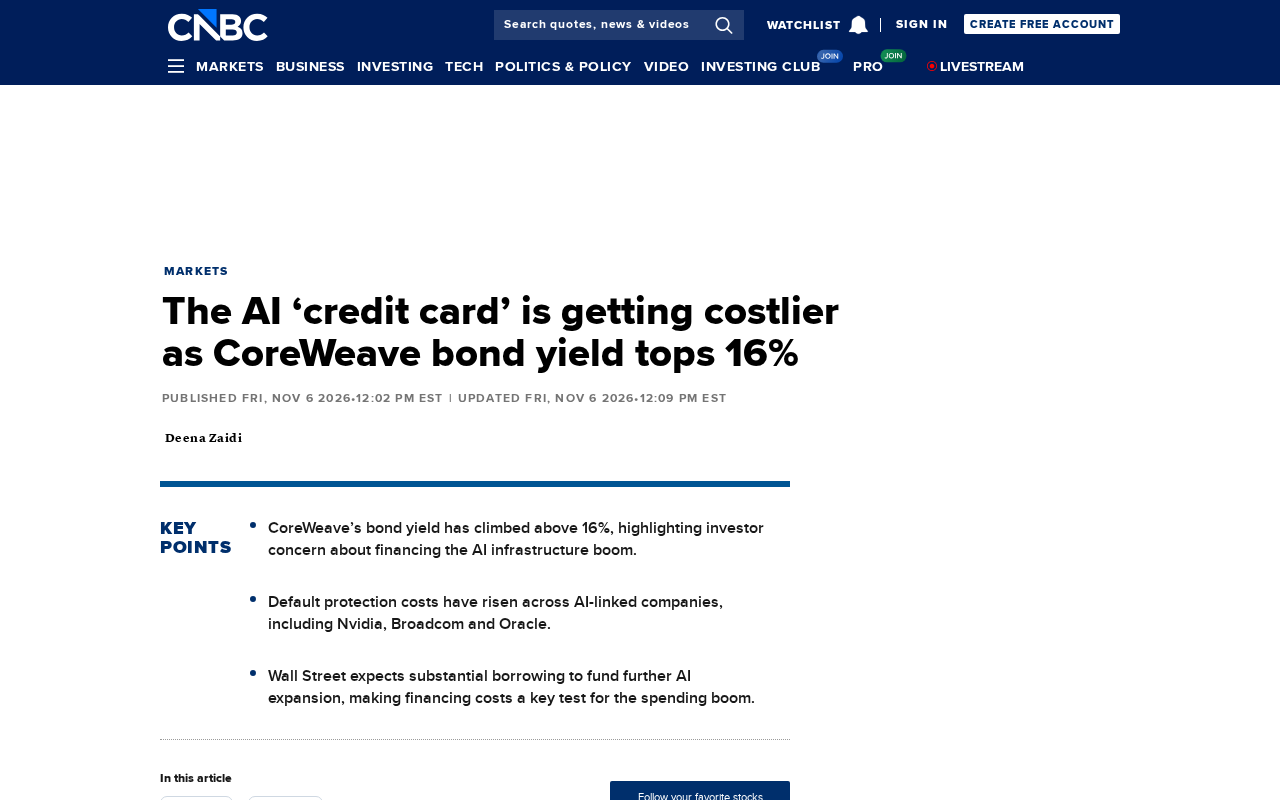
CoreWeave bond yield tops 16%, warning of AI infrastructure credit risk revaluation.
CoreWeave's bond yield surpassing 16% has drawn market attention to credit stress in the AI industry. The article notes that a 16% yield means investors are demanding extremely high risk compensation—far above normal high-yield levels—signaling concerns about CoreWeave's debt-servicing capacity and the sustainability of the AI compute leasing model. Rising financing costs directly compress margins for debt-dependent compute leasers. The article analyzes how capex growth outpacing revenue realization, fast GPU depreciation, asset value uncertainty, and price wars together elevate credit risk. Bond markets often reflect credit risk earlier than stocks, and this yield spike can be seen as a stress test on the AI sector. If financing costs remain elevated, the industry may face slower expansion, consolidation, and business model reassessment.
Introduction
CoreWeave, a star company in the AI infrastructure space, has seen its bond yield recently surpass 16%, drawing market attention to credit stress in the AI industry. This signal comes from a discussion on Hacker News—though the original thread didn't gain much traction, the shift in cost of capital it reflects is worth examining closely.
What a Surging Bond Yield Means
Bond yields move inversely to prices. A CoreWeave bond yield above 16% indicates that investors are demanding extremely high risk compensation to hold its debt. In a normal market environment, investment-grade corporate bond yields typically sit in the single digits, and even high-yield (junk) bonds rarely sustain levels above 16% for long. This level suggests significant market concern about CoreWeave's debt-servicing capacity or the sustainability of the AI compute leasing model.
High yields directly drive up the company's financing costs. For compute leasers that rely on debt expansion to purchase GPUs and build data centers, rising capital costs compress profit margins and can even affect the pace of expansion.
Bond Yields and Credit Spreads: A bond yield can be broken down into two components: the risk-free rate and the credit spread. The credit spread is the additional compensation investors demand for bearing the issuer's default risk, typically measured in basis points (1 bp = 0.01%). If CoreWeave's bond yield exceeds 16% while the U.S. Treasury yield is around 4% at the same time, that implies a credit spread of over 1,000 basis points—far above the 300–500 bp level typical of high-yield bonds. This spread level usually appears when an issuer has been downgraded to CCC or below, or when the market has serious doubts about its short-term solvency. A sharp widening of credit spreads often precedes formal rating agency action, serving as an early warning signal from the credit market about deteriorating issuer fundamentals.
The Macro Backdrop of AI Credit Stress
CoreWeave is not an isolated case. Under the AI boom, massive capital has flowed into compute infrastructure, but the pace of revenue realization doesn't match the growth rate of capital expenditure. Investors are beginning to reassess AI companies' credit risk: on one hand, GPU depreciation cycles are short and technology iterates quickly, creating uncertainty around asset values; on the other hand, competition in the compute leasing market is intensifying, and price wars could erode profit margins.
Bond markets often reflect credit risk earlier than stock markets. The jump in CoreWeave's bond yield can be seen as a stress test signal from the credit market for the AI sector.
GPU Depreciation and Asset Specificity Risk: As the core asset of compute leasers, GPUs have an economic lifespan far shorter than traditional data center equipment. Nvidia GPU architectures iterate roughly every two years, and new generations typically offer significant improvements in energy efficiency and compute power, causing rental prices for older GPUs to decline rapidly. Moreover, GPUs are highly specific assets with limited secondary market liquidity and significant discounts in liquidation value. This means that for debt financing secured by GPUs, the collateral value may decay faster than the debt amortization schedule, further amplifying creditors' recovery risk. This asset characteristic is key context for understanding market concerns about compute leasers' creditworthiness.
Potential Impact on the AI Industry
If AI companies' debt financing costs continue to rise, the industry may face several changes:
- Slower expansion: Compute leasers reliant on leverage may delay or scale back new data center plans.
- Industry consolidation: Financially weaker players may be acquired or exit, intensifying the winner-take-all dynamic.
- Business model scrutiny: Investors will focus more on AI companies' cash flow and path to profitability rather than growth narratives alone.
The High-Yield Market and AI Infrastructure Financing: In recent years, AI infrastructure companies like CoreWeave have raised substantial funding through the high-yield bond and asset-backed securities (ABS) markets, securitizing GPU purchase contracts and data center leases as underlying assets. The pricing of these structured financing products depends heavily on the cash flow stability of the underlying assets. When bond yields jump, it not only affects new issuance pricing but may also trigger financial covenant provisions in existing financing agreements—such as interest coverage ratios or leverage caps—thereby limiting the company's ability to take on further debt. The refinancing window in the high-yield market is critical for issuers; if yields remain elevated for an extended period, refinancing maturing debt will face significant difficulties. This transmission mechanism cannot be overlooked when assessing AI companies' liquidity risk.
Conclusion
CoreWeave's bond yield surpassing 16% is a warning signal worth heeding. It reminds us that the capital feast of the AI narrative is not without cost, and that credit market pricing is conveying a message of risk revaluation for AI infrastructure companies. Going forward, attention should be paid to the company's financing progress and the debt performance of peers in the industry.
One-line Summary
CoreWeave bond yield tops 16%, warning of AI infrastructure credit risk revaluation.
Paragraph Summary
CoreWeave's bond yield surpassing 16% has drawn market attention to credit stress in the AI industry. The article notes that bond yields move inversely to prices, and a 16% yield means investors are demanding extremely high risk compensation—far above normal high-yield levels—signaling concerns about CoreWeave's debt-servicing capacity and the sustainability of the AI compute leasing model. Rising financing costs will directly compress profit margins for compute leasers dependent on debt-fueled expansion. The article analyzes that under the AI boom, capex growth outpaces revenue realization, while fast GPU depreciation, uncertain asset values, and intensifying price wars together elevate credit risk. Bond markets often reflect credit risk earlier than stock markets, and this yield spike can be seen as a stress test from the credit market on the AI sector. If financing costs remain elevated, the industry may face slower expansion, increased consolidation, and a reassessment of business models.
Related articles

Watching Movies in the Terminal: Building an SSH Streaming Service with Codex Multi-Agent Workflow
A creator uses Codex multi-agent workflow to build an SSH-accessible streaming service in the terminal, with planning, cloud async dev, AI-drawn scenes, and synced live channels.

AI Face Licensing: A New Micro-Drama Trend or a Hollywood Trap?
Actors are licensing their faces to micro-drama startups for AI digital doubles to perform. Popular in China, the model raises concerns in Hollywood over lost control and diluted bargaining power.

Amazon's First Digital Photo Frame Is 50% Off for Black Friday: Is the Alexa Frame Worth Buying?
Amazon's first digital photo frame, the Alexa Photo Frame, is nearly 50% off for Black Friday, with prices starting at $114. We analyze why this new product dropped in price just one month after launch, its positioning, who it's for, and buying advice.