Corridor Raises $25M Seed Round Targeting the SMB Health Benefits Brokerage Market

Corridor raises $25M seed to bring tech-enabled health benefits brokerage to underserved small businesses.
American small businesses have long struggled to access quality health benefits guidance — traditional brokers have little incentive to serve small accounts with low commission potential, leaving SMB owners to navigate complex decisions alone. Corridor is targeting this structural gap with a $25M seed round, aiming to use technology to lower the marginal cost of serving smaller clients and turn previously unprofitable long-tail accounts into a sustainable business. While the market opportunity is real and the digital transformation of benefits brokerage is still early, Corridor faces meaningful challenges around compliance infrastructure, carrier relationships, and unit economics that will determine whether the model can truly scale.
Corridor's Market Entry Point
The health benefits brokerage industry has long had a structural blind spot: small and medium-sized businesses (SMBs) are routinely overlooked by traditional brokers. The reason is straightforward — smaller accounts generate far lower commissions than large clients, giving traditional brokers little incentive to serve this segment. Corridor is capitalizing on exactly this pain point, announcing a $25 million seed round to build a health benefits brokerage designed specifically for SMBs.
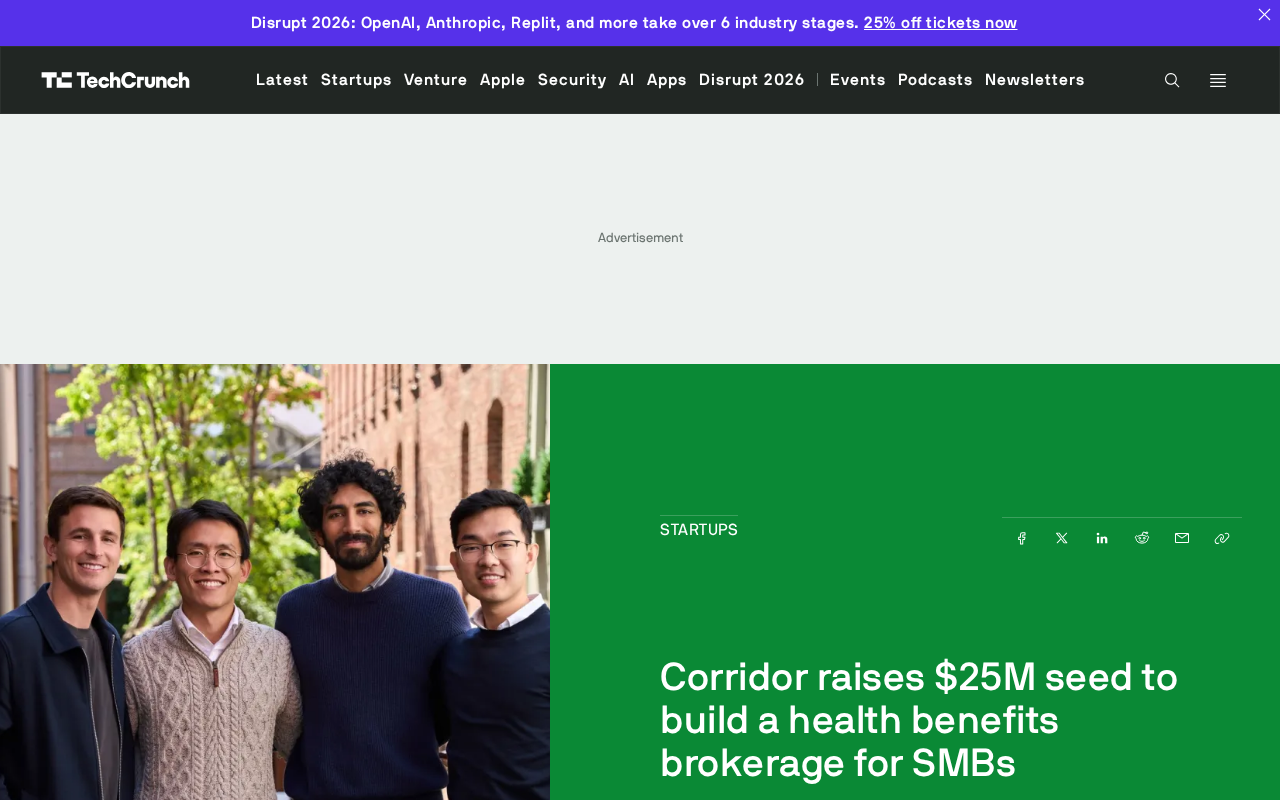
For the majority of American small business owners, purchasing and managing employee health benefits is a complex, time-consuming endeavor. Yet the traditional brokerage business model naturally steers resources toward large enterprise accounts that yield higher commissions, leaving SMBs chronically underserved. Corridor aims to fill this gap with a more efficient brokerage model built around the specific needs of smaller businesses.
Why Traditional Brokers Ignore SMBs
Corridor points to commission structure as the core of the problem. Traditional health benefits brokers earn revenue tied closely to account size, and the returns from small accounts simply can't justify the time and effort required to service them. As a result, small businesses lack professional guidance when selecting and managing health benefits, often left to navigate the process on their own or settle for suboptimal plans.
This structural mismatch creates an opening for new entrants. If technology can reduce the marginal cost of serving an SMB, accounts that were previously "not worth it" could become economically viable. This is the same thesis that has driven a wave of fintech and insurtech companies targeting SMBs in recent years — using scale and automation to redefine long-tail markets that large institutions have abandoned.
In the United States, health benefits brokers typically earn revenue through insurer-paid commissions or fee-based arrangements. For group health insurance, commissions are generally calculated as a percentage of premiums — usually 3% to 8% — meaning the absolute dollar amount is lower for smaller accounts. Yet the communication, paperwork, and compliance work required to service a 10-person company isn't dramatically different from servicing a 500-person company. This "high fixed costs, low revenue ceiling" dynamic makes serving businesses with fewer than 50 employees nearly unprofitable for traditional brokers. Meanwhile, the Affordable Care Act (ACA) has steadily tightened employer compliance requirements, raising the bar further and making it even harder for SMBs to manage benefits without professional guidance.
What a $25M Seed Round Signals
A $25 million seed round is significant by any measure, and it reflects investor conviction in this niche. Health benefits are a meaningful component of employee compensation packages, and the need to purchase and manage them is real and recurring. SMBs exist in enormous numbers, and if Corridor can develop a repeatable service model, the addressable market is substantial.
Broader industry trends support the thesis: the digitization of benefits administration and insurance brokerage is still in its early stages. Traditional processes rely heavily on manual communication and paper documentation. A new generation of platforms — offering software-driven quoting, plan comparison, enrollment, and claims management — has the potential to dramatically improve the experience for small business owners.
It's worth noting that the tech-enabled health benefits brokerage space already has several established players, including Gusto, Rippling, and Justworks, all of which have integrated health benefits management into broader HR and payroll platforms. Corridor's seed round size suggests it is positioning closer to a "pure-play" brokerage model rather than one embedded within an HR software ecosystem. Its core competitive advantage likely lies in deeper insurance product comparison, carrier relationships, and compliance services — rather than using payroll or other high-frequency features as a growth driver. The upside of this approach is focus; the downside is that customer acquisition costs and integration with existing HR tools become critical variables. The relatively large seed round also suggests the model may require significant investment in licensing and compliance, underwriting teams, or subsidized early pricing to build an initial customer base — beyond what a pure software product would demand.
Challenges and Outlook
Despite a clear market entry point, Corridor faces real challenges. Health benefits brokerage is an industry that runs on compliance, relationships, and trust. New entrants must build credible networks spanning insurers, regulators, and business clients. At the same time, maintaining healthy unit economics while serving a long-tail customer base is the defining test of whether this kind of model can scale.
For small business owners, a brokerage platform that genuinely understands their needs and delivers professional-grade service at a reasonable cost is genuinely appealing. Whether Corridor can deliver on that promise will depend on execution — product maturity and customer growth will ultimately tell the story. For now, this funding round at least gives the company the capital it needs to get started.
Related articles

Workbuddy for Absolute Beginners: How a Desktop AI Agent Fits Into Real Workflows
A beginner's guide to the Workbuddy desktop AI agent: installation, claiming credits, file management, and building automated workflows—compared with CodeX for fit and cost, helping professionals shift from AI question-askers to AI managers.

OpenAI's New Agent Stack: Computer Use, Decisions API, and Ultra-Fast Workflows
OpenAI Dev Day unveiled a new agent stack: Computer Use outperforms humans, Decisions API delivers ultra-low-latency classification via Luna, Agents API opens the same Computer Use capabilities, and GPT-6.1 Sol costs only one-seventh of Astra. Core updates, benchmark data, and developer insights.

Liang Wenfeng Open-Sources DeepInfo Inference Framework, Takes On U.S. Ban
DeepSeek open-sources its DeepInfo inference framework after its models, featuring GPU/CPU cross-pipelining, small-model prediction with large-model verification, and full Huawei Ascend and NVIDIA chip support—facing the U.S. federal ban head-on. This article analyzes its significance for AI deployment and open-source strategy.