Cost Comparison of 33 AI Image Generation Models: A 100x Price Gap

A community benchmark reveals a 100x cost gap across 33 AI image generation APIs, from $0.0025 to $0.25 per image.
A Reddit community member benchmarked 33 AI image generation APIs, revealing a 100x price gap between the cheapest (Flux Fast Schnell at $0.0025/image) and most expensive (Recraft 4 Pro at $0.25/image). The report covers new entrants like ByteDance Seedream, Gemini 3.1 Flash Lite Image, and GPT Image 1.5, and emphasizes that latency, quality, and rate limits matter just as much as unit cost when choosing a model.
33 Models Tested: The Real Cost Gap in AI Image Generation APIs
With the explosive growth of AI image generation models, developers and enterprises face an unavoidable question when evaluating options: why does one text-to-image model cost just fractions of a cent per image, while another runs nearly 20 cents?
Recently, a Reddit community member published a cost benchmark report covering 33 mainstream AI image generation models. This continuously updated list covers established models while incorporating notable newcomers — including ByteDance's Seedream series, Gemini 3.1 Flash Lite Image, and GPT Image 1.5. For teams evaluating image generation APIs for their projects, this is a highly informative cross-model comparison.
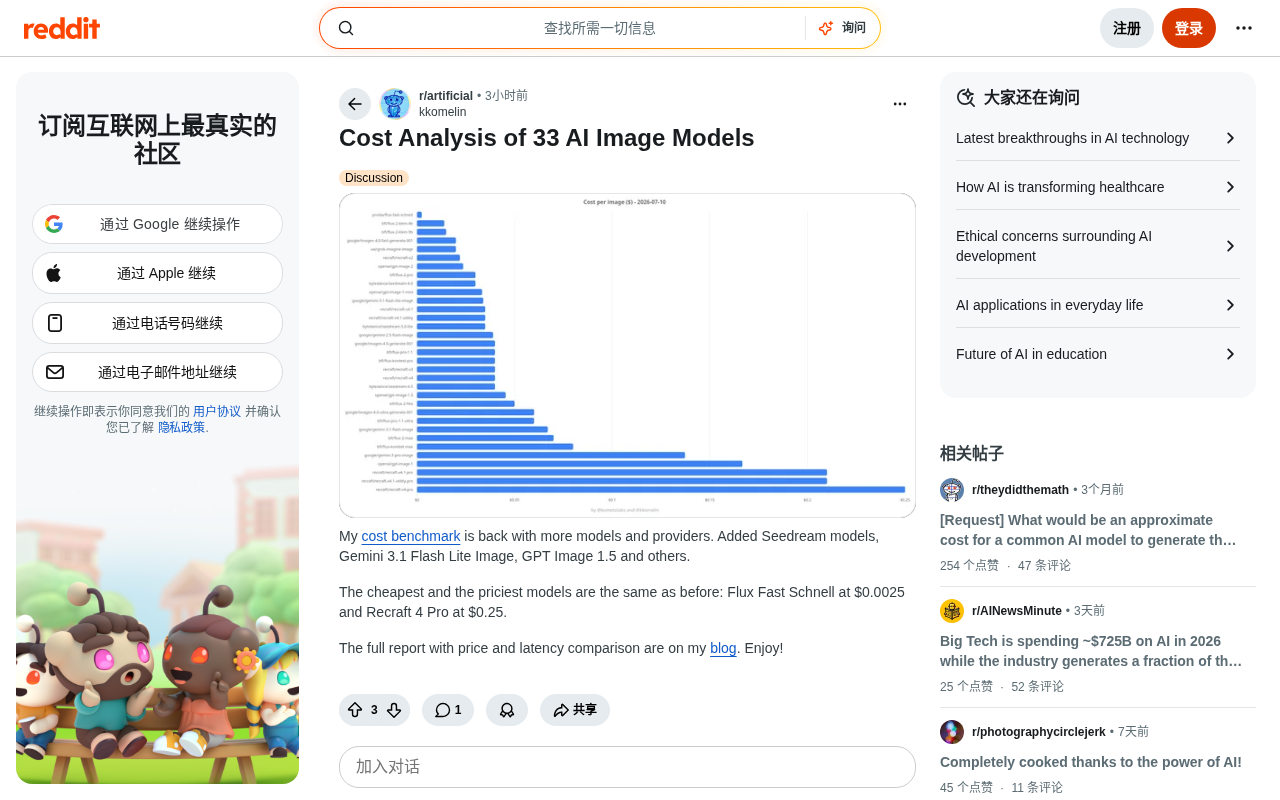
A 100x Price Gap: From $0.0025 to $0.25
The most striking finding in the report is the enormous disparity in per-image cost across models.
- Cheapest model: Flux Fast Schnell at just $0.0025 per image
- Most expensive model: Recraft 4 Pro at $0.25 per image
That's a jaw-dropping 100x difference. To put it in perspective: if your application generates 100,000 images per day, Flux Fast Schnell would cost roughly $250/day, while Recraft 4 Pro would run $25,000/day — a difference of nearly $9 million per year.
There's a clear technical logic behind this hundredfold pricing gap. AI image generation API pricing is driven by multiple factors: model parameter count (professional models often reach billions of parameters), the number of sampling steps required for inference (more steps mean longer GPU compute time), output resolution (high-resolution images multiply VRAM and bandwidth demands), and the cost of alignment training for specialized domains. Flux Fast Schnell, for example, is developed by Black Forest Labs and uses Flow Matching instead of the iterative denoising process in traditional diffusion models, typically completing generation in just 4 steps versus the 20–50 steps standard diffusion models require. This architectural innovation directly drives down inference costs dramatically. By contrast, professional models like Recraft 4 Pro prioritize allocating more compute resources to detail accuracy and style consistency, which naturally drives costs higher.
Notably, the cheapest and most expensive models in this update remain the same as in the previous version. Despite the constant influx of new models, the price ceiling and floor remain unchanged — suggesting that the cost structure of the image generation space has entered a relatively stable phase.
Don't Just Look at Price: Latency Matters Too
The report's author specifically highlights that the full benchmarks include not just price comparisons but also latency comparisons — a dimension developers often overlook, yet one that's critical to user experience.
Why Latency Can't Be Ignored
For real-time interactive applications (such as chatbot image generation or online design tools), response speed directly impacts user retention. A cheap model that takes 15 seconds to respond often loses out to a slightly pricier one that delivers results in 3 seconds.
In production environments, image generation API latency typically consists of two components: queue time and actual inference time. During peak hours, queue time can sometimes exceed inference time itself. For applications handling large volumes of concurrent requests, it's also important to pay attention to rate limit policies — some low-cost models use strict rate limiting to control costs, which can become a system bottleneck in high-concurrency scenarios. Incorporating load testing into the evaluation process, rather than only assessing latency in a development environment, is the more prudent engineering practice.
A proper model evaluation should therefore weigh four dimensions:
- Per-image cost: Directly determines long-term expenses at scale
- Generation latency: Affects user experience and system concurrency
- Image quality: High-cost models like Recraft 4 Pro offer clear advantages in detail and professional output
- Provider reliability: API availability, rate limit policies, and service continuity
New Entrants: Who's Competing in the Image Generation Space
Several heavyweight additions to this benchmark reflect the current competitive landscape of the image generation API market.
ByteDance Seedream Series
Seedream's inclusion signals that domestic Chinese models are actively entering the global developer ecosystem. As ByteDance's image generation model, it holds potential localization advantages in Chinese-language scene understanding and specific visual styles. ByteDance has accumulated extensive and diverse image data from products like Douyin and CapCut — a data asset that may give Seedream a differentiated foundation in generalization across certain styles and scenarios.
Gemini 3.1 Flash Lite Image
Google's "Flash Lite" naming makes its positioning immediately clear: lightweight, fast, and low-cost. These models typically target high-throughput batch generation use cases where maximum image quality is a secondary concern. Within Google's product lineup logic, Flash Lite is the image-side extension of its "speed and cost first" series, consistent with Gemini Flash's positioning on the text side — well-suited for developers with budget constraints who need large-scale API calls.
GPT Image 1.5
OpenAI's image model continues the company's ongoing push in multimodal capabilities. It may not be the cheapest option, but its ecosystem integration and ability to understand and follow complex instructions keep it as the default go-to for many developers. OpenAI's image models excel particularly at text rendering and instruction following — capabilities that are uniquely valuable in commercial scenarios such as marketing material generation and infographic creation.
How to Use This Benchmark Data Correctly
It's worth noting objectively that this report comes from an independent community member's testing, with data sources, testing conditions, and update frequency all maintained by the author. It's best treated as a starting reference for API evaluation, not as a final decision-making authority.
When deploying in production, teams should still validate against their own business scenarios:
- Define core requirements: Are you optimizing for artistic quality, or large-scale batch image generation?
- Run small-scale tests: Compare quality and speed across models using real prompts
- Calculate long-term costs: Factor in estimated call volume, not just unit price
- Monitor updates continuously: Image models iterate rapidly; pricing and performance can change at any time
Summary: Find the Right Price-to-Performance Balance for Your Needs
The 100x price gap from $0.0025 to $0.25 vividly illustrates the diversity and fragmentation of the AI image generation API market. Budget models make large-scale, high-frequency image generation accessible; premium models hold the line on professional-grade quality.
For developers, the goal isn't to find the "cheapest" or "most expensive" model — it's to find the price-to-performance balance that best fits your business. Understanding the technical logic behind pricing differences — from sampling steps to model architecture, from concurrency limits to latency composition — is what allows you to accurately locate your ideal option on this cost map of 33 models.
Related articles

Qwen3 27B In-Depth Review: A Powerful Reasoner That Overthinks — and How to Fix It
In-depth review of Qwen3 27B's reasoning capabilities and overthinking problem. Analyzes performance advantages, causes of overthinking, and provides practical optimization solutions.

RL for Reasoning Only Changes 1-3% of Tokens? The Truth and Controversy Behind the Claimed 1000x Compute Savings
RL training for LLM reasoning only changes 1-3% of output tokens, with researchers claiming 1000x compute savings. We analyze the deep implications, non-uniform token distribution issues, and the gap between benchmarks and real usability.

AI Algorithm Engineer Self-Study Roadmap: A Complete Plan from Zero to Landing Your First Offer
A detailed AI algorithm engineer self-study roadmap covering foundations, core algorithms, CV/NLP direction selection, and career transition strategies for landing offers.