Coze Agent Workflow in Practice: A Complete Guide to Building Your Own AI Assistant from Scratch

Build cross-industry AI agents with Coze 3.0 — no coding required, with transferable AI product thinking.
This article introduces a comprehensive course on building AI agents with Coze 3.0, designed for learners with no coding background. The course transforms AI from a chat tool into a task-automating assistant using both automatic (natural language prompt) and manual building approaches. It covers real-world use cases across digital humans, e-commerce, education, finance, and more, while emphasizing transferable AI product thinking over rote tool memorization.
Why Learn Coze Agents?
AI tools are evolving at a breakneck pace, with new buzzwords and platforms emerging constantly. Many people feel anxious about falling behind, yet don't know where to start. This tutorial series — centered around Coze — is designed exactly for this pain point. No coding background required, no domain expertise needed. People from all kinds of roles can dive right in.
The course has a clear mission: transform AI from a "chat tool" into a powerful assistant that can complete complex tasks with a single command. Issue one instruction, and it delivers results — whether that's video editing, AI comics, e-commerce product page creation, or applications in finance, education, or other specialized fields. The course walks you through every step.
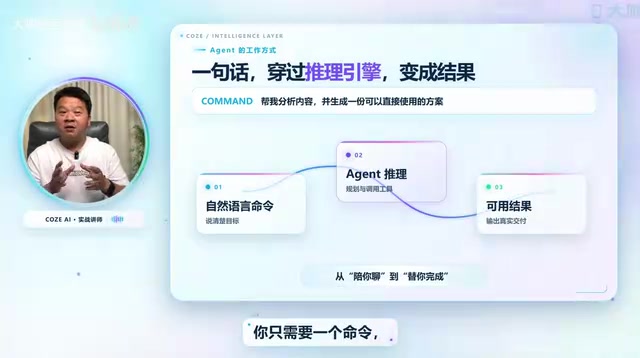
What sets this course apart is its emphasis on more than just "how to use Coze well." It's designed to help learners build AI product thinking and a methodology for structured application. Tools will always be updated, but the ability to think systematically and break down problems is a long-term asset that transfers to any platform.
Two Ways to Build in Coze 3.0
Coze currently supports two approaches: automatic and manual. Each serves a different purpose, covering everything from simple to complex use cases.
Automatic Build: Generate from a Single Sentence
Automatic building is one of Coze 3.0's standout features — just describe what you need in plain language and the system generates an agent, workflow, or skill for you.
For example, type "Build me an agent that automatically generates promotional images when I upload a product photo" into the agent module. The system starts building immediately. Once done, upload a product photo, wait a moment, and your promotional image is ready.
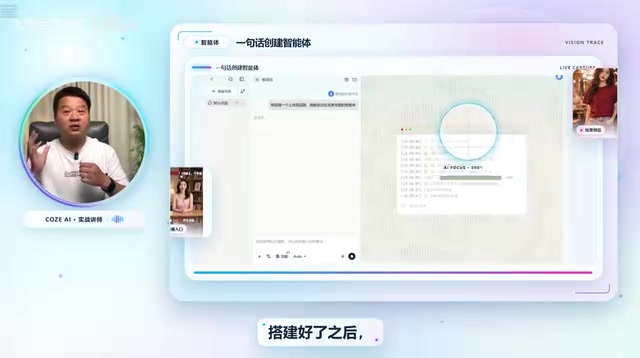
The same applies to workflows. Type "Build a workflow that automatically generates a poetry learning card when I input a poem's title" — and specify that the card should include a thematic image with attractive layout — and the finished workflow produces a beautifully designed learning card the moment you drop in a poem title. The skill module works the same way: one sentence creates a skill that "automatically generates Xiaohongshu copy and cover images from a given topic."
Of course, the first version generated automatically may not be perfect, but for straightforward tasks, automatic building works just fine. Later lessons cover how to refine outputs for greater precision and better fit.
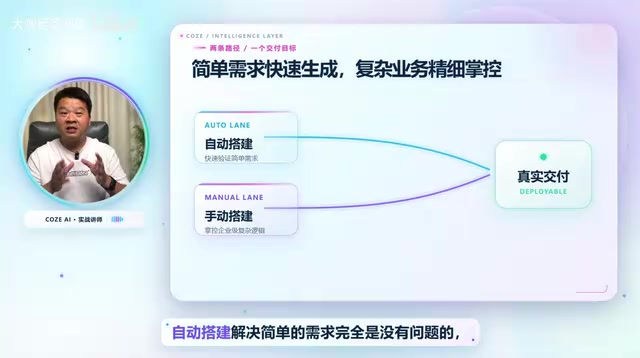
Manual Build: Tackling Complex and Enterprise-Level Scenarios
For complex tasks or enterprise-grade agents, automatic building alone isn't enough — that's where manual building comes in. The course goes deep into real-world deployment scenarios across various industries, and manual building is one of the key focuses of the advanced lessons.
Coze is an AI agent building platform developed by ByteDance that lets users create, configure, and deploy AI assistants without writing any code. The platform is built around three core layers: Agents are the user-facing units for conversation or task execution; Workflows are automated sequences that chain multiple steps together, ideal for tasks with a defined order of operations; and Skills (Plugins) are callable capability modules such as web search, image generation, or data retrieval. These can be used independently or combined and nested to build solutions ranging from simple to highly complex. Coze also offers a domestic version (coze.cn) and an international version (coze.com), which differ in the underlying large language models they connect to, though the building logic is essentially the same.
Real-World Case Studies Across Multiple Industries
The greatest value of this course lies in its extensive real-world examples — not theoretical exercises. Key scenarios include:
- Digital Humans: Input a script and automatically generate a digital avatar lip-sync short video
- AI Comics: Provide a simple description and generate a comic strip segment
- E-Commerce: Upload a clothing photo and instantly generate high-quality promotional images; upload images to auto-generate product videos
- Content Creation: Deconstruct the underlying logic behind viral short videos
- Education: Essay grading assistants, idiom learning cards, tutoring tools, and more
- Finance, Accounting, Legal: Comprehensive coverage of relevant agents and workflows

The course also covers Coze 3.0's local device and cloud device capabilities, enabling Coze to function as a full-scenario AI productivity assistant — including the integration of local deployment pipelines.
From Tool to Methodology
The course progresses layer by layer: from design thinking and building techniques, to hands-on execution, and finally to local deployment. It's not just about technical operations — it's about industry thinking and real-world implementation.
There's one core goal: use Coze as the entry point, help learners develop transferable skills, build AI tools tailored to their own industry, and ultimately construct a high-quality personal "AI team" — mastering the methods and techniques for deploying AI across multiple platforms.
For anyone looking to systematically get started with AI agent building, this 0-to-1 learning path is worth trying. Start with automatic building for a quick hands-on experience, then deepen your skills with manual building for complex scenarios, and ultimately develop a transferable methodology. That's far more valuable in the long run than memorizing the steps of any single tool.
At its core, "AI product thinking" is the ability to decompose requirements: break a vague business goal into concrete steps that AI can execute sequentially, then select the right modules — conversation, workflow, external API, etc. — to implement it. This closely mirrors how software product managers think: define inputs and outputs first, then design the processing logic in between. Once you have this mindset, even if you switch from Coze to Dify, FastGPT, or another agent framework, your core process design skills remain fully applicable. That's why the course emphasizes "methodology transfer" over "memorizing operational steps": the lifespan of a tool is far shorter than the staying power of a way of thinking — tools are measured in months, thinking in years.
Related articles

Chain of Thought Isn't Just for AI: How Humans Can Use CoT to Improve Thinking Quality
Chain of Thought isn't just a prompt trick for large models. Starting from a Hacker News discussion, this article analyzes why CoT works for human thinking too, breaks down actionable ways to transfer it, and highlights the key differences between human CoT and machine CoT.
Cloudflare Teams Up with OpenAI: Closi…
Cloudflare Teams Up with OpenAI: Closing the Loop from Vulnerability Discovery to Defense with AI
Cloudflare uses OpenAI Daybreak to investigate security vulnerabilities and generate reviewable remediation plans, while developers use Codex to boost coding efficiency and quality.

Orca Multi-Agent Orchestration in Practice: A Guide to Parallel Collaboration with Claude and Codex
Orca is Stable AI's free open-source agent workbench supporting 34 agents like Claude Code and Codex in parallel. Learn its Git worktree isolation, multi-model orchestration, and mobile management.