Coze Beginner's Guide: A Complete Cognitive Guide to Building AI Agents from Scratch
A beginner's guide to ByteDance's Coze platform for building AI agents with zero coding skills.
This guide explains ByteDance's Coze platform — a low-code/no-code tool for building AI agents. It covers the differences between the domestic and international versions, how to access GPT-4 for free, the plugin ecosystem, and deployment options. The article makes a case for learning Coze now during its free window period and explores the commercial potential of AI Bots.
What Is Coze?
Coze is a one-stop AI Bot development platform launched by ByteDance. At its core, it's a low-code/no-code platform. Low-Code/No-Code Platforms have become a major trend in software development in recent years. Traditional software development requires developers to master programming languages, databases, server deployment, and a whole range of specialized skills — a simple application might take weeks or even months to build. Low-code platforms dramatically boost development efficiency through visual drag-and-drop components and pre-built modules, while no-code platforms go even further by completely eliminating the need for programming skills. According to Gartner, by 2025, 70% of new applications will be built using low-code/no-code technology. Coze is a vertical platform within this space, specifically focused on building AI agents.
Its greatest value lies in this: whether or not you know how to code, as long as you have basic logical thinking and communication skills, you can develop your own AI agent based on large language models to solve complex problems through conversation. The Large Language Model (LLM) mentioned here is a deep learning model based on the Transformer architecture, trained on massive amounts of text data. Its core capability is understanding and generating natural language, enabling it to perform tasks like translation, summarization, Q&A, code generation, and more. The explosion of ChatGPT in late 2022 brought LLMs into the public spotlight, followed by a wave of models including ByteDance's Skylark, Baidu's ERNIE Bot, Alibaba's Tongyi Qianwen, and OpenAI's GPT series — collectively forming the infrastructure of today's AI applications.
More importantly, Bots built on Coze can be published to various chat platforms and social media platforms for real-world deployment. This breaks the high barrier of traditional app development — building an app used to feel like science fiction for beginners, but now Coze makes it all within reach.
What Exactly Is an AI Bot?
Many beginners have a vague understanding of AI agents. Here's a simple way to think about it: An AI Bot is essentially an app powered by AI technology behind the scenes.
Open Coze's Bot Store and you'll find all kinds of agents: role-playing bots, photo processing bots, short video creation bots, logo design bots, essay writing assistants… You can think of them as the various apps on your phone, each with different functions. The difference is that these apps are driven by AI large models — they don't run on traditional conditional logic and fixed rules. Instead, they rely on the large model's ability to understand and generate natural language, flexibly responding to all kinds of user needs.

Three Key Differences Between Coze's Domestic and International Versions
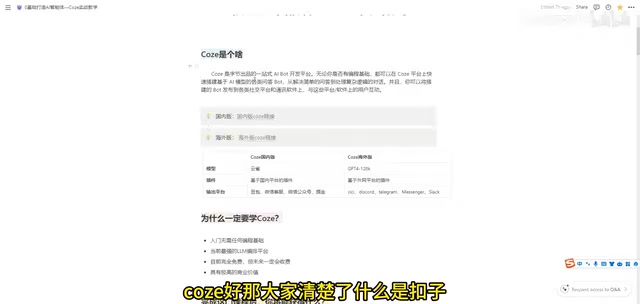
Due to differences in local laws, regulations, and network environments, Coze is available in a domestic (China) version and an international version. For beginners, the domestic version is more accessible with its fully Chinese interface and lower learning curve, while the international version has a slight edge in features. The core functionality of both versions is essentially the same — just pick whichever works best for you. The specific differences come down to three areas.
Model Differences
The model is the core engine of the entire platform. The domestic version uses ByteDance's in-house Chinese LLM called "Skylark," which offers solid but unremarkable performance. The international version, on the other hand, generously provides access to OpenAI's GPT-4 128K model.
The "128K" in GPT-4 128K refers to the size of the context window — the amount of text the model can process at once, which is 128,000 tokens (roughly equivalent to 100,000 English words or 50,000–60,000 Chinese characters). That's like reading an entire medium-length book in one go. A larger context window means the model can handle more information in a single conversation, understand more complex task backgrounds, and reduce information loss. For AI Bot development, a large context window means the Bot can process longer documents and more complex workflow instructions in a single interaction, significantly enhancing the agent's practical utility.
This is particularly significant: using GPT-4 through OpenAI's official channels requires a Plus subscription ($20/month, approximately ¥160 RMB), and calling the API for external development costs extra on top of that. Coze offers this expensive model to developers for free — it's essentially a "freeloader's" dream tool. Additionally, DALL·E 3 and GPT-4V multimodal models are also available, effectively saving you the entire cost of an OpenAI Plus subscription.
DALL·E 3 is OpenAI's third-generation text-to-image model, capable of generating high-quality images from natural language descriptions with notable improvements in text rendering and detail control. GPT-4V (GPT-4 with Vision) is the multimodal version of GPT-4 — the "V" stands for Vision — capable of not only processing text but also understanding and analyzing image content. Multimodal AI is a key direction in AI development, referring to models that can simultaneously process multiple types of information such as text, images, audio, and video. The combined use of these models means AI Bots are no longer limited to text-only interactions — they can "describe what they see" and "generate images from text," vastly expanding the range of possible applications.
Plugin Differences
Plugins extend the capabilities of large language models beyond their inherent abilities. For example, GPT-4 cannot retrieve real-time flight information on its own, but once connected to a flight search plugin, it gains the ability to look up live flight data.
The Plugin System fundamentally addresses a core limitation of LLMs: their knowledge is frozen at the cutoff date of their training data, and they cannot directly interact with external systems. Through plugins, models can call external APIs to fetch real-time data and perform specific actions. This concept is directly aligned with the ChatGPT Plugins that OpenAI launched in 2023 and the subsequent Function Calling mechanism. In the field of AI Agent research, this is known as "Tool Use" — a critical step in evolving AI from "good at talking" to "good at doing." Coze's plugin ecosystem is the productized implementation of this technical approach.
Due to network and regulatory differences, the domestic version's plugins are more tailored to the Chinese market, while the international version covers platforms like YouTube and Twitter, offering a broader variety.
Output Platform Differences
Output platforms refer to "where you deploy your finished Bot." The domestic version supports customer service accounts, WeChat Official Accounts, Feishu (Lark), and more. The international version supports Discord, Telegram, and similar platforms. However, as the platform evolves, this gap is rapidly narrowing — it's very likely that APIs will be opened up in the future, allowing Bots to be integrated into any website, mini-program, or app.
Why Is Now the Right Time to Learn Coze?
Zero Barrier to Entry — Pure Text-Driven Development
Learning Coze requires no programming knowledge whatsoever. Its logic is built entirely through text — you construct your app's internal architecture by typing. This "text-driven" approach is essentially Prompt Engineering: carefully designing natural language inputs to guide the large model toward desired outputs. Building a Bot on Coze is fundamentally about defining the Bot's persona, setting behavioral boundaries, and designing conversation flows — all done through text, without writing a single line of code.
Whether you're a stay-at-home parent, a career newcomer, or a professional programmer, you can get started quickly. For zero-experience users looking to break into AI development, Coze offers the lowest possible barrier to entry.
One of the Most Powerful LLM Orchestration Platforms Available
LLM Orchestration refers to the process of combining and coordinating large language models with various tools, data sources, and business logic to build complete applications. Several notable platforms have emerged in this space: Dify is an open-source LLM application development platform that supports self-hosted deployment and is suitable for developers with some technical background; LangChain is an orchestration framework for programmers that requires writing Python code; Microsoft's Copilot Studio, Baidu's AppBuilder, and others are also players in the same arena.
Compared to these competitors, Coze provides a more comprehensive workflow system, packaging complex development logic into easy-to-use "syntactic sugar" and handing it directly to developers. "Syntactic Sugar" is originally a programming term referring to syntax that makes code easier to read and more concise. Here, it's a metaphor for how Coze wraps complex underlying logic into simple, intuitive visual operations. With the most powerful features and the lowest barrier to entry, it's one of the best choices currently available for orchestrating large models.

The Free Window Is Closing
Coze is currently in its early user growth phase, generously offering expensive resources like GPT-4 for free. This is similar to the massive subsidy strategies that ride-hailing and food delivery platforms used in their early days — attracting users with an exceptional experience while accumulating high-quality Prompts and Bots.
But every interaction between a user and an AI model (the "inference" process) consumes GPU computing power. Take GPT-4 as an example: OpenAI's official API pricing is approximately $30 per million input tokens and $60 per million output tokens, meaning a single complex conversation could cost anywhere from a few cents to several dozen cents. For a platform offering free services, daily usage by millions of users quickly adds up to astronomical computing costs. For ByteDance, this is quite literally "burning money by the minute." Once the platform has accumulated enough users, charging is virtually inevitable — this follows the classic internet playbook of "burn cash to acquire users → build competitive moats → gradually monetize." Therefore, now is the golden window when learning costs are at their absolute lowest.
Enormous Commercial Potential
Once Coze opens up free deployment channels in the future, its commercial value will be fully unleashed. Imagine: every school's official website, every company's homepage, every OA system, every app, and even NPC characters in games could potentially be replaced by AI Bots.
The core logic of AI monetization is actually quite clear: Find workflows where humans used to earn money or produce results, and replace the manual components with AI Bots — delivering the same outcomes at lower cost and higher efficiency. That's where the value lies.
What Will You Gain from a Coze Tutorial?

First, a deep understanding of AI large models. Unlike basic content that only teaches you "how to chat with AI, summarize copy, or write resumes," building agents hands-on through practice after practice gives you a concrete, profound understanding of model fine-tuning and orchestration techniques. In the context of the Coze platform, "fine-tuning" more accurately refers to "training" the model's behavior through prompt design, knowledge base configuration, and workflow orchestration — making a general-purpose model perform like a specialized one. This differs from strict Fine-tuning in the technical sense, which involves additional training on specific datasets, but the core goal is the same: making the model produce more precise outputs in specific scenarios.
Second, tangible output. The course is learning-by-doing with practice-first methodology. By following along, you'll build multiple AI Bots tailored to your own needs and learn how to deploy them to any platform.
Third — and this is the most easily overlooked yet most important point — the ability to independently deconstruct knowledge. In this age of information overload, knowledge itself is cheap. What truly separates people is the ability to "break down and apply knowledge." As a beginner who can't read code, how do you solve coding problems through conversations with AI? How do you conquer a completely unfamiliar technical domain? This methodology is far more valuable in the long run than any specific piece of knowledge.
Conclusion
This article focuses on building cognitive understanding: clarifying what Coze is, what AI Bots can do, and why now is the right time to learn. Future installments will move into hands-on, step-by-step tutorials for building functional agents on the Coze platform. For anyone looking to enter the world of AI application development with the lowest possible barrier, seizing the current free window is undoubtedly the smart move.
Related articles

Chain of Thought Isn't Just for AI: How Humans Can Use CoT to Improve Thinking Quality
Chain of Thought isn't just a prompt trick for large models. Starting from a Hacker News discussion, this article analyzes why CoT works for human thinking too, breaks down actionable ways to transfer it, and highlights the key differences between human CoT and machine CoT.
Cloudflare Teams Up with OpenAI: Closi…
Cloudflare Teams Up with OpenAI: Closing the Loop from Vulnerability Discovery to Defense with AI
Cloudflare uses OpenAI Daybreak to investigate security vulnerabilities and generate reviewable remediation plans, while developers use Codex to boost coding efficiency and quality.

Orca Multi-Agent Orchestration in Practice: A Guide to Parallel Collaboration with Claude and Codex
Orca is Stable AI's free open-source agent workbench supporting 34 agents like Claude Code and Codex in parallel. Learn its Git worktree isolation, multi-model orchestration, and mobile management.