Coze for Beginners: A Complete Guide to ByteDance's AI Application Development Platform

A beginner's guide to Coze, ByteDance's low-code AI application development platform.
Coze is ByteDance's low-code AI development platform that lets anyone build AI applications without deep programming knowledge. This guide breaks down its core concepts — agents, AI apps, workflows, nodes, and plugins — explaining how they work and how they differ from similar platforms like Dify. A free personal tier makes it easy to start building right away.
What Is Coze: ByteDance's AI Application Development Platform
Coze is an AI application development platform launched by ByteDance. Its positioning closely mirrors that of the open-source Dify — even without a deep programming background, you can use this platform to quickly build a wide range of AI applications. Whether it's Agents, Workflows, or conversation flows, Coze provides full support for all of them.
In short, Coze is a low-code platform for AI application development. It wraps complex technical components — large model capabilities, knowledge bases, plugins, and workflow orchestration — into visual modules, allowing both developers and everyday users to build their own AI applications like assembling building blocks.
Background on Low-Code Platforms: Low-code platforms have become a major trend in software development in recent years. Traditional software development requires developers to master programming languages, framework design, server deployment, and a host of other skills — the barrier to entry is extremely high. Low-code platforms package away complex technical details through visual drag-and-drop interfaces, pre-built components, and templated workflows, enabling non-professional developers to build fully functional applications. This trend is especially pronounced in the AI space — the technical details involved in calling large models, prompt engineering, context management, and tool invocation are incredibly complex. Platforms like Coze and Dify address this by modularizing these components so that ordinary users can focus on business logic rather than low-level implementation.
One important distinction to note: Coze itself is not open source, which sets it apart from Dify. So when we discuss the "platform architecture of Coze," we're not referring to its source code structure, but rather the core terminology, hierarchical relationships, and conceptual framework involved in building AI applications on the platform.

Core Differences Between Coze and Dify: Two Design Philosophies for Application Types
The most intuitive reference point for understanding Coze is Dify. Dify supports five major application types: chatbots, agents, text-generation apps, workflows, and conversation flows. Coze, on the other hand, takes a dramatically simplified approach at the application-building layer, offering only two types of AI applications:
- Agent
- AI App
This binary design reduces the decision-making overhead for beginners: you either build an agent that can call tools, or you build a complete AI application with a visual interface. Fewer options mean a sharper focus.
As for whether to choose Dify or Coze for a specific use case, that's a judgment call best made after gaining a thorough understanding of Coze's full feature set — any comparison made without that foundation will be superficial at best.
Subscription Model: Free Personal Tier, Pay-as-You-Go for Enterprise
Coze offers both personal and enterprise subscription tiers. The personal tier includes a daily free quota, which is more than sufficient for individual developers to learn and handle lightweight usage. The enterprise tier is designed for teams with high-frequency, large-scale usage needs. This tiered pricing is quite beginner-friendly — you can absolutely use the free quota to work through the entire journey from onboarding to hands-on projects.
Agent Development: From Single-Agent to Multi-Agent Collaboration
Agents are one of Coze's core modules. To truly understand agents, it helps to grasp the underlying technology: the essence of an Agent is enabling a large language model (LLM) to do more than just generate text — it can perceive its environment, call tools, plan actions, and accomplish goals. A typical Agent execution loop looks like this: receive user input → understand intent → decide which tools to call → execute tools → observe results → continue reasoning until the task is complete. This "think-act-observe" loop is known as the ReAct framework, and it underpins most mainstream Agent implementations. Coze encapsulates this complex mechanism into a visual configuration interface, where developers only need to configure the following key elements:
- Skills: Add capabilities to the agent, such as calling plugins or executing workflows;
- Knowledge: Inject proprietary data so the agent can answer questions based on your own materials;
- Memory: Maintain contextual continuity across multi-turn conversations.
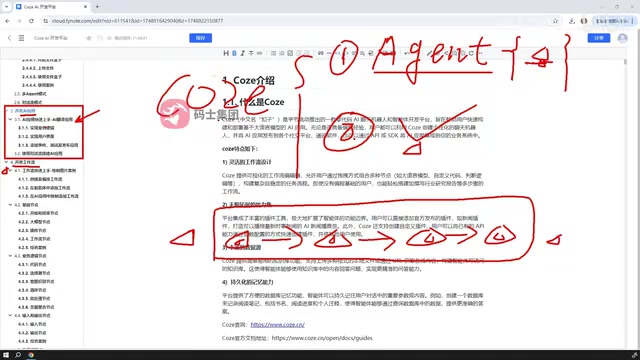
More advanced still, Coze agents support two operating modes: single-agent mode and multi-agent mode. In single-agent mode, one agent independently completes a task; in multi-agent mode, multiple agents collaborate, each responsible for a different stage of the process, working in conjunction with conversation flows to handle more complex business logic.
Technical Background on Multi-Agent Collaboration: Multi-Agent Systems originate from the field of distributed artificial intelligence. The core idea is to decompose complex tasks and have multiple specialized agents collaborate to complete them — much like the division of labor in human organizations. In the era of large models, the advantages of multi-agent architectures are especially clear: a single agent is constrained by context window limits and prone to errors on complex, long-running tasks. Multi-agent systems can break a task into subtasks, with each agent focusing on what it does best. Common multi-agent patterns include the Orchestrator-Worker model, the Pipeline model, and the Debate model. The multi-agent configuration supported by Coze allows developers to implement these architectures without writing complex scheduling code.
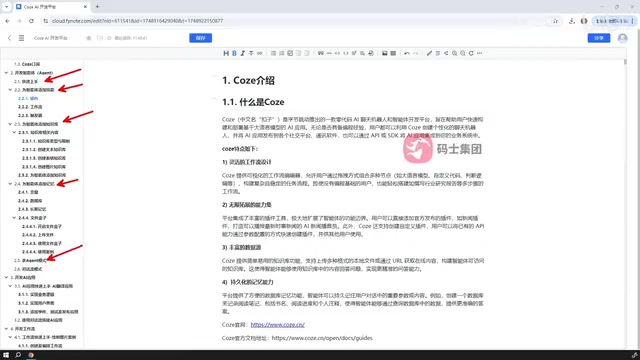
It's worth emphasizing that workflows can be nested inside agents. You can package a structured processing flow into a workflow, then mount it onto an agent, allowing the agent to execute along predefined steps with precision when performing tasks. This combination dramatically expands the capability boundaries of an agent.
AI Apps: Deep Integration of Visual Interfaces and Workflows
AI Apps are the other major application type in Coze. The concept sounds simple, but developing them is no easy feat.
The core difference between AI Apps and Agents comes down to two dimensions:
First, support for nested workflows. AI Apps allow the large model to process user requests, generate content, or execute a series of operations following user-defined steps — not limited to pure data processing.
Second, support for visual interfaces. Users can build complete application pages through drag-and-drop, and end users interact with the AI directly on that page — for example, generating artwork, starting a conversation, or creating a presentation.
If Agents lean more toward "conversational AI assistants," then AI Apps are closer to a complete product — with a front-end interface, interaction logic, and workflow-driven execution, ready to be delivered directly to end users.
Workflows and Nodes: The Most Flexible Core Capability in Coze
Workflows are the most central and flexible capability in Coze. They connect a series of nodes according to specific logic, forming a pipeline for data processing or content generation that drives the large model to execute tasks step by step in alignment with the developer's intent.
Technical Background on Workflow Orchestration: Workflow orchestration is the technique of organizing a series of computational steps into a directed acyclic graph (DAG) based on their dependencies. In traditional software engineering, this work is handled by tools like Apache Airflow. In the age of large models, workflow orchestration has been brought into AI application development to control the order in which LLMs are called, the flow of data, and conditional branching. Its core value lies in the fact that, compared to the purely agent-driven planning approach, workflows offer greater determinism and predictability — making them ideal for business scenarios that require strict step-by-step execution. Coze's node-based workflow system is the product-level realization of this philosophy — developers define execution logic by "drawing connections" rather than writing code.
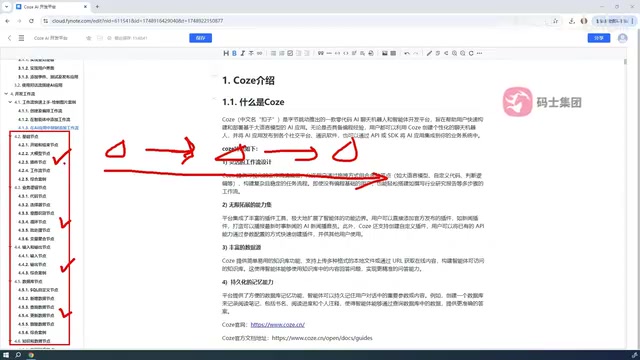
Coze provides a rich variety of node types, covering the following main categories:
- Basic nodes: Form the skeleton of a workflow;
- Business logic nodes: Handle conditional branching, loops, and other control flows;
- Input/output nodes: Manage the flow of data in and out;
- Database nodes: Perform read and write operations on data;
- Knowledge and data nodes: Interface with knowledge base resources;
- Image processing nodes: Support image generation and editing;
- Component nodes: Encapsulate reusable functional modules.
Compared to Dify, Coze offers a larger and more flexible set of nodes, including a substantial number submitted by third-party developers. A practical learning strategy is: first master the usage of common basic nodes, then learn how to search for and use specific nodes on the platform as needed. This way, no matter what business requirement you encounter, you'll be able to find the right tool to implement it.
Plugin System: A Three-Layer Ecosystem of Official, Third-Party, and Custom Plugins
Plugins are the key mechanism for extending Coze's capabilities. Whether used as nodes in a workflow or as skills in an agent, plugins allow AI to call external capabilities to complete specific tasks.
Plugins and Function Calling Technology: The underlying mechanism of Coze's plugin system is based on Function Calling, a technology introduced by OpenAI and now widely adopted. It allows developers to pre-define the interface specifications for a set of tools (including function names, parameter descriptions, and return value formats), enabling the LLM to recognize during a conversation when a tool needs to be called and to generate structured call parameters according to those specifications. This technology upgrades LLMs from "can only generate text" to "can operate external systems" — it is the technical cornerstone of Agent capabilities. The custom plugin feature allows developers to bring any HTTP service within the LLM's tool-calling range by defining API interface specifications, enabling truly unlimited capability expansion.
Coze's plugin ecosystem is organized into three layers:
- Official plugins: Provided by ByteDance, covering mainstream common use cases;
- Third-party plugins: Submitted and shared by other developers;
- Custom plugins: When neither official nor third-party options meet your needs, you can define your own interface to connect any external service to your AI application.
This open plugin ecosystem means the ceiling on Coze's extensibility is virtually nonexistent.
Knowledge Base: Let AI Answer Questions Based on Your Private Data
Coze's knowledge base feature is built on RAG (Retrieval-Augmented Generation) technology. The core logic of RAG works as follows: user-provided documents are split into smaller chunks, converted into vectors via an embedding model, and stored in a vector database. When a user asks a question, the system first retrieves the text segments most relevant to the query, then feeds those segments as context — along with the question — into the LLM, enabling the model to answer questions based on specific reference material.
This approach addresses two fundamental limitations of LLMs: a fixed knowledge cutoff date, and the inability to access private data. Coze encapsulates the entire RAG pipeline into its "Knowledge Base" module. Users simply upload documents — no need to understand the underlying technical details of vectorization or similarity search — and their agent gains a specialized, proprietary knowledge system.
Code Integration: Calling Your Coze Agent via Python or Java
For developers, Coze isn't limited to visual building within the platform. It also supports calling built agents through code. You can write code in Python or Java to interact with an Agent and integrate Coze's capabilities into your own business systems.
This means Coze can function both as a standalone AI application platform and as a backend service capability embedded within a larger product ecosystem — offering considerable flexibility.
Summary: Who Is Coze Best Suited For?
Overall, Coze is a fully-featured, low-barrier AI application development platform. Its core strengths include:
- Simplified application types (Agent + AI App) that reduce decision-making overhead for beginners;
- Visual interfaces that allow users without a technical background to build complete products;
- A vast node library and open plugin ecosystem that provide enormous room for extensibility;
- A free personal tier that makes learning and experimentation virtually cost-free.
All core content covered in this article is grounded in Coze's official documentation and illustrated with practical examples. For learners looking to get started with AI application development, mastering these foundational concepts — platform architecture, agents, AI apps, workflows, nodes, plugins, and code integration — is more than enough to support you in independently building the AI application you envision.
Key Takeaways
Related articles

The Truth Behind Codex 'Build a Website in 5 Minutes': AI Isn't Creating Sites—It's Helping You Copy Them
Exposing the truth behind viral Codex 5-minute website videos: creators aren't building original sites with AI—they're copying shared prompts or scraping others' work. Learn AI coding tools' real limits.

Getting Started with AI Agent Development: A Complete Guide from Concept to Practice
A comprehensive guide to AI Agent architecture and development, covering automated marketing, intelligent customer service, and investment analysis scenarios with single and multi-agent collaboration.

The Truth Behind Codex 'Build a Website in 5 Minutes': AI Isn't Creating Sites — It's Helping You Copy Them
Exposing the truth behind viral Codex 5-minute website videos: creators aren't building original sites with AI — they're copying shared prompts or scraping others' work.