Coze for Beginners: A Complete Guide to Getting Started with the AI App Development Platform

A beginner's guide to Coze, ByteDance's drag-and-drop AI application development platform.
Coze (扣子) is ByteDance's all-in-one AI app development platform designed for users with no coding background. This guide covers its core advantages — drag-and-drop development, plugin integrations, and built-in RAG knowledge base — along with the differences between the domestic and international versions, and when to use AI agents (Bots) versus full AI applications.
For everyday users who want to boost productivity with AI but have no coding background, Coze — developed by ByteDance — is arguably the most accessible all-in-one AI application development platform available today. This article is based on an introductory Coze tutorial from Bilibili's Baizhan Programmer channel, systematically covering Coze's core positioning, key advantages, version differences, and capability boundaries to help beginners quickly build a solid conceptual framework.
What Is Coze?
Coze is an all-in-one AI application development platform launched by ByteDance. As a product from TikTok's parent company, it is deeply integrated with ByteDance's own Doubao large language model. Its singular mission: lower the barrier to AI application development.
Background: What Is a Large Language Model (LLM)?
Large Language Models (LLMs) are the foundational layer underlying everything Coze can do. Built on the Transformer architecture and trained on massive text datasets, these deep learning models can understand and generate natural language. GPT-4o, DeepSeek, and Doubao are all examples of LLMs. At their core, they generate coherent text by predicting "the next word" — yet in doing so, they exhibit emergent capabilities like reasoning, summarization, translation, and code generation. For everyday users, the key insight is this: an LLM is essentially a "general-purpose language processing engine." Coze's role is to wrap that engine into a configurable, deployable tool — so you can embed its capabilities into real workflows without ever needing to understand how the model works internally.
The platform's defining feature is drag-and-drop development — regardless of your coding background, you can create and deploy AI agents powered by large language models through a visual interface, automating and intelligently enhancing your workflows. The process requires virtually no coding; and in the rare cases where code is needed, Coze supports AI-generated code — just describe what you need in plain language.
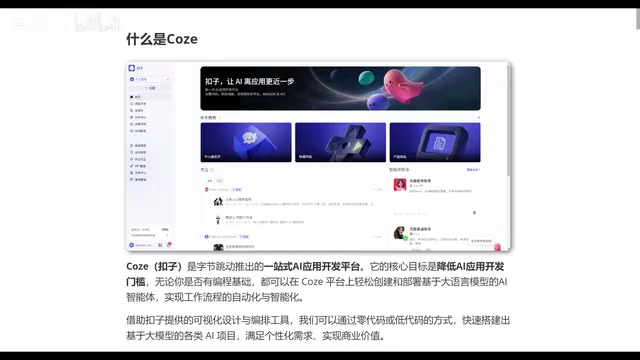
It's worth noting that Coze isn't a silver bullet. It's best suited for small-scale AI applications for personal or professional use, and has clear limitations when it comes to large enterprise projects. For professional developers building complex, large-scale systems, Coze's use cases are relatively narrow.
A Real-World Use Case
Imagine you work in customer service for a travel company, and clients constantly ask about itinerary planning. Writing a personalized recommendation by hand used to take anywhere from 10 minutes to several hours. With an AI agent built on Coze, you simply feed in the client's requirements (number of days, destination, etc.), and a complete itinerary is generated in seconds. This kind of efficiency gain is precisely the core value Coze delivers to everyday users.
Three Core Advantages of Coze
Extremely Low Development Barrier
This is Coze's most defining characteristic. It offers a visual drag-and-drop interface combined with a natural language development paradigm: when a step requires code, you just describe what you need in plain language and the platform generates the code automatically. Users with zero programming experience can quickly build functional AI applications.
Under the hood, this is powered by Coze's robust abstraction of Workflows. Workflows draw on design principles from RPA (Robotic Process Automation) and low-code platforms, allowing users to define task execution sequences by connecting "nodes" — for example: "receive input → call search plugin → LLM formats results → send to Feishu." Each node represents an atomic operation; the connections between nodes define data flow and conditional branching. Workflows are deterministic and follow preset paths, making them ideal for standardized backend processes. The LLM within an agent, on the other hand, autonomously decides which tools to call and when to stop. In Coze, both can be used together for the best of both worlds.
Rich Ecosystem and Integration Capabilities
Coze includes a robust plugin system that makes it easy to connect external APIs. Plugins are the key design element that breaks through the core limitation of LLMs — the fact that they "can talk but can't act." LLMs are closed text-processing systems; they can't proactively fetch real-time information or operate external systems. Plugins (essentially wrappers around external APIs) give them "hands and feet": calling the Amap API for live traffic data, calling the Feishu API to create calendar events, calling a weather API for tomorrow's forecast...
This design philosophy mirrors OpenAI's Function Calling and Anthropic's Tool Use — both enable LLMs to recognize "when an external tool is needed" during text generation and trigger it automatically. Coze's value is that it pre-packages a large number of commonly used APIs as plug-and-play plugins, so users don't have to deal with authentication, request formatting, or other technical details.
The platform also supports multiple mainstream large language models and includes a convenient built-in knowledge base (RAG) feature.
Background: What Is RAG (Knowledge Base)?
RAG (Retrieval-Augmented Generation) is a key technology for addressing two major LLM weaknesses: outdated knowledge and hallucination. LLMs have a training data cutoff date and cannot directly access private enterprise documents. RAG works by chunking and vectorizing your proprietary materials (product manuals, policy documents, historical data, etc.) and storing them in a knowledge base. When a user asks a question, the system retrieves the most relevant text snippets and sends them along with the question to the LLM to generate a grounded response. This means the model's output is backed by real documents, dramatically reducing "confidently wrong" answers. Coze's built-in knowledge base wraps this entire RAG pipeline into a visual workflow — just upload your documents and you're ready to go, enabling your agent to answer questions accurately based on specific source materials.
End-to-End Enterprise-Grade Support
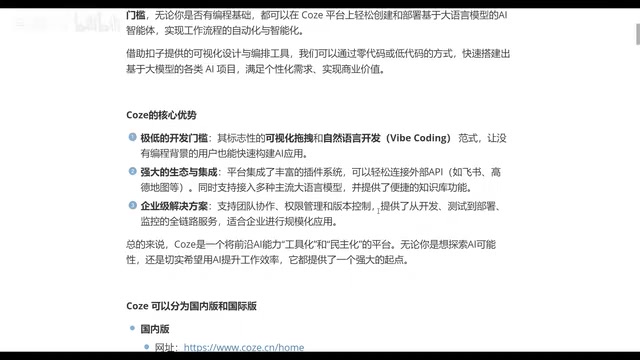
Coze supports team collaboration, permission management, and version control, providing full-lifecycle services from development and testing through to deployment and monitoring. That said, it's worth being honest: Coze still has limitations for large enterprise projects, and its core strength remains in rapidly developing small-scale AI projects.
Overall, Coze is a platform that democratizes and operationalizes cutting-edge AI capabilities. Whether you're exploring AI's possibilities or looking to meaningfully improve your work efficiency, it's a powerful starting point with an exceptionally low barrier to entry.
Domestic vs. International Version
Coze comes in two versions, and many users only know about the Chinese domestic version — but there's also an international version. The core differences lie in interface language and available models:
| Comparison | Domestic Version (coze.cn) | International Version (coze.com) |
|---|---|---|
| Interface Language | Chinese | English |
| Available Models | Doubao, DeepSeek, Kimi, StepFun, etc. | GPT series, Gemini, DeepSeek, etc. |
| Access | Direct access | Requires VPN |
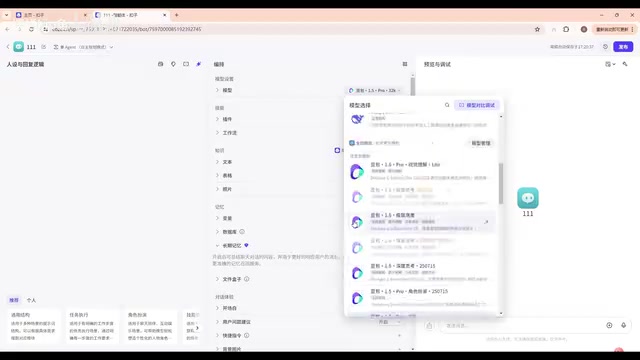
As for which version is more capable: the international version is generally stronger overall, since it can access GPT-4o and other models with leading general capabilities. While DeepSeek performs well domestically, there is still a gap overall.
That said, this tutorial series is based on the domestic version — no VPN required, the Chinese interface is more beginner-friendly, and for everyday work scenarios, the domestic version's model capabilities are more than sufficient.
What Coze Can Build: Agents and AI Applications
Coze was originally focused on developing AI agents (Bots), and now also supports creating AI applications directly. Understanding the difference between the two is key to getting the most out of Coze.
AI Agents (Bots)
An agent is a conversation-based AI project — essentially a chat interface. Users input their needs through dialogue, and the LLM automatically invokes plugins or workflows to execute business logic and generate a final response. The interaction follows a classic "question and answer" format.
Background: What Is an AI Agent?
AI Agents represent one of the most important paradigm shifts in AI in recent years. Unlike traditional chatbots that simply respond to questions, agents have autonomous planning and multi-step execution capabilities: they can decompose complex tasks, call external tools (such as search engines, databases, and APIs), and dynamically adjust their next actions based on intermediate results until the goal is achieved. This "perceive → think → act" loop makes them more like a digital employee capable of independently completing work, rather than a passive Q&A system. Coze's Bot is essentially a lightweight implementation of an Agent — you define what the agent "can do" by configuring plugins and workflows, and the LLM dynamically decides "when to do it and how" during the conversation.

One important note: on the Coze platform, AI agents are uniformly referred to as Bots (robots). Different name, same concept. These Bots can handle automated services, intelligent conversation, and a wide range of other tasks.
AI Applications
AI applications are standalone programs built using large language model technology, with complete business logic and a visual user interface — both a frontend and a backend. Unlike agents that rely on conversation, applications have clearly defined inputs and outputs.
Take a translation tool as an example: the user inputs content, clicks translate, the backend calls the LLM to process the request and outputs the result — no conversation required. It functions more like a real software tool. Coze's application creation feature is currently in Beta, but the experience is already quite polished.
How to Choose
A simple decision rule: if you're building a small conversational tool, an agent is usually sufficient. If you need a small program with clearly defined inputs and outputs — where the LLM is called silently in the background to handle business logic — then the application mode is a better fit.
Summary
Coze's value lies in turning complex AI application development into a drag-and-drop experience accessible to anyone. For beginners, a few core concepts are all you need to get started: Coze is a visual AI app development platform that supports both conversational agents (Bots) and full-UI AI applications; it's powered by large language models under the hood, with RAG knowledge bases handling private data, a plugin system connecting to the outside world, and workflows orchestrating complex business logic — together, these form Coze's complete capability stack. The domestic version requires no VPN, is fully in Chinese, and suits most beginner scenarios well. Once you have these concepts clear, building a functional AI agent that solves a real problem in 10 minutes is entirely achievable — no exaggeration.
Key Takeaways
Related articles

The Truth Behind Codex 'Build a Website in 5 Minutes': AI Isn't Creating Sites—It's Helping You Copy Them
Exposing the truth behind viral Codex 5-minute website videos: creators aren't building original sites with AI—they're copying shared prompts or scraping others' work. Learn AI coding tools' real limits.

Getting Started with AI Agent Development: A Complete Guide from Concept to Practice
A comprehensive guide to AI Agent architecture and development, covering automated marketing, intelligent customer service, and investment analysis scenarios with single and multi-agent collaboration.

The Truth Behind Codex 'Build a Website in 5 Minutes': AI Isn't Creating Sites — It's Helping You Copy Them
Exposing the truth behind viral Codex 5-minute website videos: creators aren't building original sites with AI — they're copying shared prompts or scraping others' work.