Cracking Hard Problems: Why Breakthroughs Belong Only to Those Obsessed with the Process

Hardcore breakthroughs are rare because most people want results without enduring the grinding process.
Starting from a Twitter post, the article argues that everyone wants a solved hard problem but few want to live in the agony of solving it. It contrasts result-oriented people, who chase reputation and funding and can't persist through long feedback droughts, with process-obsessed people, who are fanatically curious and accumulate tacit knowledge through repeated trial and error. Using Linux and AI research as examples, it shows breakthroughs are byproducts of long-term process investment, and offers tips like shrinking focus units, recording failure value, finding like-minded partners, and accepting nonlinear cycles.
The Truth Behind the Glow: Why Breakthroughs Are Rare
In tech circles and startup communities, we constantly see admiration and longing for "solving hard problems." A short post from Twitter perfectly captures this contradictory mindset: "Everyone wants to have a solved hard problem, but almost no one wants to actually live in the agony of solving it." The reason this resonates is that it punctures an over-packaged illusion — everyone craves the glow of a breakthrough, but few are willing to walk the long, grinding road that leads to it.
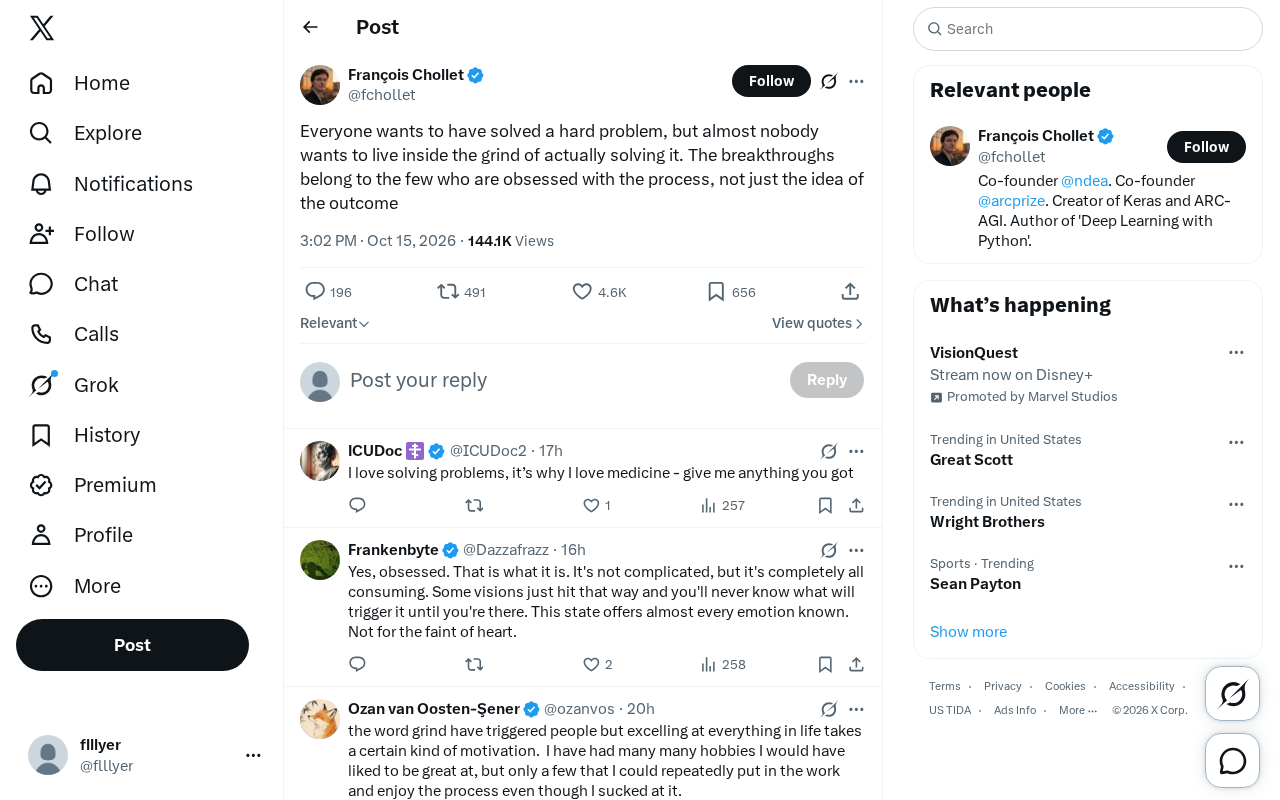
A "hard problem" can mean training a large model that reasons reliably, breaking through a chip manufacturing bottleneck, or taking an open-source project from zero to one and earning community trust. These achievements look clean and elegant in their final form, but the repeated failures, debugging, and starting over are the real daily reality. The post's author delivers a blunt, sharp judgment: breakthroughs belong to the few who are obsessed with the process itself, not just with imagining the result.
Result-Oriented vs. Process-Obsessed: The Essential Difference Between Two Mindsets
The Trap of the Result-Oriented
Being result-oriented isn't inherently bad — it's a necessary tool for setting goals and measuring progress. The problem is that when a person focuses only on the "payoff after solving the problem" — reputation, funding, career advancement — they find it hard to sustain momentum through long periods of uncertainty. Hard problems often take years to solve, with no positive feedback along the way, only failed experiments and the loneliness of being misunderstood. Result-oriented people tend to run out of patience in such environments and pivot to the next opportunity that looks easier to "pick."
The Advantage of the Process-Obsessed
In contrast, process-obsessed people have an almost fanatical curiosity about the problem itself. They enjoy the cycle of breaking down problems, testing hypotheses, and refining details — even when that cycle produces no external reward in the short term. This mindset brings two key advantages: first, they're willing to invest time others won't, because the investment itself is the reward; second, through repeated trial and error, they accumulate a large amount of tacit knowledge that can't be gained from books or courses — only through hands-on "grinding." When a breakthrough finally comes, it isn't luck — it's the inevitable product of long-term process investment.
Tacit Knowledge is a key concept for understanding this advantage. Introduced by philosopher Michael Polanyi in Personal Knowledge, it refers to knowledge that is difficult to encode and transmit through language, text, or courses — like the feel of swimming, the intuition for error patterns when debugging code, or the taste for judging whether a research direction is worth pursuing. Tacit knowledge can only be acquired through hands-on practice, repeated trial and error, and prolonged immersion. This is precisely the moat of the process-obsessed: the more they fail, the more wrong paths they eliminate, and the thicker the tacit knowledge they accumulate. This knowledge can't be quickly replicated by competitors through reading papers or poaching talent, because it's attached to an individual's history of practice, not to documents. When a hard problem reaches a critical turning point, it's often this tacit knowledge that lets a few people sense the direction of a breakthrough before others do.
Real-World Cases: How Process-Obsessed People Change Industries
From open-source communities to frontier research, this pattern plays out repeatedly. Take the early development of the Linux kernel: Linus Torvalds and the core contributors didn't initially see today's vast Linux ecosystem — they were simply fascinated by the technical details of an operating system kernel and willing to discuss patches line by line on mailing lists. Likewise, many researchers who made foundational contributions in AI were driven by pure interest in a mathematical or engineering problem, not by calculating citation counts.
Interestingly, this doesn't mean results don't matter at all. Process-obsessed people also need direction and milestone goals, or they risk falling into meaningless perfectionism. The difference is that they treat results as a byproduct of the process, not the sole driving force. This prioritization makes them more resilient when they hit setbacks.
The Linux kernel's mailing list collaboration model is worth mentioning. Before Git and GitHub existed, Linux kernel development relied on public mailing lists — developers sent patches as plain text to the list, where maintainers reviewed line by line, replied, and requested changes. This seemingly inefficient approach actually built a high-intensity technical grinding ground: every patch had to go through public criticism and iteration, and contributors developed an extreme挑剔ness for code details. It was this day-after-day "line-by-line discussion" that grew Linux from one person's hobby project into the operating system underpinning global internet infrastructure. It confirms a rule: real technical communities aren't held together by grand visions, but by the shared habit of grinding on concrete problems.
How to Cultivate an Obsession with the Process
If you want to go further in a hardcore field, try these adjustments:
- Shrink the unit of focus: Don't fixate daily on "when will this be solved" — focus on whether you advanced the validation of one specific hypothesis today.
- Record the value of failure: Treat each failure as progress that eliminated one possibility, not as a pure loss.
- Find grinding partners on the same wavelength: Process-obsessed people often need a community or small circle for support; grinding alone easily loses its reference point.
- Accept the nonlinearity of cycles: Progress on hard problems isn't linear — sudden breakthroughs after long stagnation are the norm. Don't use short-term metrics to negate a long-term direction.
Conclusion: Choosing to Grind Is Choosing the Path of the Few
That Twitter post summed up a cruel but true filtering mechanism in one sentence: ideas aren't valuable — grinding is. In an era of information overload and instant-gratification culture, fewer and fewer people are willing to "live in the agony of solving hard problems." This precisely means that if you can cultivate a genuine obsession with the process, you'll have far fewer competitors on this road than you'd imagine. Breakthroughs don't belong to the smartest people — they belong to those who can best endure the grind and find meaning in it.
One-line Summary
Hardcore breakthroughs are rare because most people want only the result and won't endure the agony of the grinding process.
Paragraph Summary
Starting from a short Twitter post, the article points out the contradictory mindset that "everyone wants to have a solved hard problem, but almost no one wants to live in the agony of solving it." It divides mindsets into two types: result-oriented people focus on reputation, funding, and promotion, and struggle to persist through hard problems with no positive feedback for long periods; process-obsessed people have a fanatical curiosity about the problem itself, are willing to invest time others won't, and accumulate tacit knowledge through repeated trial and error that can't be gained from books. Citing early Linux kernel development and foundational AI research, the article shows that breakthroughs are often the byproduct of long-term process investment, not luck. It ends with suggestions: shrink the unit of focus, record the value of failure, find like-minded partners, and accept nonlinear cycles — emphasizing that breakthroughs belong to those who can best endure the grind and find meaning in it.
Related articles

Chain of Thought Isn't Just for AI: How Humans Can Use CoT to Improve Thinking Quality
Chain of Thought isn't just a prompt trick for large models. Starting from a Hacker News discussion, this article analyzes why CoT works for human thinking too, breaks down actionable ways to transfer it, and highlights the key differences between human CoT and machine CoT.
Cloudflare Teams Up with OpenAI: Closi…
Cloudflare Teams Up with OpenAI: Closing the Loop from Vulnerability Discovery to Defense with AI
Cloudflare uses OpenAI Daybreak to investigate security vulnerabilities and generate reviewable remediation plans, while developers use Codex to boost coding efficiency and quality.

Orca Multi-Agent Orchestration in Practice: A Guide to Parallel Collaboration with Claude and Codex
Orca is Stable AI's free open-source agent workbench supporting 34 agents like Claude Code and Codex in parallel. Learn its Git worktree isolation, multi-model orchestration, and mobile management.