Crafta-Bench: A Deep Dive into the Benchmark Tool for Cursor Background Agents

crafta-bench provides a systematic benchmarking framework for Cursor Background Agents
Developer nwinter released the open-source project crafta-bench, specifically designed to benchmark Cursor editor's Background Agents. Cursor's Background Agents operate on an Agent Loop architecture, autonomously executing programming tasks by indexing codebases through RAG. Though still in early stages, the project reflects the industry trend toward systematic AI programming Agent evaluation, and standardized benchmarking frameworks are crucial for rational tool selection amid fierce competition among multiple AI coding tools.
Overview
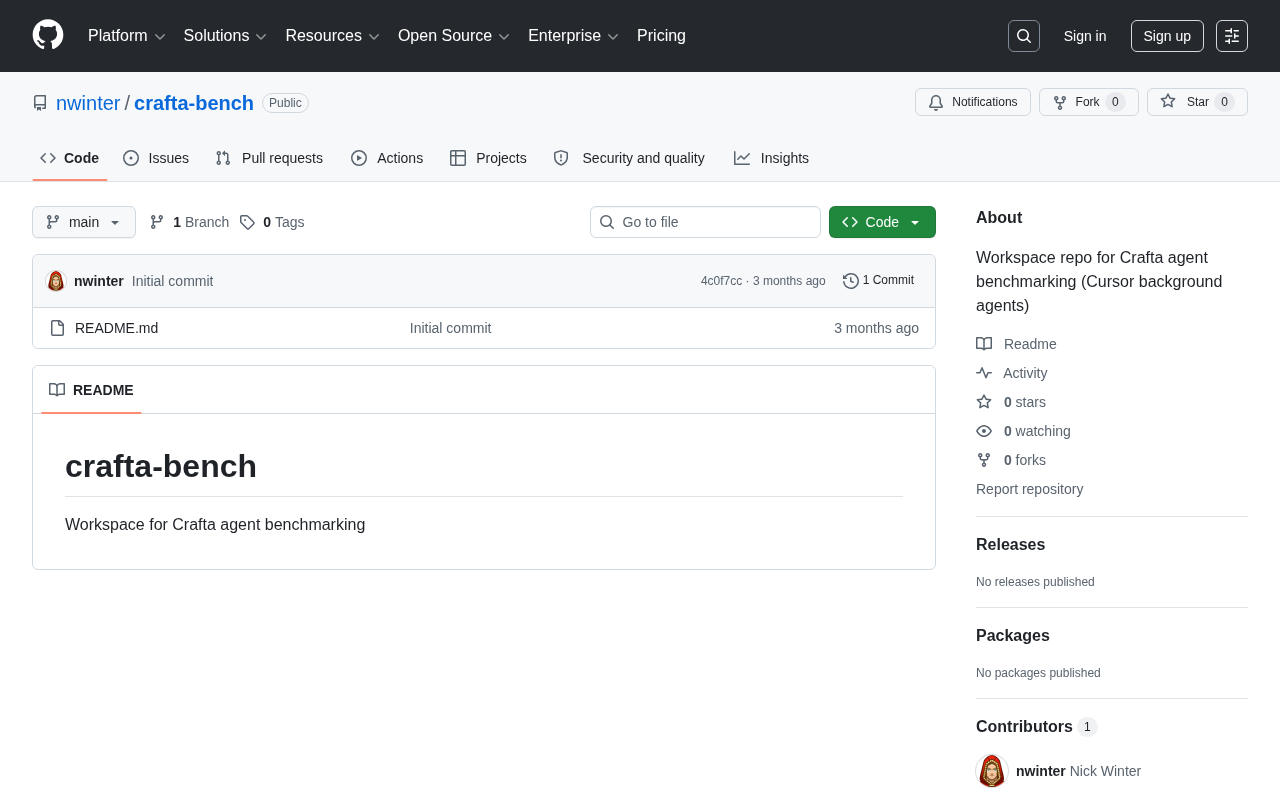
Developer nwinter recently published an open-source project called crafta-bench on GitHub, specifically designed to benchmark Cursor editor's Background Agents. Although the project is still in its early stages (zero Stars and zero Forks), the direction it targets—systematic evaluation of AI programming assistants—is becoming an increasingly important focus for the developer community.
What Are Cursor Background Agents?
Cursor's Evolution
Cursor is one of the most closely watched AI code editors today. Built on VS Code's open-source codebase (Electron + Node.js architecture) with deep customizations, it integrates large language models like OpenAI GPT-4 and Claude to transform a traditional IDE into an AI-native editor.
Its technical roadmap has progressed through three distinct phases: The first phase involved code completion based on Fill-in-the-Middle (FIM) technology, similar to GitHub Copilot's Tab completion experience, where the model predicts code to fill in based on context before and after the cursor. The second phase introduced Composer mode, allowing developers to perform multi-file edits through natural language conversation, with AI understanding cross-file code dependencies. The third phase is the Background Agents feature, introducing an asynchronous autonomous execution paradigm. This evolution reflects the capability progression of AI programming tools from "assistance" to "collaboration" to "delegation."
Background Agents is one of Cursor's newer core capabilities, allowing AI to autonomously execute complex programming tasks in the background—including code generation, refactoring, debugging, and more—without requiring developers to monitor the interaction interface the entire time. This mode is essentially like giving AI a clear task and letting it complete it independently while the developer handles other work.
From a technical implementation perspective, Background Agents relies on an Agent Loop architecture, where the LLM repeatedly executes an "observe-think-act" cycle in a loop. Specifically, the Agent indexes the entire project codebase through RAG (Retrieval-Augmented Generation) to obtain context, formulates an execution plan, then performs file read/write operations, terminal commands, code searches, and other actions through Tool Use. The results of each operation are fed back to the LLM for the next decision. This pattern aligns with the design philosophy of Agent frameworks like AutoGPT and OpenAI's Function Calling, but Cursor deeply integrates it into the IDE environment, enabling the Agent to directly operate on the developer's real project files and development environment.
Why Do We Need Benchmarks?
As AI Agent capabilities grow stronger, a critical question emerges: How do we objectively measure the actual performance of these Agents?
Different prompting strategies, different task types, and different codebase scales can all cause Agents to exhibit vastly different capability levels. Without standardized evaluation frameworks, developers struggle to make evidence-based tool selection decisions.
Building benchmarks for AI programming Agents also faces multiple methodological challenges. First is the "data contamination" problem: since LLM training data may include public evaluation problems and their answers, evaluation results can be inflated—the model might be "recalling" answers rather than truly "solving" problems. Second is the "multi-dimensionality of evaluation metrics": code correctness can be verified through test cases, but soft metrics like code quality and maintainability are difficult to assess automatically. Third is "environment consistency": Agent performance is highly dependent on the runtime environment (operating system, dependency versions, network conditions, etc.), and ensuring evaluation reproducibility requires carefully designed sandbox environments. Finally, there's "task representativeness": how to design evaluation task sets that genuinely reflect daily development work—avoiding over-simplification or over-complication—is itself an open research question.
Detailed Analysis of the Crafta-Bench Project
Project Positioning
crafta-bench defines itself as a "Workspace repo for Crafta agent benchmarking"—a dedicated workspace repository for Crafta Agent benchmarking. From the naming, "Crafta" likely refers to an evaluation framework or toolchain built around Cursor Background Agents.
Current Status and Development Potential
The project is currently in a very early stage:
- Stars: 0 — Has not yet gained broad community attention
- Forks: 0 — No other developers contributing yet
- Language: None — Code content not yet substantive
Nevertheless, the emergence of this project itself sends an important signal: the developer community is shifting from "using AI programming tools" to "systematically evaluating AI programming tools." This is an inevitable step in any technology's path to maturity.
Industry Trends in AI Programming Agent Evaluation
Comparison of Major Evaluation Frameworks
In the broader AI programming space, benchmarking has become a hot topic:
| Framework | Evaluation Target | Use Case |
|---|---|---|
| SWE-bench | Solving real GitHub Issues | End-to-end task completion ability |
| HumanEval | Code generation correctness | Function-level code generation |
| MBPP | Basic programming ability | Entry-level programming tasks |
| crafta-bench | Cursor Background Agents | Agent capabilities of a specific tool |
SWE-bench, published by a Princeton University research team in 2023, is one of the most influential AI programming Agent evaluation benchmarks. It collected 2,294 real GitHub Issues and their corresponding Pull Request fixes from 12 well-known Python open-source projects (such as Django, scikit-learn, sympy, etc.). During evaluation, AI Agents must autonomously locate problematic code, write fix patches, and pass the project's existing unit tests given only the Issue description. SWE-bench Verified is a curated subset containing 500 human-verified high-quality samples. Currently, top-tier AI Agents (such as Devin, OpenAI's SWE-agent) achieve solution rates of approximately 40-55% on this benchmark, demonstrating that autonomously solving real software engineering problems remains an extremely challenging task.
HumanEval, released by OpenAI in 2021, contains 164 hand-written Python programming problems, each accompanied by function signatures, docstrings, and unit tests. MBPP (Mostly Basic Python Problems), released by Google, contains approximately 1,000 entry-level programming problems. While both benchmarks are widely used, they have obvious limitations: they only evaluate single-function-level code generation capabilities and cannot reflect AI performance in real-world scenarios involving multi-file dependencies, understanding complex codebases, and making incremental modifications. This is why evaluation frameworks targeting real engineering scenarios, like SWE-bench and crafta-bench, are gaining increasing attention.
Projects like crafta-bench that target specific tools represent a more segmented and practical evaluation direction.
Core Evaluation Dimensions
A comprehensive AI programming Agent benchmark typically needs to cover the following dimensions:
- Task completion rate: Whether the Agent can correctly complete specified programming tasks
- Code quality: Readability, maintainability, and performance of generated code
- Autonomy: The degree to which tasks can be completed without human intervention
- Execution efficiency: Time and computational resources required to complete tasks
- Robustness: Stable performance when facing ambiguous requirements or complex codebases
The Competitive Landscape of AI Programming Tools
The AI programming tool market is currently in a phase of intense competition, which is an important backdrop driving the need for evaluation. GitHub Copilot holds the largest market share thanks to its first-mover advantage and GitHub ecosystem, with its Copilot Workspace feature also evolving toward Agent capabilities. Cursor has risen rapidly with its deep AI integration and smooth interaction experience, reportedly surpassing $100 million in ARR (Annual Recurring Revenue). Windsurf (formerly Codeium) features the Cascade multi-step reasoning Agent, emphasizing step-by-step planning capabilities for complex tasks. Additionally, there are players like Devin (a fully autonomous AI software engineer from Cognition Labs, claiming to independently handle everything from requirements analysis to deployment), Augment Code, Tabnine, and others.
This competitive landscape makes standardized evaluation particularly important—developers and enterprises need objective data to make tool selection decisions rather than relying solely on carefully crafted marketing demo videos from vendors. Projects like crafta-bench emerge precisely against this backdrop.
Practical Implications for Developers
Taking a Rational Approach to AI Programming Tools
The emergence of projects like crafta-bench reminds us that while embracing AI programming tools, we also need to establish scientific evaluation systems. We shouldn't judge tools solely based on subjective impressions or marketing claims, but rather obtain objective data through reproducible benchmarks.
Contributing to the Open-Source Evaluation Ecosystem
For interested developers, following and participating in early-stage evaluation projects like this is an excellent entry point. As Cursor, Windsurf, GitHub Copilot, and other tools continue competing on Agent capabilities, standardized evaluation frameworks will become increasingly important.
Specific ways to participate include:
- Contributing test cases: Design evaluation tasks covering different programming scenarios, including but not limited to bug fixes, feature additions, code refactoring, performance optimization, and other typical development scenarios
- Refining scoring criteria: Help establish more scientific evaluation metric systems, particularly exploring automated assessment methods for hard-to-quantify dimensions like code quality (such as using LLM-as-Judge techniques)
- Cross-tool comparison: Extend evaluation frameworks to more AI programming tools, establishing fair and comparable horizontal evaluation systems
Conclusion
Although crafta-bench is currently just a fledgling project, the direction it represents—systematic benchmarking of AI programming Agents—carries significant industry importance. As AI programming assistants evolve from simple code completion to Background Agents capable of autonomously completing complex tasks, we need reliable evaluation tools to measure their true capabilities more than ever before.
Whether you're a heavy Cursor user or a developer interested in AI programming tool evaluation, this project and subsequent developments in the field are worth following closely.
Key Takeaways
- crafta-bench is a benchmarking workspace project targeting Cursor Background Agents, currently in its early stages
- Cursor's Background Agent feature is based on an Agent Loop architecture, indexing codebases through RAG and cyclically executing an "observe-think-act" process, allowing AI to autonomously perform complex programming tasks in the background
- Systematic evaluation of AI programming Agents is becoming an industry trend, with frameworks emerging from SWE-bench to tool-specific evaluation benchmarks
- Comprehensive Agent evaluation needs to cover task completion rate, code quality, autonomy, efficiency, and robustness, while facing methodological challenges such as data contamination and environment consistency
- In the context of intense competition among Cursor, Copilot, Windsurf, Devin, and other tools, standardized evaluation frameworks are crucial for developers making rational tool selection decisions
Related articles
 Product Reviews
The Programmer's Desk Setup Guide: Building a Workspace That Feels Like Home
Discover how programmers build productive, comfortable workspaces. From multi-monitor setups to ergonomic design, explore the desk philosophy that drives focus and flow.
 Product Reviews
Qoder vs Cursor Real-World Comparison: Which $20/Month AI IDE Is Better?
Hands-on comparison of Qoder vs Cursor AI IDEs: Agent autonomy, human interaction count, and architecture decisions. Qoder needed only 2 interactions vs Cursor's 8.
 Product Reviews
Cursor Cloud Agent Demo: Eliminating Bottlenecks Across the Entire Software Development Lifecycle
Deep analysis of Cursor's Cloud Agent demo showing how cloud VMs, automated test artifacts, and a full-chain control plane systematically eliminate human bottlenecks across the software development lifecycle.