Crawl4AI: The 80K-Star Open-Source Web Crawler Built for LLMs and RAG

Crawl4AI is an 80K-star open-source crawler that converts web pages into LLM-ready Markdown and JSON.
Crawl4AI is an open-source web crawling framework designed specifically for LLMs and RAG applications, with over 80,000 GitHub Stars. It converts web pages into clean Markdown text and structured JSON, eliminating tedious HTML cleaning. Built with async architecture and headless browser support, it integrates seamlessly with LangChain and LlamaIndex, serving as a data foundation for RAG pipelines, AI Agents, and automated monitoring systems.
When Web Crawling Meets Large Language Models
In an era dominated by Large Language Models (LLMs) and Retrieval-Augmented Generation (RAG) applications, efficiently acquiring and organizing high-quality web data has become an unavoidable challenge for every developer. RAG is a technical paradigm that combines external knowledge retrieval with the generative capabilities of large models — the system first retrieves the most relevant document fragments from a pre-built knowledge base, then injects these fragments as context into the model's prompt, enabling the model to generate answers grounded in real data. While this approach effectively mitigates the "hallucination" problem in large models, the quality of a RAG pipeline is highly dependent on the quality of its input data, making data collection and preprocessing critically important. Traditional crawling tools are powerful, but they typically output messy HTML code, forcing developers to spend significant effort on cleaning, parsing, and format conversion before the data can actually be fed to a large model.
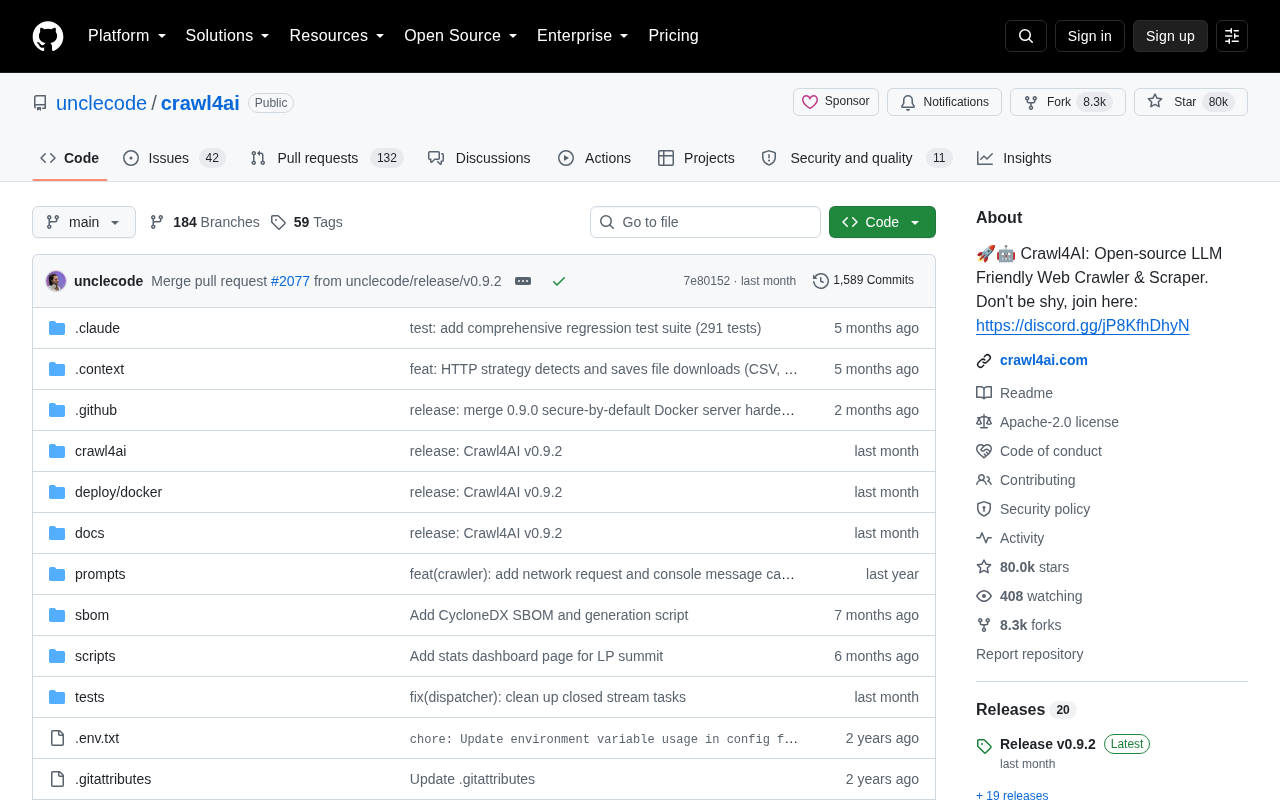
Crawl4AI is an open-source project born to solve exactly this pain point. As an "LLM-friendly" web crawler and data scraping tool, it has garnered approximately 80,000 Stars on GitHub, with over 8,296 Forks and as many as 229 new Stars in a single day, maintaining steadily rising momentum in the developer community.
Crawl4AI's Core Philosophy: What Makes a Crawler "LLM-Friendly"
The Paradigm Shift from HTML to Markdown
The key to being "LLM-friendly" lies in the output format. Traditional crawlers return raw HTML riddled with various tags, styles, and script noise. Crawl4AI's most distinctive capability is directly generating clean, structured Markdown text.
This feature may seem simple, but its practical significance is enormous. Markdown format is naturally suited as input for large models — it preserves semantic structures like headings, lists, and links while filtering out redundant visual noise. Developers can feed crawled results almost "as-is" directly into models like GPT or Claude, or store them in vector databases for RAG retrieval. Vector databases (such as Pinecone, Weaviate, Milvus, Chroma, etc.) are core infrastructure for RAG systems. They convert text into high-dimensional vectors via embedding models and perform semantic-level similarity retrieval based on cosine similarity. Unlike traditional keyword search, vector retrieval understands relevance at the semantic level. Markdown text, with its clear structure and low noise, performs significantly better than raw HTML during chunking and embedding — chunking strategies can naturally split along Markdown heading hierarchies, ensuring semantic completeness of each text block.
A Design Philosophy for AI Data Pipelines
Crawl4AI is written in Python and integrates seamlessly with the mainstream AI development ecosystem (LangChain, LlamaIndex, etc.). LangChain and LlamaIndex are currently the two most popular LLM application development frameworks: LangChain provides a modular "Chain" abstraction that connects prompt management, model invocation, memory management, and tool usage into complete workflows; LlamaIndex focuses more on data indexing and retrieval scenarios, offering rich Data Connectors, indexing strategies, and query engines. Crawl4AI can be seamlessly integrated through the connector interfaces of both frameworks, allowing crawled data to flow directly into the processing pipeline of LLM applications.
Its design philosophy doesn't treat "crawling a webpage" as the endpoint, but rather as the starting point of an entire AI data pipeline. From data collection, cleaning, and structuring to final output, the entire process is optimized around the consumption needs of large models.
Crawl4AI Core Features in Detail
Structured Data Extraction: JSON Output Beyond Markdown
Beyond Markdown output, Crawl4AI also supports rule-based or LLM-based structured data extraction. Developers can define the desired field Schema, and the tool will automatically extract JSON data matching the structure from pages. This feature is particularly useful in scenarios like building product databases, news aggregators, or knowledge graphs.
A knowledge graph is a data model that organizes knowledge in graph structures (nodes + edges), storing entities and their relationships as triples (subject-relation-object). In AI applications, combining knowledge graphs with large models (GraphRAG) is becoming a new trend, providing more precise structured reasoning capabilities than pure vector retrieval. For example, automatically extracting "brand-product-price" relationships from large numbers of product pages, or extracting "person-event-time" triples from news articles, requires first converting webpage content into structured JSON before importing it into a graph database. Crawl4AI's JSON Schema extraction feature covers exactly this need, making the transformation from unstructured web pages to structured knowledge efficient and controllable.
High-Performance Async Crawling and Extensible Architecture
Crawl4AI has been specifically optimized for performance, supporting asynchronous concurrent crawling capable of handling large-scale, high-frequency collection tasks. Its async architecture is built on Python's asyncio event loop mechanism — traditional synchronous crawlers must wait for server responses after making HTTP requests before processing the next request, while the async architecture allows switching to other tasks while waiting for I/O operations, dramatically improving throughput.
Under the hood, Crawl4AI leverages headless browser engines like Playwright to handle JavaScript-rendered dynamic pages, which is especially important in the modern web environment. Many websites use SPA (Single Page Application) architectures with client-side rendering via frameworks like React and Vue — simple HTTP requests only return an empty HTML shell, and a browser engine must execute JavaScript to obtain the actual DOM structure and page content. Crawl4AI solves this challenge through headless browsers, ensuring complete data extraction even from heavily JavaScript-dependent modern websites.
Meanwhile, its modular architecture design leaves ample room for secondary development and feature extension, allowing developers to flexibly customize crawling strategies based on business requirements.
Open-Source Community and Ecosystem
The project adopts a fully open-source model and has established an active Discord community for developer exchange. Nearly 80,000 Stars and a continuously growing contributor base demonstrate that the project has formed a healthy community ecosystem. For enterprises and individual developers alike, open source means greater transparency, lower usage costs, and stronger control — no need to worry about being constrained by commercial API rate limits or price fluctuations.
Typical Use Cases for Crawl4AI
As the Data Foundation for RAG Applications
When building enterprise internal knowledge bases or vertical domain Q&A systems, it's typically necessary to extract information from large volumes of web pages. The Markdown and structured data directly output by Crawl4AI can dramatically shorten the data preprocessing engineering cycle, freeing teams to focus more on model tuning and business logic. In practice, a complete RAG pipeline includes data collection → text cleaning → document chunking → vector embedding → index storage → retrieval recall → reranking → context injection → model generation, among other stages, where data collection and cleaning often account for over 40% of total development time. By outputting high-quality Markdown, Crawl4AI compresses the workload of the first two stages to a minimum, significantly accelerating the entire pipeline's construction speed.
As the Information Perception Module for AI Agents
With the rise of AI Agent technology, giving models the ability to "search the web for information" has become a hot direction. An AI Agent refers to an AI system with autonomous planning, reasoning, and action capabilities — unlike simple Q&A interactions, Agents can decompose tasks based on objectives, select and invoke external tools, and dynamically adjust strategies based on execution results. OpenAI's Function Calling, Anthropic's Tool Use, and open-source frameworks like AutoGPT and CrewAI are all driving this direction forward. In Agent architectures, web search and information scraping are among the most fundamental and critical tool capabilities, empowering Agents to access real-time information and breaking through the temporal boundaries of model training data.
Crawl4AI can serve as an Agent's web perception module, crawling and organizing external information in real time to provide data support for the agent's reasoning and decision-making. Its LLM-friendly output format means Agents can directly incorporate crawled results into their reasoning context without additional format conversion steps, significantly reducing tool invocation latency and complexity.
Data Analysis and Competitive Monitoring
Whether for competitor price monitoring, sentiment analysis, or market research, Crawl4AI provides stable and reliable data collection capabilities, delivering results in formats suitable for downstream analysis. Combined with its structured JSON extraction feature, developers can define field Schemas for product names, prices, ratings, and other fields, schedule crawls of target websites, and write results directly to databases, building automated data monitoring pipelines.
Conclusion: A New Paradigm for Data Collection in the AI Era
The popularity of Crawl4AI reflects the evolutionary direction of foundational toolchains in the AI era: tools are no longer isolated functional modules but critical components deeply integrated into AI workflows. It redefines the traditional technology of "web crawling" as a "data engine serving large models," precisely addressing developers' core needs.
From a broader perspective, this trend reflects a fundamental principle of AI application development: a model's capability ceiling is determined by data quality. Whether it's the quality of knowledge bases in RAG systems, the accuracy of information retrieved by Agents, or the quality of training corpora for fine-tuning, everything depends on the standards of data collection and processing. "AI-native" infrastructure tools like Crawl4AI have emerged precisely under this shared understanding.
For teams building RAG systems, AI Agents, or requiring large-scale web data collection, this open-source tool with nearly 80,000 Stars is worth serious evaluation. As the community continues to grow and features keep iterating, Crawl4AI is poised to become one of the benchmark tools in the AI data collection space.
Related articles

Chain of Thought Isn't Just for AI: How Humans Can Use CoT to Improve Thinking Quality
Chain of Thought isn't just a prompt trick for large models. Starting from a Hacker News discussion, this article analyzes why CoT works for human thinking too, breaks down actionable ways to transfer it, and highlights the key differences between human CoT and machine CoT.
Cloudflare Teams Up with OpenAI: Closi…
Cloudflare Teams Up with OpenAI: Closing the Loop from Vulnerability Discovery to Defense with AI
Cloudflare uses OpenAI Daybreak to investigate security vulnerabilities and generate reviewable remediation plans, while developers use Codex to boost coding efficiency and quality.

Orca Multi-Agent Orchestration in Practice: A Guide to Parallel Collaboration with Claude and Codex
Orca is Stable AI's free open-source agent workbench supporting 34 agents like Claude Code and Codex in parallel. Learn its Git worktree isolation, multi-model orchestration, and mobile management.