Crawl4AI Tutorial: Scrape Website Data in Just a Few Lines of Code

Crawl4AI replaces reverse engineering with headless browser automation and LLM-powered semantic data extraction.
Crawl4AI is an open-source AI crawler framework that uses a real browser engine to handle page encryption and anti-bot measures automatically, letting developers scrape data with just a target URL. It outputs full pages as Markdown or extracts structured fields like titles, like counts, and links via declarative rules. Combined with a proxy it handles overseas sites like Twitter and Facebook; integrated with an LLM it enables natural-language-driven semantic extraction. As an open-source project it's highly extensible. Note that claims of "bypassing all anti-bot systems" are overstated — always respect robots.txt, platform terms, and applicable laws.
Why Use an AI Crawler Framework Instead of Traditional Reverse Engineering
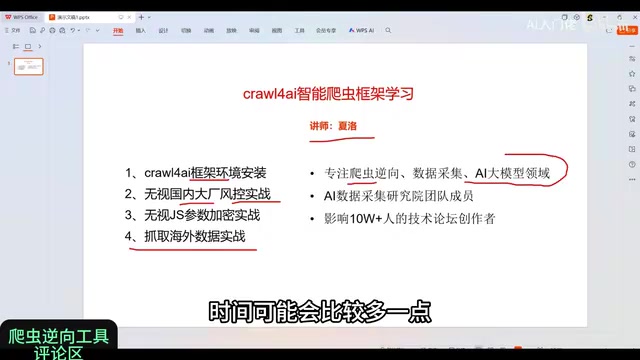
In traditional web scraping, collecting data from a protected website often means extensive reverse engineering. Take a common content platform as an example: developers need to open the browser's F12 DevTools, manually bypass debug breakpoints, analyze encrypted parameters in request headers (such as x-s and x-s-common), and extract Cookie values just to complete a single scrape. Some sites have highly complex encryption logic — video creator "Luoge" on Bilibili mentioned spending nearly an entire project cycle cracking a single well-protected site.
Crawl4AI changes this workflow. It's an open-source AI-powered web crawling framework that encapsulates the tedious work of encryption bypassing and page parsing, allowing developers to simply provide a target URL to collect data. It's worth noting that the author's claim of "ignoring all anti-bot measures" is somewhat exaggerated — actual results still depend on the target site's protection strength, and usage should remain compliant and realistic.
The encrypted parameters commonly seen in traditional scraping reverse engineering (such as Xiaohongshu's x-s and x-s-common) are essentially request signature mechanisms platforms use to prevent automated collection. These parameters are typically generated dynamically by JavaScript on the client side, with obfuscated algorithms embedded in page code. Developers need to use a debugger to gradually reconstruct the calculation logic, then reproduce the same signing process in Python to send requests that the server recognizes as legitimate. This process is not only time-consuming, but also faces the problem of code breaking when platforms regularly update their algorithms. Crawl4AI's core bypass approach is to launch a real browser engine (based on Playwright), letting JavaScript automatically complete signature calculations in a real environment — avoiding the need for manual reverse engineering. In essence, it's closer to "headless browser automation" than breaking encryption algorithms.
Environment Setup and Basic Usage
Installing Crawl4AI is straightforward — a single pip command does the job:
pip install crawl4ai
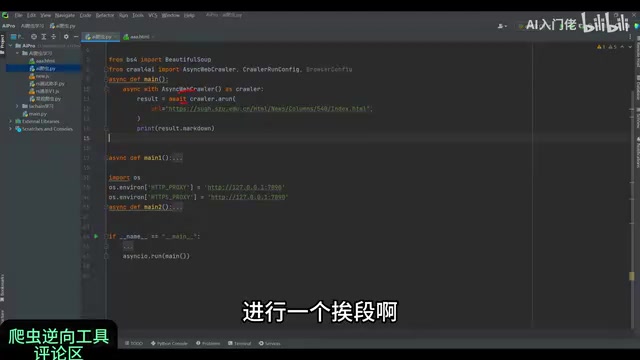
The video author uses a Python 3.8 environment. After installation, import the framework's core classes, pass in the target URL, and you're ready to start scraping. The key steps are just three:
- Create the framework's runtime context (crawler instance)
- Pass in the target page URL and execute the crawl
- Output results in a structured format such as Markdown
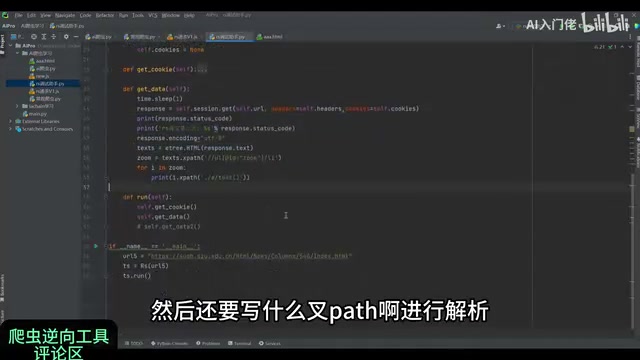
By comparison, using the traditional requests library often results in being immediately blocked by Cookie encryption or anti-bot mechanisms, returning content that isn't the real page. Developers then need to extract specific parameters, assemble Cookies, and write parsing logic — a fairly tedious process.
Structured Data Extraction in Practice
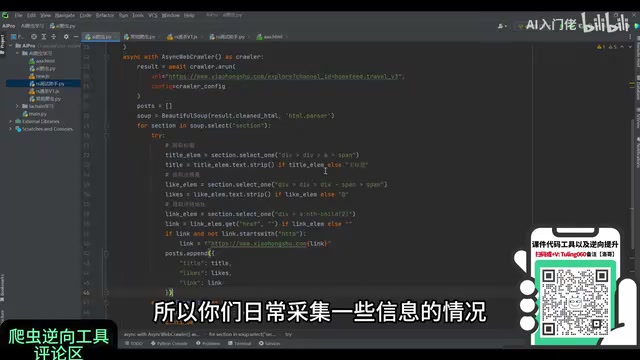
Crawl4AI doesn't just scrape full page content — it also supports targeted extraction of structured fields. For example, when scraping notes from a content platform, if you want to retrieve the title, like count, and detail page URL, you simply configure the appropriate extraction rules by specifying the target tags and defining the parsing method. The framework then organizes the results into a list output.
This configuration approach simplifies data collection from a multi-step "crack → parse → extract" process into a single declarative configuration. In the demo, the author shows titles, like counts, and detail page links extracted cleanly, with clear fields and well-formatted output.
For developers accustomed to writing XPath or regex parsers manually, this automated parsing significantly reduces maintenance overhead — traditional scrapers often require constant adjustments to parsing code when page structures change frequently.
Overseas Data Collection and LLM Integration
When scraping overseas sites, Crawl4AI usage is nearly identical to domestic ones: pass in the target URL, configure a proxy, and launch. The author mentions that scraping speed is solid when combined with a proxy, making it suitable for collecting public data from platforms like Twitter and Facebook.
Another notable feature of the framework is its support for large language model integration. By connecting to an LLM, Crawl4AI can perform more intelligent content extraction — instead of relying on fixed tag rules, you describe the data you need in natural language, and the model handles semantic-level extraction. This is especially valuable for scraping tasks where page structures are inconsistent or where understanding contextual semantics is required.
Since Crawl4AI is an open-source project, developers can also customize and extend it based on their own needs — such as integrating different model backends or defining custom scraping strategies — leaving plenty of room for expansion.
When Crawl4AI integrates with large language models, the typical workflow is: the framework first scrapes and cleans the raw page content (converting it to Markdown to remove noisy tags), then sends the cleaned text along with the user's natural language extraction instructions to the LLM, which returns structured JSON results. The advantage of this approach is greater robustness to page structure changes — as long as the semantics remain the same, the model can still correctly locate target information even if HTML tag hierarchies shift. The trade-off is that every scrape incurs token costs, which need to be weighed against expenses in large-scale collection scenarios. Common integration backends include OpenAI and locally deployed Ollama models; developers can choose based on their data privacy and cost requirements.
Usage Recommendations and Compliance Reminders
As an open-source AI crawler framework, Crawl4AI does significantly lower the barrier to data collection in terms of ease of use — a few lines of code can accomplish tasks that previously required extensive reverse engineering, making it genuinely valuable for data collection and research use cases.
However, phrases like "break through all anti-bot measures" and "absolutely unstoppable" in the video carry obvious promotional overtones and should be taken with a grain of salt. Whether scraping actually succeeds — and whether the scraping activity is compliant — depends on the target site's protection mechanisms, terms of service, and local laws and regulations. When collecting publicly available data, you should respect the site's robots.txt protocol and terms of use, and avoid placing excessive load on platforms or crossing lines related to privacy and copyright.
Overall, Crawl4AI is a useful tool for improving web scraping development efficiency, but it's not a "master key." Compliance awareness matters just as much as technical capability.
Related articles

JobRunner MCP Server: AI Agents Can Now Fix Failed Java Jobs
JobRunner launches an open-source MCP server enabling AI agents to view cluster status, diagnose failures, and recover Java jobs—incident response from any cloud coding environment or existing agent.

MLAI Digital Launches 9 Security Agents: MCP Server Safeguards the Full Lifecycle of Agentic AI
MLAI Digital launches Security MCP Server with nine built-in specialized security agents covering vulnerability discovery, attack simulation, prompt injection detection, API and infrastructure assessment, and accelerated remediation—embedding security validation across the full Agentic AI lifecycle from development to production.

Running Isaac Lab on H100 GPUs: Exploring Better Approaches
Exploring optimization methods for running Isaac Lab on NVIDIA H100 GPUs, including MIG configuration, mixed precision, TensorRT acceleration, and community experience to improve robotics simulation and reinforcement learning efficiency.