Credal Machine Learning: Reliable Guarantees for Risk-Averse Decision-Making

Research proposes using Credal sets to model epistemic uncertainty, achieving nearly lossless risk-averse machine learning.
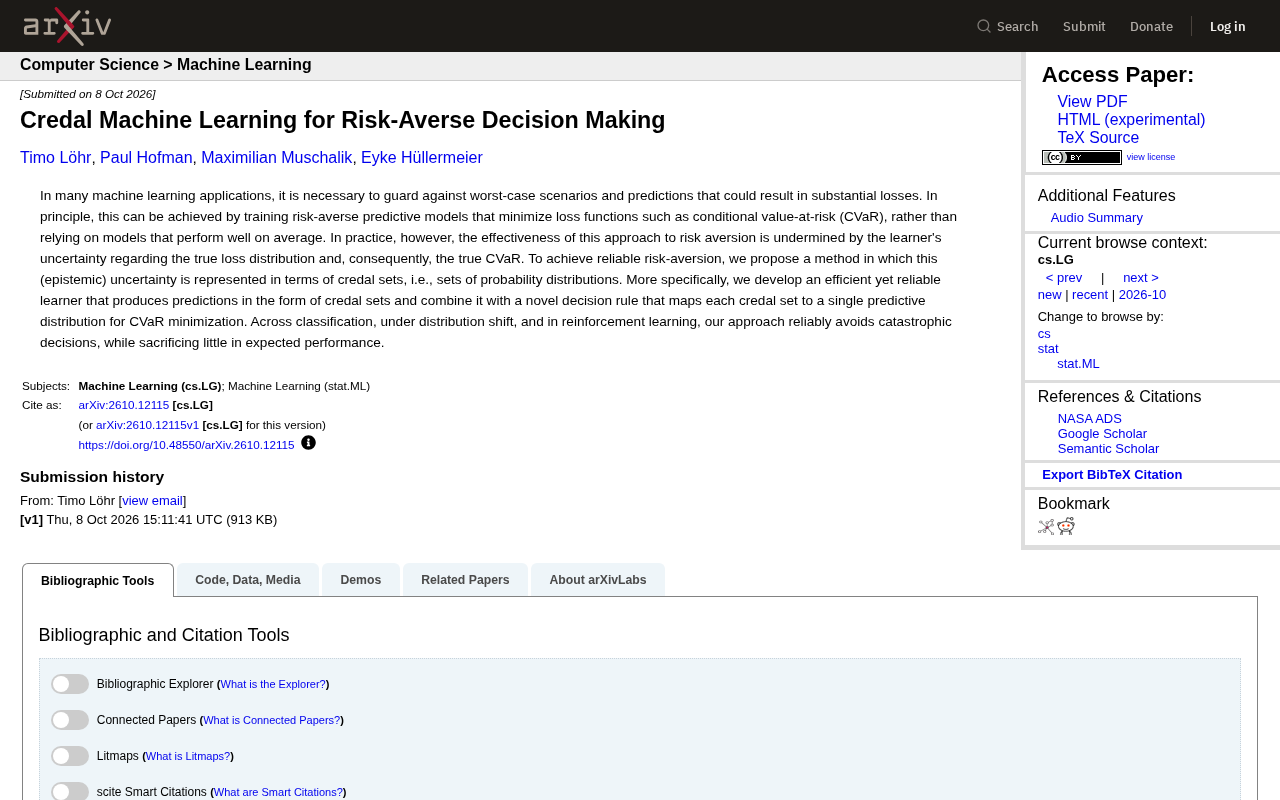
This article introduces the core dilemma facing risk-averse machine learning: traditional CVaR minimization methods suffer from the learner's epistemic uncertainty about the true loss distribution, which significantly diminishes risk-aversion effectiveness. Researchers propose a solution based on Credal sets, using a set of probability distributions rather than a single distribution to characterize epistemic uncertainty, and design a novel decision rule that maps Credal sets to a single predictive distribution for CVaR minimization. This method reliably avoids catastrophic decisions across classification, distribution shift, and reinforcement learning scenarios with minimal expected performance loss, providing a principled path for safe AI deployment in high-risk domains.
In today's world where machine learning is widely applied, many scenarios require models not only to perform well on average, but also to withstand significant losses in worst-case situations. For example, in fields like autonomous driving, financial risk control, and medical diagnosis, a single catastrophic decision can cause irreversible consequences. Traditional risk-averse methods attempt to train predictive models by minimizing loss functions such as Conditional Value-at-Risk (CVaR), but this approach faces a fundamental challenge in reality: the learner's uncertainty about the true loss distribution can severely undermine the actual effectiveness of risk aversion.
The Core Dilemma of Risk-Averse Machine Learning
Conditional Value-at-Risk (CVaR) is an important metric for measuring tail risk, focusing on the worst portion of the loss distribution. Theoretically, if a learner could accurately know the true loss distribution, directly minimizing CVaR would yield an ideal risk-averse model. The problem is that in reality, learners can only estimate the loss distribution from limited data, and such estimates inevitably contain bias.
This uncertainty arising from cognitive limitations—known as epistemic uncertainty—causes the learner's CVaR estimate to deviate from the true value. When a model makes decisions based on a biased CVaR estimate, the intended risk-averse effect may be significantly diminished, or in some cases may even increase risk. This contradiction constitutes the core challenge in the field of risk-averse machine learning.
Mathematical Definition of CVaR and the Risk-Aversion Spectrum
Conditional Value-at-Risk (CVaR), also known as Expected Shortfall, is defined as the expected value of the tail portion of the loss distribution exceeding a certain confidence level α. Mathematically expressed: CVaR_α = E[L | L ≥ VaR_α], where VaR_α is the α-quantile of the loss distribution. Compared to VaR, which only provides a quantile threshold, CVaR further characterizes the severity of tail losses and possesses favorable optimization properties such as convexity and sub-additivity, making it the preferred risk measure in financial risk management and machine learning.
In the spectrum of risk-averse machine learning, besides CVaR, there are methods such as variance penalties, Wasserstein distance constraints, and Distributionally Robust Optimization (DRO). However, CVaR has attracted considerable attention due to its direct focus on tail risk and favorable convex optimization structure. A key intuition for understanding CVaR is that it does not care about the overall shape of the loss distribution—only how bad the worst α proportion of scenarios are. This is precisely the core demand of "risk aversion."
Credal Sets: A New Framework for Representing Epistemic Uncertainty
To address the above problems, researchers have proposed a solution based on Credal sets. A Credal set is a set of probability distributions rather than a single probability distribution. By using Credal sets to characterize the learner's epistemic uncertainty about the loss distribution, it becomes possible to more faithfully reflect the model's ability to "know what it doesn't know."
Specifically, this method develops an efficient and reliable learner whose predictive output is no longer a single probability distribution, but rather takes the form of a Credal set. This means that when facing uncertainty, the model no longer forces a definite but potentially incorrect prediction, but instead retains a set of possible distributions, thereby providing a richer information basis for subsequent decision-making.
The key innovation of this approach lies in transforming epistemic uncertainty from "noise to be eliminated" into "information to be modeled and utilized." By explicitly representing uncertainty, subsequent decision rules can make choices with more complete probabilistic information.
Epistemic Uncertainty vs. Aleatoric Uncertainty
In the field of uncertainty quantification in machine learning, uncertainty is typically divided into two categories: aleatoric uncertainty originates from the inherent randomness of the data itself, such as sensor noise or random environmental fluctuations, and cannot be eliminated even with infinite data; epistemic uncertainty arises from the model's insufficient knowledge of the true data-generating process and can theoretically be reduced by adding more data.
A Credal Set is a mathematical tool for representing epistemic uncertainty. It consists of a set of probability distributions rather than a single distribution. In the Bayesian framework, when prior information is insufficient, the choice of prior itself is uncertain. Considering the set of posterior distributions induced by all "reasonable" priors constitutes a Credal set. Unlike Bayesian model averaging (which obtains a single distribution by weighted averaging of posteriors), Credal sets preserve the disagreements between distributions, enabling decision-makers to distinguish "consensus regions" from "contested regions." This concept originates from imprecise probability theory and has recently gained new application value in robust machine learning.
From Credal Sets to Decisions: A Novel Decision Rule
Having only Credal sets is not enough. How to derive a specific predictive distribution from a set of probability distributions to minimize CVaR is another key question. Researchers have designed a novel decision rule for this purpose, which can map each Credal set to a single predictive distribution specifically for CVaR minimization.
The design of this decision rule requires balancing conservatism and usability: being too conservative may cause the model's performance under normal conditions to decline significantly, while being too aggressive may fail to effectively avoid tail risk. The goal of this rule is precisely to achieve reliable risk aversion at the cost of minimal expected performance loss.
Multi-Scenario Validation: Classification, Distribution Shift, and Reinforcement Learning
This method has been validated across multiple scenarios. In classification tasks, it can reliably avoid catastrophic decisions; under distribution shift conditions—where training and test data distributions are inconsistent—it similarly maintains robust risk-aversion capability; in reinforcement learning environments, the method also demonstrates reliable performance.
Notably, this method achieves risk aversion while incurring very little sacrifice in expected performance. This means it does not trade safety by significantly reducing average performance, but rather gains protection against worst-case scenarios with almost no loss in normal performance. This "nearly free" risk aversion is quite important for practical deployment.
Types and Challenges of Distribution Shift
Distribution shift refers to the situation where training and test data come from different distributions, and is one of the core challenges facing machine learning models after deployment in the real world. Common types of distribution shift include: covariate shift (input distribution changes but conditional distribution remains unchanged), label shift (label marginal distribution changes), and concept drift (the conditional distribution itself changes over time). In risk-averse scenarios, distribution shift is particularly dangerous because models not only face performance degradation caused by distribution changes, but may also make catastrophic decisions when out-of-distribution samples enter tail risk regions.
Traditional robust optimization methods often assume that distribution shift lies within a known uncertainty set, whereas the advantage of the Credal set method is that it does not rely on strong assumptions about the form of the shift, but instead directly models the model's own epistemic uncertainty. This enables it to maintain risk-aversion capability when facing unknown types of distribution shift, and it also has broad application prospects in safety research for reinforcement learning.
Implications for AI Safety and Reliable Decision-Making
This work provides a practical and feasible path for risk-sensitive machine learning applications. In high-risk domains such as autonomous driving, financial trading, and medical-assisted diagnosis, occasional catastrophic errors by models can lead to serious consequences, and the Credal machine learning framework offers a principled solution for such scenarios.
From a broader perspective, this method reflects an increasingly important trend in AI research: shifting from pursuing optimal average performance to making reliable and safe decisions under uncertain environments. As machine learning systems assume increasingly critical roles in the real world, this explicit modeling and utilization of epistemic uncertainty may become an important foundation for building trustworthy AI systems.
One-line Summary
Research proposes using Credal sets to model epistemic uncertainty, achieving nearly lossless risk-averse machine learning.
Paragraph Summary
This article introduces the core dilemma facing risk-averse machine learning: traditional CVaR minimization methods suffer from the learner's epistemic uncertainty about the true loss distribution, which significantly diminishes risk-aversion effectiveness. Researchers propose a solution based on Credal sets, using a set of probability distributions rather than a single distribution to characterize epistemic uncertainty, and design a novel decision rule that maps Credal sets to a single predictive distribution for CVaR minimization. This method reliably avoids catastrophic decisions across classification, distribution shift, and reinforcement learning scenarios with minimal expected performance loss, providing a principled path for safe AI deployment in high-risk domains.
Related articles

Chain of Thought Isn't Just for AI: How Humans Can Use CoT to Improve Thinking Quality
Chain of Thought isn't just a prompt trick for large models. Starting from a Hacker News discussion, this article analyzes why CoT works for human thinking too, breaks down actionable ways to transfer it, and highlights the key differences between human CoT and machine CoT.
Cloudflare Teams Up with OpenAI: Closi…
Cloudflare Teams Up with OpenAI: Closing the Loop from Vulnerability Discovery to Defense with AI
Cloudflare uses OpenAI Daybreak to investigate security vulnerabilities and generate reviewable remediation plans, while developers use Codex to boost coding efficiency and quality.

Orca Multi-Agent Orchestration in Practice: A Guide to Parallel Collaboration with Claude and Codex
Orca is Stable AI's free open-source agent workbench supporting 34 agents like Claude Code and Codex in parallel. Learn its Git worktree isolation, multi-model orchestration, and mobile management.