Crew: A Multiplayer Workspace for Human-AI Collaboration, Making AI Agents True Team Members

Crew reimagines team collaboration by making AI Agents first-class members in a multiplayer workspace.
Crew is a multiplayer workspace product that positions AI Agents as equal participants in team collaboration rather than isolated chat assistants. It enables task distribution to Agents, shared team context access, and transparent AI work processes. While facing challenges around Agent reliability, permission governance, and proving real collaboration value, Crew represents a significant signal that future productivity tools will be designed around human-AI hybrid teams.
When AI Agents Enter Team Collaboration
Over the past two years, AI Agents have rapidly evolved from a technical concept into productivity tools. AI Agents refer to AI systems capable of perceiving their environment, making autonomous decisions, and executing actions—distinct from traditional Q&A chatbots. Modern AI Agents are typically built on Large Language Models (LLMs), combined with mechanisms like Tool Use, Planning, and Memory, enabling them to decompose complex tasks, invoke external APIs, and dynamically adjust strategies based on execution results. From AutoGPT sparking attention in 2023, to OpenAI's GPTs and Anthropic's Claude Computer Use in 2024, to the emergence of various enterprise-level Agent platforms, AI Agents have moved from lab concepts to real-world application scenarios.
But the vast majority of products still remain in the "one person talking to one AI" dialogue paradigm: you ask questions in a chat box, AI gives answers, and then you copy-paste the results into team collaboration tools. This fragmented workflow exposes a core problem—AI Agents have yet to truly integrate into human collaboration scenarios.
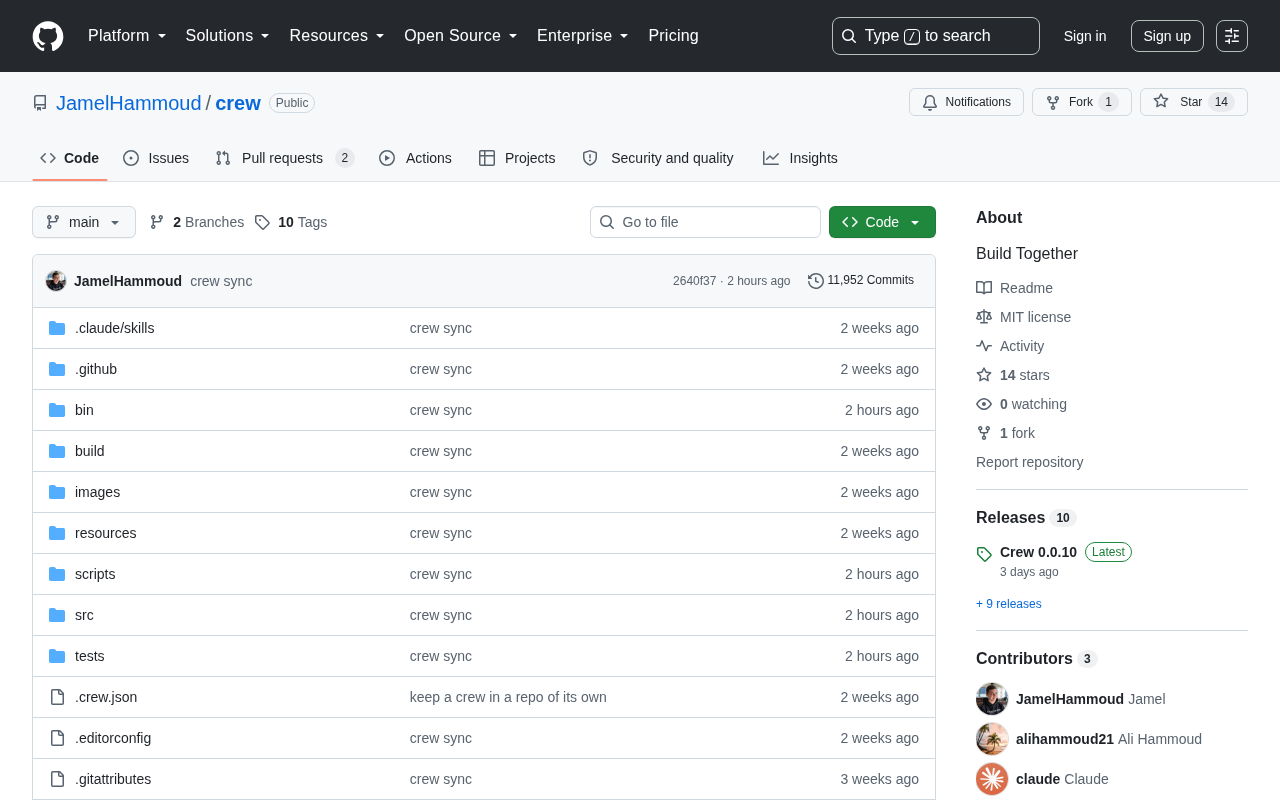
Crew is a product aimed squarely at this pain point. It positions itself as "a multiplayer workspace for humans and AI agents to work together," attempting to transform AI from an isolated conversational assistant into a first-class citizen in team collaboration.
Crew's Core Philosophy: A Paradigm Shift from Single-User Dialogue to Multiplayer Collaboration
What Is a "Multiplayer Workspace"?
Traditional AI tools are mostly "single-player games"—each user interacts with AI in their own session, with both the process and results difficult to share. The "multiplayer" concept Crew emphasizes essentially brings the real-time collaboration philosophy of Google Docs and Notion into the AI Agent domain.
The Multiplayer (real-time multi-user collaboration) concept originated in online gaming and was later introduced to productivity tools by Google Docs in 2006. Its core technologies include Operational Transformation (OT) and Conflict-free Replicated Data Types (CRDT), which enable multiple users to simultaneously edit the same document without conflicts. Modern collaboration tools like Figma, Notion, and Linear all employ similar real-time synchronization architectures. Extending this paradigm to the AI Agent domain means solving entirely new technical challenges: real-time broadcasting of Agent behavior, concurrent command conflicts from multiple users directing the same Agent, and consistency synchronization of Agent execution states.
In such a human-AI collaboration space, multiple team members can see each other's interactions with AI and observe the tasks AI Agents are currently executing. This means AI is no longer "your personal assistant" but rather "a shared team member." When an engineer asks an Agent to generate code, product managers and designers can watch this process in real time and intervene to make adjustments at any point.
Redefining the Human-Machine Boundary
Crew's core innovation lies in placing "humans" and "AI Agents" on the same collaboration plane. Behind this is a noteworthy product philosophy: AI Agents shouldn't merely be tools—they should be viewed as collaborative participants with a certain degree of autonomy.
This design introduces a series of new collaboration patterns:
- Task Distribution: Humans can assign tasks to AI Agents just as they would delegate work to colleagues
- Context Sharing: Agents can access the team's shared context rather than operating in isolation
- Process Visibility: An Agent's work process is transparent to all members, facilitating oversight and error correction
Why Human-AI Collaboration Workspaces Deserve Attention
Solving the "Last Mile" of AI Adoption
One of the biggest obstacles enterprises face when adopting AI Agents is how to seamlessly embed AI output into existing team workflows. Many teams still practice "individuals using AI, then manually integrating results into the team," which is not only inefficient but also significantly diminishes AI's value.
The "last mile" problem enterprises face when deploying AI Agents is far more complex than technical implementation. First is the data silo problem—enterprise information is scattered across emails, documents, code repositories, project management tools, and dozens of other systems, requiring Agents to have unified context access capabilities. Second is trust and controllability—according to McKinsey's 2024 survey, executives' biggest concerns about AI are unpredictable outputs and data security. Additionally, there are organizational culture barriers, as many teams have yet to establish work habits and process standards for collaborating with AI. Together, these issues form the gap between AI being "usable" and being "useful."
Products like Crew attempt to solve this problem at the foundational level—making collaboration a native capability of AI Agents, rather than a feature integrated after the fact. If this model proves viable, AI Agents will evolve from tools that boost individual productivity into infrastructure that transforms how teams are organized.
Competition and Differentiation from Slack AI, Notion AI, and Other Existing Tools
The market has already seen numerous related explorations: from Slack and Microsoft Teams integrating AI assistants, to Notion AI and Coda AI embedding intelligent capabilities within collaborative documents. But most of these products are "adding AI to collaboration tools," while Crew's approach is closer to "redesigning the workspace around human-AI collaboration."
The difference between the two may seem subtle but is actually profound. The former treats AI as a plugin; the latter designs the entire product architecture with AI as a co-equal working entity. The latter approach is more thorough but also faces greater product design and user habit challenges. Specifically, Slack AI and Notion AI's design logic adds an AI invocation layer within existing message streams or document structures—users' core workflows remain unchanged, with AI serving as supplementary enhancement. Crew's design, however, requires users to accept an entirely new work interface where Agent behavior and human behavior are presented and managed on the same dimension, placing extremely high demands on interaction design.
Practical Considerations and Potential Challenges for an Early-Stage Product
Crew is still in its early stages. As an emerging product, it needs to answer several key questions:
First, AI Agent reliability. Multiplayer collaboration scenarios demand higher stability and accuracy from Agent outputs. When multiple team members rely on the same Agent's output, a single error can be amplified across the entire team. Current mainstream LLMs still suffer from "Hallucination" problems—generating content that appears reasonable but is actually incorrect. In single-user scenarios, users typically verify outputs themselves; but in multiplayer collaboration environments, an Agent's erroneous output may be directly cited and propagated by other members as fact, creating an error "snowball effect."
Second, permissions and governance. When AI Agents can access shared team context and autonomously execute tasks, managing their permission boundaries and preventing unauthorized operations becomes a critical concern for enterprise adoption. AI Agent permission management is a core topic for enterprise-level applications, and the industry is currently exploring multiple governance frameworks. The most basic is Role-Based Access Control (RBAC), assigning Agents specific roles and limiting their operational scope. More advanced solutions include "Human-in-the-Loop" mechanisms—requiring human approval before Agents execute high-risk operations—and "sandbox execution" modes—simulating Agent operations in isolated environments first, then applying them to production only after confirming safety. Anthropic's Constitutional AI concept and OpenAI's hierarchical permission design are both important reference directions in this field.
Third, the actual value of collaboration. "Multiple people watching AI work" sounds appealing, but does it truly improve team efficiency, or does it merely add information noise? This needs validation in real scenarios. Historically, over-transparency in collaboration tools has backfired—for example, early "open offices" and excessive real-time notifications were both proven to reduce deep work efficiency. Transparency of AI Agent processes needs to find the right granularity: too coarse lacks oversight value, too fine becomes information overload.
Conclusion: A Signal of the AI-Native Collaboration Era
Crew's emergence is a landmark signal of AI Agents reaching maturity. It represents a trend—future productivity tools will be designed around "human-AI hybrid teams" rather than simply slapping an AI label on old tools.
The deeper implication of this trend is that the design subject of software products is expanding from "humans" to the hybrid entity of "humans + AI Agents." This will redefine the fundamental paradigm of collaboration software: in the past, the core of collaboration tools was solving information synchronization and task coordination between people; in the future, they must simultaneously address collaboration orchestration between humans and Agents, and between Agents and Agents. This is not merely a product-level change—it will also influence organizational design and management theory. When not all "members" of a team are human, traditional team management methodologies need to evolve accordingly.
Regardless of whether Crew itself succeeds, this direction deserves attention from the entire industry. When AI Agents truly become team members, collaboration software, organizational structures, and even the nature of work itself may undergo a profound restructuring. For practitioners focused on AI application deployment, the evolution path of such human-AI collaboration products is worth continuous tracking and reflection.
Related articles

Python 3.15 New Feature: Is the sentinel Type Better Than None?
Python 3.15 adds the sentinel type, using named unique sentinel objects to replace None and bare object(), resolving confusion among missing values, explicit emptiness, and invalid input while avoiding type hint failures.

Deep Learning's Three Architectures and the Universal Approximation Theorem: A Complete Guide to MLPs, CNNs, and Transformers
Explaining the inductive bias differences among MLP, CNN, and Transformer, the existence meaning of the Universal Approximation Theorem (UAT), and the role of Taylor expansion in approximation analysis, while clearing up common misconceptions.

GitLab Emergency Patch Release: Analysis of Critical Security Fixes
GitLab releases critical patch 19.5.1, sparking 355 points of discussion on Hacker News. This article analyzes the background, upgrade steps for self-hosted instances, and verification points to help DevOps teams respond quickly to security updates.