CrewTower: Manage All Your AI Coding Assistants from the MacBook Notch

CrewTower turns the MacBook notch into a unified control center for managing multiple AI coding assistants.
CrewTower is a macOS app that leverages the MacBook notch area to provide unified management of multiple AI coding assistants like Claude Code, Cursor, and Codex. It enables one-click authorization, global session monitoring, and prevents tasks from silently stalling—addressing a growing pain point as multi-agent parallel programming becomes the new development normal.
As AI Coding Assistants Multiply, Management Becomes the New Pain Point
With the explosive growth of AI-assisted programming tools, developers often find themselves running multiple AI coding assistants simultaneously: Claude Code, Codex, Cursor, Gemini, Qwen, OpenCode… Each one quietly executing tasks in the background—modifying files or waiting for your confirmation. These tools have formed a multi-layered ecosystem covering different use cases from terminal command lines to integrated development environments. Claude Code is Anthropic's command-line AI programming tool that can understand codebases and execute modifications directly in the terminal; Codex is OpenAI's CLI programming agent; Cursor is a deeply modified AI-native IDE based on VS Code that embeds large model capabilities directly into the editor interface; Gemini is Google's multimodal large model applied to programming scenarios; and Qwen is Alibaba's large language model series, whose coding capabilities have shown outstanding performance across multiple benchmarks. Since these tools each have different strengths, developers often need to combine them rather than rely on a single tool.
The problem follows naturally—when an assistant needs your authorization for an operation, the request often gets buried in some terminal window. By the time you notice, the task may have been silently stalled for minutes or even longer.
A new product that recently appeared on Product Hunt, CrewTower, targets precisely this pain point. It ranked 10th on that day's leaderboard with 83 votes, categorized under "Productivity Tools," "Developer Tools," and "Menu Bar Apps." This macOS application cleverly leverages that often-overlooked "notch" area at the top of MacBook screens, transforming it into a unified control center for AI agents.
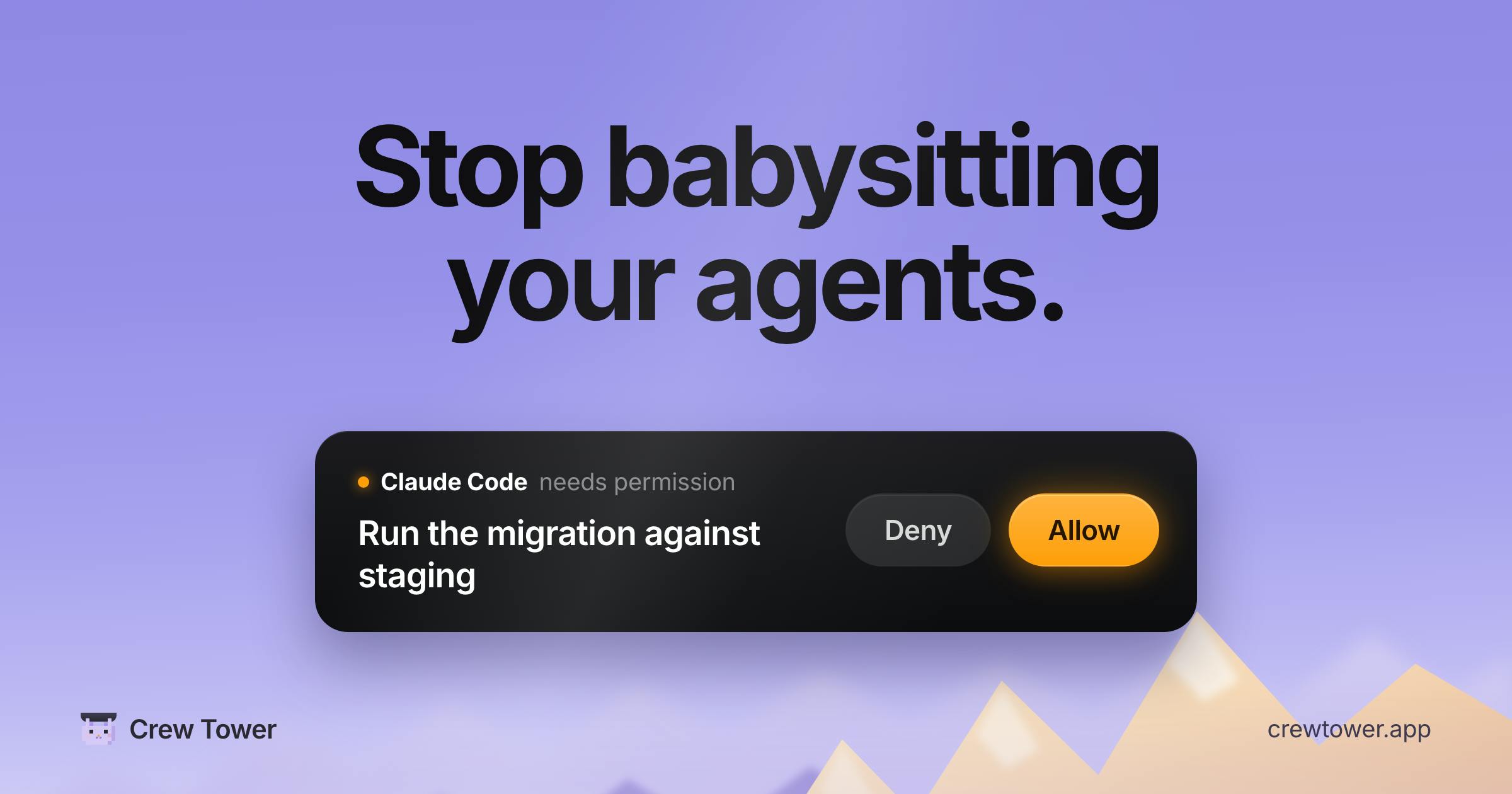
CrewTower's Core Features: Turning the Notch into an Agent Command Tower
CrewTower's core philosophy can be summarized by its tagline: "Control your agents from the notch." It resides permanently in the MacBook's notch area, monitoring every AI coding assistant you're running in real time.
The MacBook notch design debuted with the 2021 MacBook Pro 14-inch and 16-inch models, where Apple reserved a cutout area at the top of the screen for the front-facing camera. In macOS, this area is covered by the menu bar by default, with the space on either side of the notch typically displaying only system menus and status icons. Since this area is essentially "semi-idle" in most usage scenarios—users rarely focus their gaze there, yet it remains at the most prominent position on screen—CrewTower's transformation of it into a notification and control center is fundamentally a clever interaction design: leveraging a UI position that's always visible but doesn't occupy the primary workspace to carry information that requires immediate response without interrupting workflow.
One-Click Authorization: No More Terminal Window Switching
When any AI assistant needs permissions, the request appears directly at the notch with complete contextual information:
- Specific commands: The exact instruction about to be executed
- File edits: Which files are being modified
- Questions asked: What the assistant wants to ask you
You can approve or reject directly from the notch interface with a single click—no need to switch back to terminal windows. This design eliminates the tedious chain of "discover request → locate terminal → read context → type confirmation" in traditional workflows, compressing response cost to a minimum.
Global Session Overview: All AI Assistant Statuses at a Glance
Another major value of CrewTower lies in "visibility." It lets you see the status of all sessions in one place—which ones are working, which are waiting for you, and which have completed. When an assistant needs your intervention, you can jump directly to the corresponding terminal window with precise targeting.
In the official team's words, the goal is to ensure that "Nothing stalls silently." For developers juggling multiple AI agents simultaneously, this guarantee of "nothing missed" offers tremendous practical value.
Why CrewTower Aligns with AI Programming Industry Trends
Multi-Agent Parallel Collaboration Is Becoming the New Development Normal
CrewTower's emergence is no coincidence—it reflects an important evolutionary direction in AI programming: moving from a single assistant to multi-agent parallelism. More and more developers no longer rely on a single tool but combine different AI assistants based on task characteristics—using Claude Code for complex refactoring, Cursor for real-time completion, and Gemini or Qwen for specific scenarios.
As the number of agents running in parallel increases, "coordination" itself becomes an independent job. The core technical challenges of multi-agent parallel programming go beyond user-side "switching fatigue" and involve deeper coordination issues: when multiple AI agents operate on the same code repository simultaneously, file modification conflicts can occur (two agents editing the same file simultaneously), context inconsistencies can arise (one agent's modifications invalidating another agent's plan), and resource competition can emerge (multiple agents running tests or build commands simultaneously, exhausting system resources). The industry is still exploring solutions, with common approaches including assigning independent Git branch workspaces to each agent, using file locking mechanisms to prevent concurrent modification conflicts, and establishing inter-agent messaging protocols.
CrewTower productizes and visualizes the user-level coordination work, filling a gap in the AI programming tool ecosystem. While it doesn't yet address deep technical coordination between agents, the multi-agent management needs it reveals suggest significant room for future development in this space.
"Human-in-the-Loop" Authorization Design Ensures Safety and Control
You might not have noticed, but CrewTower emphasizes the authorization and confirmation process rather than full automation. This reflects a consensus in current AI programming practice: maintaining a "human-in-the-loop" (HITL) checkpoint is crucial when dealing with AI operations that might modify files or execute commands.
Human-in-the-Loop (HITL) is a core paradigm in AI system design, referring to the placement of human review nodes within the AI's decision and execution chain to ensure critical operations must receive human confirmation before execution. This concept originates from cybernetics and automation system design and is particularly important in AI programming—when AI agents have the ability to directly modify source code files, execute shell commands, or even operate databases, a single erroneous automatic execution could lead to irreversible consequences such as code being overwritten, data being deleted, or system configurations being corrupted. Current mainstream AI programming tools have widely adopted HITL design: for example, Claude Code requires user confirmation by default before executing file writes and shell commands, while Codex offers multiple permission levels ranging from fully autonomous to step-by-step confirmation.
The core challenge of HITL is balancing safety with efficiency—more confirmation steps mean more safety but also significantly slower work pace. CrewTower attempts to find a balance between "efficiency" and "safe controllability" by reducing the operational cost of these checkpoint steps.
Product Positioning and What to Know Before Using It
As a tool built by independent developer Said Altan, CrewTower has a clear and focused positioning: it doesn't try to replace any AI coding assistant but rather serves as a "meta-layer" management tool above them.
A meta-layer is a software architecture and product strategy concept referring to an abstraction layer built on top of a set of existing tools or platforms that provides unified cross-tool management capabilities. This pattern is not uncommon in software engineering: Kubernetes is a meta-layer management tool for containers—it doesn't run any business logic itself but uniformly schedules and manages hundreds or thousands of container instances; Terraform is a meta-layer orchestration tool for cloud infrastructure, letting you manage resources across different cloud platforms with a unified configuration language. CrewTower positions itself as a meta-layer management tool for AI programming agents. The core advantage of meta-layer products is that they don't need to replace underlying tools but create value through aggregation and enhancement, naturally forming complementary rather than competitive relationships with other products in the ecosystem. This strategy of "not competing with the ecosystem but enhancing it" often achieves good community acceptance.
However, such tools also face some practical challenges. First is compatibility maintenance cost—it needs to continuously adapt to updates from Claude Code, Cursor, and many other tools. The value of meta-layer products is highly dependent on the ecosystem prosperity of underlying tools, while API changes, protocol upgrades, or the underlying tools integrating similar features themselves could all pose threats to meta-layer products. Second is platform limitation—currently it deeply depends on macOS's notch feature, meaning Mac users without a notch and users on other platforms cannot experience it for now.
Additionally, judging from only 1 comment on Product Hunt, the product is still in its early stages. Its actual user experience, stability, and completeness of support for various AI coding assistants still await validation from more users.
Summary: A "Management Layer" Tool for the Multi-Agent Era
CrewTower is a classic example of a "small entry point, real pain point" product. It doesn't have a grand narrative but precisely solves a specific and annoying problem in the multi-agent programming era: how to never miss or stall any AI assistant waiting for your confirmation.
As AI coding assistants become more widespread and multi-agent workflows mature, "agent management layer" tools like CrewTower will likely become an emerging category in developer toolchains. For developers who switch between multiple AI assistants daily, it's worth watching and trying out.
Related articles

Chain of Thought Isn't Just for AI: How Humans Can Use CoT to Improve Thinking Quality
Chain of Thought isn't just a prompt trick for large models. Starting from a Hacker News discussion, this article analyzes why CoT works for human thinking too, breaks down actionable ways to transfer it, and highlights the key differences between human CoT and machine CoT.
Cloudflare Teams Up with OpenAI: Closi…
Cloudflare Teams Up with OpenAI: Closing the Loop from Vulnerability Discovery to Defense with AI
Cloudflare uses OpenAI Daybreak to investigate security vulnerabilities and generate reviewable remediation plans, while developers use Codex to boost coding efficiency and quality.

Orca Multi-Agent Orchestration in Practice: A Guide to Parallel Collaboration with Claude and Codex
Orca is Stable AI's free open-source agent workbench supporting 34 agents like Claude Code and Codex in parallel. Learn its Git worktree isolation, multi-model orchestration, and mobile management.