Cronloop AI: A Scheduled Task Platform That Lets AI Agents Run Automatically in Loops

Cronloop AI combines cron-like scheduling with AI agents for automated, self-improving recurring tasks.
Cronloop AI is a platform that lets users create AI agents that run automatically on recurring schedules, from every five minutes to weekly. Users describe tasks in Markdown and choose between Codex or Claude Code as the execution engine. Its standout features include a durable memory system for cross-run continuity and self-improvement capabilities. Ideal for developers automating code monitoring, data reports, and system health checks.
From "One-Off Conversations" to "Continuously Running" AI Agents
Most AI tools today still operate in a "question-and-answer" interaction mode — the user makes a request, the model responds, and the task ends. However, many real-world jobs aren't one-time affairs; they require periodic, continuous execution: monitoring data changes, generating reports on schedule, tracking code repositories, checking system status, and more. Cronloop AI targets precisely this pain point, proposing an imaginative new direction — letting AI agents run in loops.
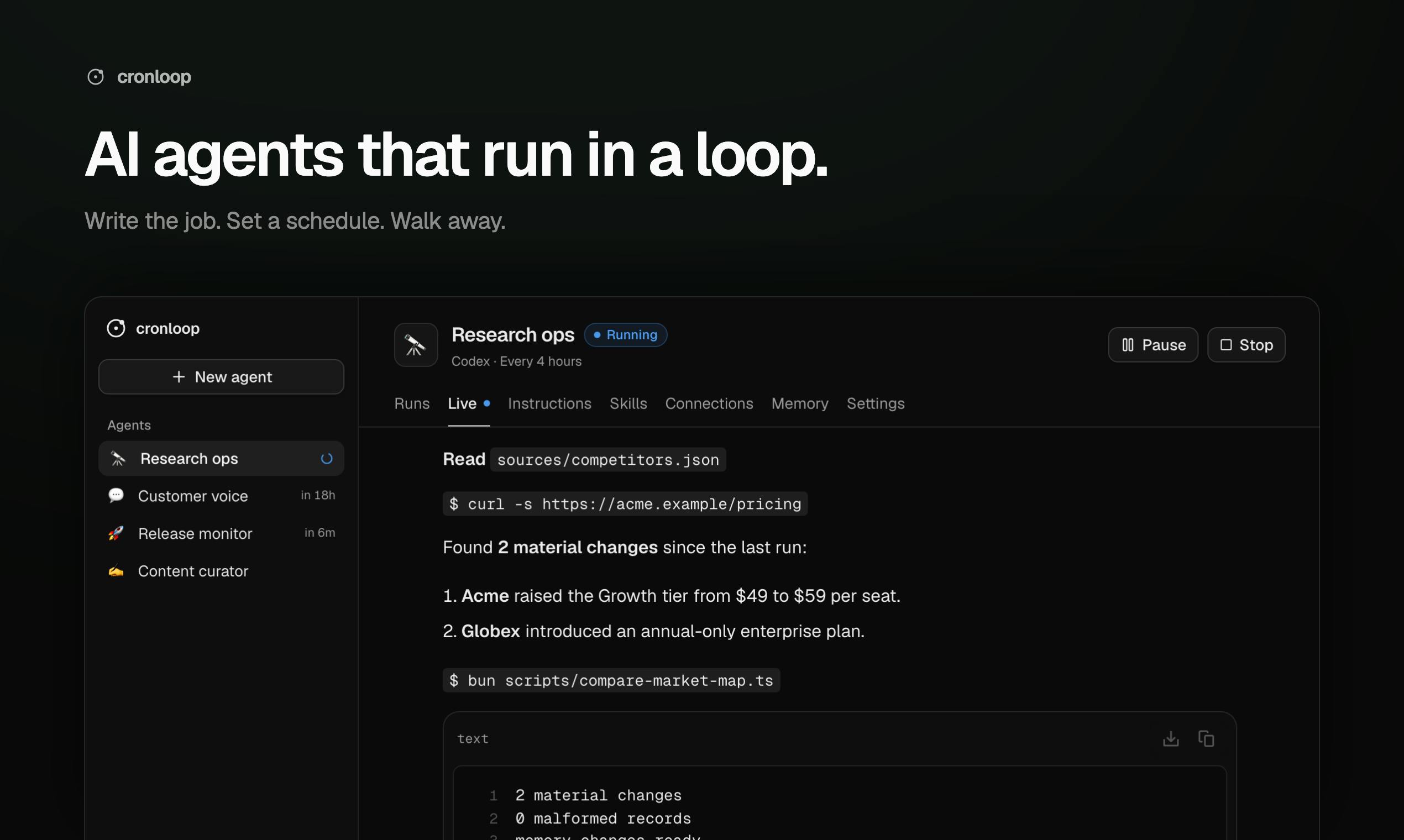
According to product information on Product Hunt, Cronloop allows users to create AI agents that run in loops, with frequencies ranging from every five minutes to once a week. The name itself is quite telling — "Cron" refers to the classic scheduled task scheduler in Unix systems, while "loop" represents cycling — together, they perfectly express the product's core philosophy: merging the reliability of scheduled tasks with the intelligent capabilities of AI agents.
It's worth noting that Cron, as a daemon process in Unix/Linux operating systems, has been the de facto standard for server-side task scheduling since AT&T Bell Labs first introduced it in 1975. Users define precise execution times by writing cron expressions (composed of five time fields: minute, hour, day, month, weekday). For example, 0 9 * * 1 means "execute every Monday at 9 AM." While cron has proven its reliability over nearly 50 years, its configuration threshold isn't friendly to non-technical users, and traditional cron jobs execute fixed scripts without the ability to dynamically adjust behavior based on context — exactly the problem Cronloop aims to solve.
Cronloop AI's Core Mechanism: Describe Tasks in Markdown, Choose Your AI Engine
A Minimalist Configuration Flow
Cronloop's workflow is designed to be remarkably simple. According to the official description, users only need to complete a few steps: describe the task content in plain-text Markdown, select the underlying execution engine (Codex or Claude Code), connect the required tools, and the agent is ready.
This "describe tasks in natural language" approach lowers the barrier to automation. Traditional scheduled tasks often require writing scripts, configuring cron expressions, and handling various exceptions, but Cronloop attempts to abstract all of this into a human-readable Markdown description. Choosing Markdown as the task description medium is a clever design decision — Markdown is a lightweight markup language created by John Gruber in 2004 that preserves the simplicity of plain text while providing clear semantic hierarchy through structured elements like headings, lists, and code blocks for the AI engine. Compared to having users write JSON configuration files or YAML templates, Markdown is far more intuitive; at the same time, it's more structured than completely free-form natural language input, helping AI engines accurately parse user intent. For users who aren't proficient in programming, this is undoubtedly a more accessible entry point.
Dual Engine Choice: Codex and Claude Code
Interestingly, Cronloop offers two engine options: Codex and Claude Code. This means it isn't tied to a single model provider, but gives users the freedom to choose between the OpenAI and Anthropic ecosystems.
These two engines differ significantly in technical architecture and capability focus. Codex is OpenAI's AI agent platform designed for software engineering, built on its latest reasoning models, capable of autonomously executing coding tasks in cloud sandbox environments and excelling at parallel processing of multiple development tasks. Claude Code, on the other hand, is Anthropic's command-line AI coding agent that runs directly in the user's development environment, renowned for its deep understanding of large codebases and context retention capabilities. The two represent different architectural paradigms for AI coding agents: Codex leans toward cloud-isolated execution, emphasizing security and scalability; Claude Code stays closer to developers' local workflows, emphasizing deep grasp of project context.
Claude Code particularly excels at autonomous code-related task execution, which explains why the product is categorized under "Software Engineering" — it's likely primarily aimed at developer scenarios such as automated code review, dependency checking, CI assistance, and more. By supporting both engines, Cronloop lets users choose the most suitable execution backend based on specific task characteristics.
Two Key Differentiators: Durable Memory and Self-Improvement
A Durable Memory System Gives Agents Continuity
One of Cronloop's most noteworthy features is its "durable memory system." In traditional AI agent design, each run is typically stateless — the model doesn't remember what it did last time. But for agents that run in loops, memory is practically a must-have: the agent needs to know the previous execution results, which data has already been processed, and what problems were encountered before.
From a technical perspective, memory systems for AI agents represent a core challenge in the industry today. Large language models are inherently stateless — each call starts from scratch, retaining no information from prior interactions. To achieve persistent memory across sessions, external storage mechanisms are typically required, such as vector databases (Pinecone, Weaviate, etc.) for storing semantically-indexed historical information, or structured databases for recording execution states and key data points. More sophisticated implementations also incorporate memory retrieval and compression mechanisms — at each run, the agent doesn't load the entire history (which would quickly exhaust the context window), but instead retrieves the most relevant historical fragments through semantic similarity search. This design is known in academia as a variant of RAG (Retrieval-Augmented Generation) architecture and is critical infrastructure for building long-running agents.
Durable memory gives agents continuity across run cycles. For example, an agent monitoring competitor activity can remember information it already reported last week, presenting only new changes in the current run rather than repeatedly outputting everything. This memory capability is a key foundation for building truly practical long-running agents.
Self-Improvement with Each Run
Another compelling selling point is that agents "can self-improve each run." This claim points to a cutting-edge and somewhat controversial direction in the autonomous agent space — letting AI optimize its own behavioral strategies through repeated execution.
In terms of technical implementation, AI agent "self-improvement" typically follows several paths: first, Prompt Tuning, where the agent automatically adjusts the prompts used in the next run based on execution result feedback; second, meta-learning, which adjusts decision strategies by recording successes and failures; and third, reward signal optimization based on reinforcement learning. It's important to note that this "self-improvement" is fundamentally different from model fine-tuning — the agent improves its workflow and strategies, not the underlying model itself. The controversy in this area lies in the fact that unconstrained self-modification can lead to Behavior Drift, where the agent gradually deviates from the user's original intent. Therefore, reliable self-improvement systems typically require clearly defined constraint boundaries and human review mechanisms.
If this feature works as described, then in theory, agents would gradually learn to complete tasks better as the number of runs increases: adjusting prompts, correcting errors, optimizing output formats, and so on. Of course, such "self-improvement" in practice usually still has boundaries, and actual effectiveness remains to be seen. However, from a product design philosophy perspective, this complements the memory system, together forming Cronloop's core value proposition that distinguishes it from ordinary scheduled scripts.
Cronloop AI's Market Positioning and Use Cases
Cronloop was built by Mike Tromba and received 85 upvotes on Product Hunt, ranking 12th that day, categorized under SaaS, Software Engineering, and Artificial Intelligence. While the number of reviews is still limited and the product is in its early stages, the product philosophy it represents is quite noteworthy.
Positioning Within the "Agentic Automation" Trend
A clear trend in AI is the evolution from "chat assistants" to "autonomous agents." From AutoGPT igniting the autonomous agent concept in 2023, to the emergence of Devin (the first AI software engineer) and various agent frameworks (LangGraph, CrewAI, AutoGen) in 2024, to OpenAI launching the Codex agent platform and Anthropic releasing Claude Code in 2025, the AI industry is undergoing a fundamental shift from the "tool paradigm" to the "agent paradigm." Under the tool paradigm, AI is passive — waiting for user input and generating one-time output; under the agent paradigm, AI is proactive — capable of planning, executing, observing, reflecting, and making autonomous decisions across multi-step tasks. Gartner predicts that by 2028, at least 15% of day-to-day work decisions will be made autonomously by AI agents.
Cronloop can be seen as a concrete attempt to apply this trend to the "scheduled automation" track. It combines the concepts of "agents" and "scheduling" to fill a clear market gap. Current mainstream automation platforms like Zapier, Make (formerly Integromat), and n8n primarily operate on a "trigger-action" workflow paradigm — users define explicit trigger conditions (such as receiving an email or a form submission), then execute preset action sequences. The advantage of this model is strong determinism and predictability, but its fundamental limitation is the lack of "understanding" and "judgment" capabilities: it can only execute predefined logic branches and cannot handle ambiguous tasks requiring reasoning. For example, traditional automation can "send yesterday's sales data every day at 9 AM," but it cannot "analyze anomalous trends in sales data and provide possible explanations." This is precisely the gap Cronloop aims to bridge — combining the reliability of scheduled tasks with AI's cognitive capabilities, filling the void where traditional automation tools lack intelligence and general-purpose AI assistants lack continuous execution ability.
Potential Use Cases
Based on its features, Cronloop is suitable for scenarios including but not limited to:
- Code repository monitoring: Periodically checking for dependency updates, security vulnerabilities, and PR status
- Data report generation: Regularly fetching data and generating structured summaries
- Information aggregation: Tracking news or competitor developments on specific topics
- System health checks: Periodically checking service status and generating alerts
Cronloop currently offers the opportunity to create your first agent for free, making the barrier to entry quite low for users looking to experiment with automated AI workflows.
Conclusion: AI Agents Move from Passive Response to Proactive Execution
The emergence of Cronloop AI reflects the productization journey of AI agents moving from "passive response" to "proactive execution." Describing tasks in Markdown, dual engine selection, durable memory, and self-improvement — these design choices together outline the prototype of a "reliable and intelligent scheduled agent."
Of course, as an early-stage product, its actual effectiveness, stability, and the true caliber of its "self-improvement" capabilities remain to be validated by the market. But what is undeniable is that the concept of "letting AI run in loops" hits squarely on the pulse of the current trend toward automation and AI convergence. For developers and automation enthusiasts alike, Cronloop is worth keeping on your radar.
Related articles

Cross-App Access for AI Agents: Three Identity Vendors Converge on the Same Architecture Pattern in 8 Days
Okta, Auth0, and Descope all shipped Cross App Access within 8 days. This article breaks down the two-layer access pattern behind AI Agent identity management.

Dense Models Too Slow to Run Locally? How MoE Architecture Breaks Through the Performance Bottleneck
Dense models are slow on local hardware due to memory bandwidth limits. Learn how MoE sparse activation architecture dramatically boosts local inference speed and the future of local AI deployment.

Storm Summoner: A MIDI Controller Built Specifically for Guitar Effects Pedals
A deep dive into the Storm Summoner open-source MIDI controller for guitar effects pedals—covering design philosophy, technical architecture, and how it compares to commercial solutions.