Cross-Market Meta-Learning: How MetaGrid Improves Electricity Price Forecasting Accuracy

MetaGrid uses a topology-aware Transformer and cross-market meta-learning to set a new MAE record for electricity price forecasting across five U.S. ISOs.
Electricity price forecasting has long been limited by the "one market, one model" paradigm: a single grid's hourly data spans only a few years, causing models to saturate, while nodes are treated as independent sequences, losing the spatial dependencies of network topology and congestion. MetaGrid proposes a topology-aware Transformer trained via cross-market meta-learning with a single parameter set agnostic to the number of regions, enabling rapid adaptation to unseen grids. On a leakage-free benchmark across five U.S. ISOs, using identical inputs (prices, day-ahead load forecasts, calendar features), MetaGrid achieves the lowest average MAE, improving 3.1% over the best baseline and 7.7% over training from scratch, proving the effectiveness of cross-market knowledge transfer and topology awareness and offering a scalable forecasting paradigm for data-scarce markets.
Electricity price forecasting has long been a core challenge in power market operations. Traditional approaches typically model each market separately, training a model on that grid's own historical data. This "one market, one model" approach seems reasonable, but it is constrained by the mere few years of hourly data available for a single market, causing statistical and tree-based models to saturate in performance, while high-capacity sequence models struggle to train sufficiently. More critically, these methods treat each node as an independent sequence, discarding the spatial dependencies introduced by network topology and congestion.
A recent paper proposes MetaGrid, a topology-aware Transformer that, through cross-market meta-learning, enables a single parameter set to adapt to unseen power grids. On a leakage-free benchmark across five U.S. ISOs, MetaGrid achieves the lowest average MAE, improving 3.1% over the best baseline and 7.7% over training the same architecture from scratch.
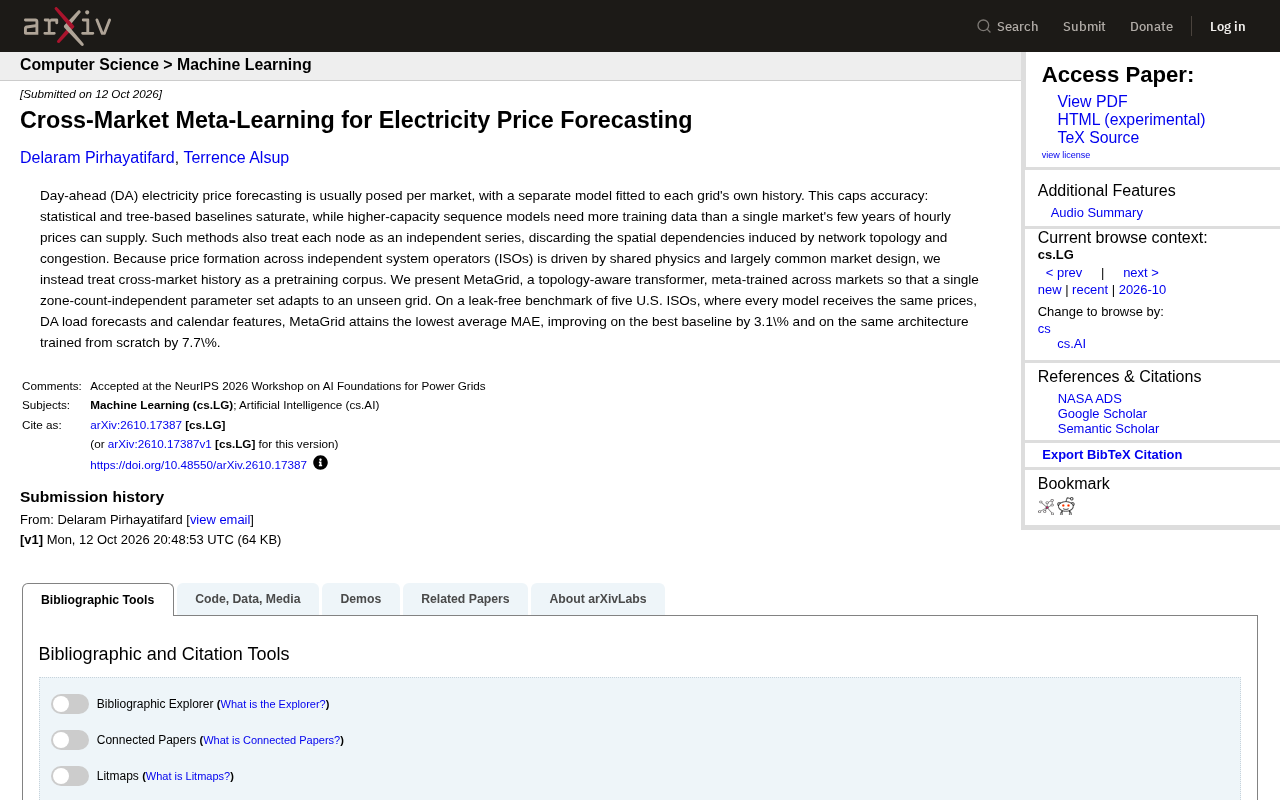
The Bottleneck of Electricity Price Forecasting: Data Scarcity and Missing Spatial Dependencies
Day-ahead electricity price forecasting is typically performed independently per market, fitting a separate model for each grid. The ceiling of this paradigm is obvious: statistical and tree-based baselines have already saturated, while higher-capacity sequence models require more training data than a single market's few years of hourly prices can provide.
Moreover, existing methods treat each node as an independent sequence, ignoring the spatial dependencies arising from network topology and congestion. In reality, price formation across different ISOs is driven by shared physical laws and largely common market designs. This means cross-market history can serve as pre-training corpus rather than isolated fragments.
This is precisely the core insight of MetaGrid: rather than starting from scratch for each market, meta-train a topology-aware Transformer across markets, teaching the model "how to learn" a new grid.
Day-ahead electricity price forecasting is a core component of power markets: market participants must submit bids or consumption schedules for each hour of the next day one day before operation, making it crucial to forecast the locational marginal price (LMP) for each node or region a day in advance. Major regional power grids in the U.S. are operated by multiple ISO/RTOs (Independent System Operators/Regional Transmission Organizations), such as PJM, MISO, CAISO, ISO-NE, and NYISO, each with its own market clearing rules and price formation mechanisms.
LMP (Locational Marginal Price) consists of three components: system energy price, congestion price, and loss price. When transmission lines become congested, prices diverge across nodes, which is the source of spatial dependencies. Traditional methods that treat nodes as independent sequences effectively ignore the price divergence mechanism caused by congestion.
MetaGrid's Design: Topology Awareness and Meta-Learning
MetaGrid is a topology-aware Transformer meta-trained across markets. Its key property is: a single, region-count-agnostic parameter set that can adapt to unseen power grids.
This means that regardless of how many zones the target grid has, the model's parameter scale remains unchanged. Through a meta-learning framework, it is trained on tasks from multiple markets, thereby acquiring the ability to rapidly adapt to new markets. At the same time, the topology-aware mechanism allows the model to leverage network structure information and capture spatial dependencies between nodes.
On the leakage-free benchmark, five U.S. ISOs use identical inputs: electricity prices, day-ahead load forecasts, and calendar features. MetaGrid achieves the best average MAE, improving 3.1% over the best baseline and 7.7% over training the same architecture from scratch. This validates the effectiveness of cross-market meta-learning and topology awareness.
Meta-Learning is centered on the idea of "learning to learn": a model is trained on a large number of related tasks to learn a good initialization or adaptation strategy, so that it can quickly converge on a new task with only a few samples. Common algorithms include MAML (Model-Agnostic Meta-Learning) and gradient-based Reptile. In the electricity price forecasting setting, each ISO market can be viewed as a task; meta-training allows the model to extract shared price formation patterns from multiple markets' histories and transfer them to new grids.
Topology awareness refers to the model explicitly modeling the grid's graph structure: treating regions or nodes as graph vertices and transmission lines or inter-regional connections as edges. A Transformer can, through attention masks or graph attention mechanisms, let each node's representation aggregate neighbor information, thereby capturing congestion propagation and spatial correlations.
Experimental Results and Implications
Experiments are conducted on five U.S. ISOs, ensuring no leakage: each model receives the same electricity prices, day-ahead load forecasts, and calendar features. MetaGrid achieves the lowest average MAE.
The improvement may seem modest, but given the difficulty of electricity price forecasting and the maturity of baseline methods, a 3.1% improvement has practical value. More importantly, the 7.7% improvement comes from comparing meta-training against training from scratch, demonstrating that cross-market knowledge transfer is indeed effective.
The significance of this research lies in breaking the mindset of "modeling each market independently." By treating cross-market history as pre-training corpus and introducing topology awareness, MetaGrid offers a scalable paradigm for electricity price forecasting. For data-scarce markets, this approach is particularly attractive.
In the future, this cross-market meta-learning idea may be extended to other energy forecasting tasks, or even broader spatiotemporal sequence forecasting problems.
MAE (Mean Absolute Error) is a commonly used evaluation metric in forecasting tasks, calculated as the average of absolute differences between predicted and true values, with the same unit as electricity prices (e.g., USD/MWh); lower values are better. Compared with MSE, MAE is more robust to outliers, making it suitable for highly volatile series such as electricity prices.
Leakage-free benchmark means strictly avoiding the use of future information in data splitting and feature engineering: training, validation, and test sets are split in chronological order, and any feature (such as load forecasts or calendar variables) is known at the forecast time. In electricity price forecasting, leakage often comes from incorrect normalization or rolling statistics; a leakage-free design ensures fairness of evaluation and practical deployment value.
One-line Summary
MetaGrid uses a topology-aware Transformer and cross-market meta-learning to set a new MAE record for electricity price forecasting across five U.S. ISOs.
Paragraph Summary
Electricity price forecasting has long been constrained by the "one market, one model" paradigm: a single grid's hourly data spans only a few years, causing model performance to saturate, while nodes are treated as independent sequences, losing the spatial dependencies of network topology and congestion. MetaGrid proposes a topology-aware Transformer that, through cross-market meta-learning, trains a single parameter set agnostic to the number of regions and can rapidly adapt to unseen grids. On a leakage-free benchmark across five U.S. ISOs, using identical inputs (electricity prices, day-ahead load forecasts, calendar features), MetaGrid achieves the lowest average MAE, improving 3.1% over the best baseline and 7.7% over training the same architecture from scratch. These results demonstrate the effectiveness of cross-market knowledge transfer and topology awareness, offering a scalable new forecasting paradigm for data-scarce markets.
Related articles

Chain of Thought Isn't Just for AI: How Humans Can Use CoT to Improve Thinking Quality
Chain of Thought isn't just a prompt trick for large models. Starting from a Hacker News discussion, this article analyzes why CoT works for human thinking too, breaks down actionable ways to transfer it, and highlights the key differences between human CoT and machine CoT.
Cloudflare Teams Up with OpenAI: Closi…
Cloudflare Teams Up with OpenAI: Closing the Loop from Vulnerability Discovery to Defense with AI
Cloudflare uses OpenAI Daybreak to investigate security vulnerabilities and generate reviewable remediation plans, while developers use Codex to boost coding efficiency and quality.

Orca Multi-Agent Orchestration in Practice: A Guide to Parallel Collaboration with Claude and Codex
Orca is Stable AI's free open-source agent workbench supporting 34 agents like Claude Code and Codex in parallel. Learn its Git worktree isolation, multi-model orchestration, and mobile management.