Cross-Platform Family Location Sharing with Open Source: A Complete Guide to OwnTracks and Traccar
Open-source cross-platform family location sharing with OwnTracks, Traccar, and Home Assistant.
Families with mixed iOS and Android devices often struggle with location sharing due to Big Tech ecosystem lock-in. This guide explores open-source, self-hosted alternatives — OwnTracks, Traccar, and Home Assistant — that work across platforms while keeping location data fully under your control. It covers setup considerations, privacy benefits, and how to choose the right solution based on your technical skill level.
The Cross-Platform Family Location Dilemma: Bridging iOS and Android
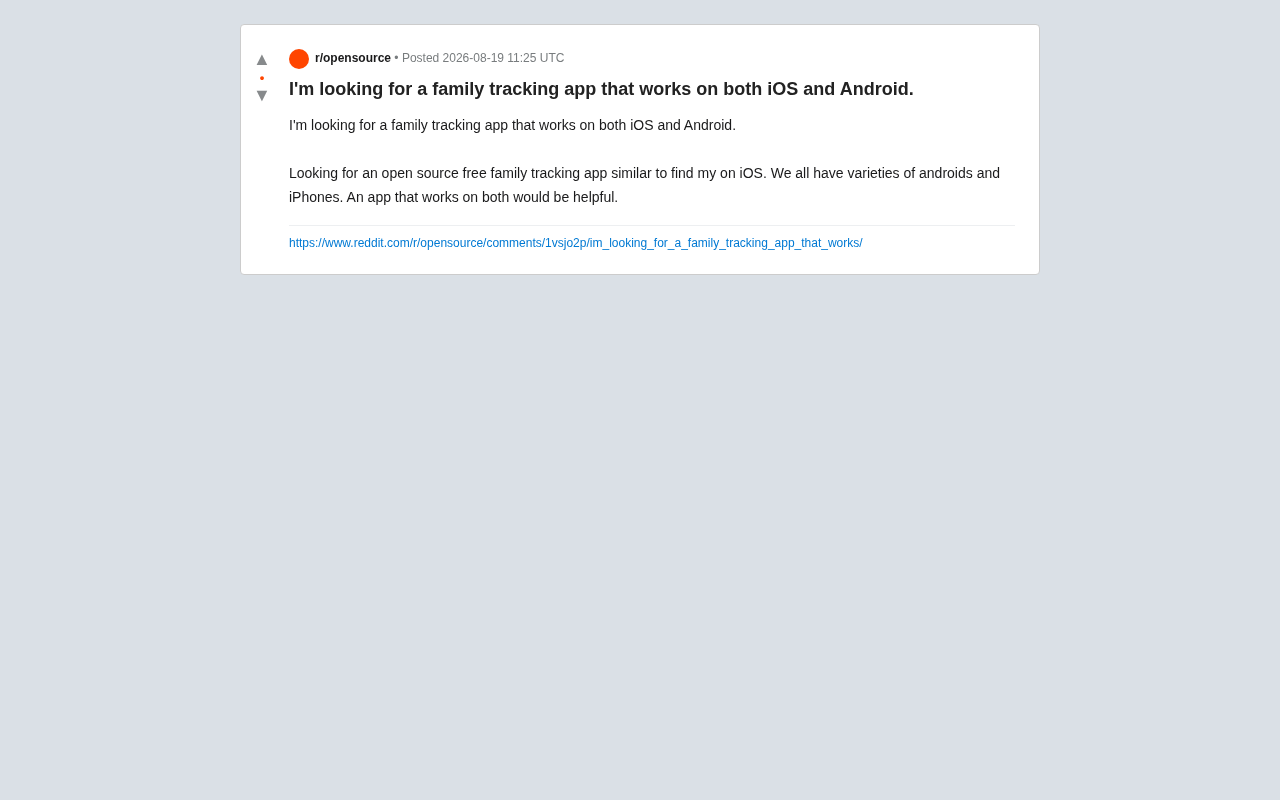
On Reddit, a user raised a highly relatable question: family members use a mix of devices — some on Android, others on iPhone — so how do you find a family location-sharing app that works seamlessly across both platforms?
Their core requirements were crystal clear:
- A user experience similar to Apple's Find My
- Support for both iOS and Android
- Preferably open source and free
This need reflects a common pain point for modern digital households. Apple's Find My ecosystem is mature and polished, but it's locked firmly within the Apple device universe. Google's Find My Device is equally confined to the Android camp. For families with mixed devices, finding a truly neutral cross-platform location solution often means stepping outside Big Tech ecosystems and turning to the open-source community.
Why Big Tech Solutions Fall Short for Cross-Platform Location Sharing
Ecosystem Lock-In Is the Fundamental Barrier
Apple's Find My relies on a massive Bluetooth/UWB crowdsourced network, offering excellent security and accuracy — but it was designed from the ground up as a moat for its closed ecosystem. The system uses an end-to-end encrypted crowdsourced network architecture: when a device is lost, it broadcasts encrypted location beacons via Bluetooth Low Energy (BLE) to nearby Apple devices. These "passing" devices upload the encrypted beacons to Apple's servers, and only the private key held by the device owner can decrypt the location data. The introduction of UWB (Ultra-Wideband) technology in 2021 further improved precision, enabling centimeter-level spatial awareness between supported devices. However, Android users — even with related components installed — cannot participate in this encrypted crowdsourced network or access the full location-sharing experience.
Likewise, Google's upgraded Find My Device network, while feature-enhanced, remains Android-centric, leaving iPhone users out in the cold.
Privacy Concerns Are Driving the Rise of Open-Source Location Solutions
Family location tracking inherently involves the most sensitive personal data — the real-time whereabouts of every family member. When using third-party commercial apps (such as subscription-based family tracking software), users entrust their entire family's movement data to a for-profit company — and such apps have repeatedly been involved in data misuse or breach incidents.
This is precisely why a growing number of privacy-conscious users are actively seeking open-source, self-hosted alternatives. Open source means transparent code and auditable logic; self-hosting means data stays entirely in your own hands. Users deploy applications on servers they control, and location data only travels between family members' devices and the family's own server — no third party can access it. You can use a Raspberry Pi at home, a NAS device, or a rented VPS to set up the server. The advantage of this approach is complete data sovereignty, unaffected by service provider policy changes or shutdowns, with the ability to customize features as needed.
Open-Source Cross-Platform Family Location Solutions Explained
OwnTracks: The Classic Self-Hosted Location Tool
In the open-source family location space, OwnTracks is an indispensable classic. It offers both iOS and Android clients, reporting location data to a user's self-hosted server via MQTT or HTTP protocols.
MQTT (Message Queuing Telemetry Transport) is a lightweight publish/subscribe messaging protocol particularly well-suited for IoT scenarios. In OwnTracks, the phone client acts as a publisher sending location data to an MQTT Broker (message broker server), while other family members' devices act as subscribers receiving these location updates. Compared to traditional HTTP polling, MQTT offers higher real-time performance, lower network overhead, bidirectional communication support, and stable connectivity even in poor network conditions.
Key advantages of OwnTracks include:
- Fully self-hosted — location data never passes through any third-party server
- Consistent cross-platform client experience
- Geofencing support, with notifications triggered when family members enter or leave specific areas
- Lightweight deployment with low resource consumption
Geofencing is a feature that uses GPS, cell tower, or Wi-Fi positioning to set virtual boundaries on a map. The system continuously monitors device location and triggers corresponding actions when a user enters or leaves a predefined area. The underlying implementation involves continuous location sampling and boundary detection algorithms. To balance accuracy and battery consumption, a layered strategy is typically used: reducing sampling frequency when far from the fence boundary and increasing monitoring density when approaching it.
The main barrier with OwnTracks is that it requires a certain level of technical skill to configure the backend server (such as setting up an MQTT Broker and Recorder), which isn't particularly friendly for average household users.
Traccar: A Feature-Rich Open-Source Location Platform
Traccar is another mature open-source location system. Originally designed for vehicle GPS tracking, it's equally well-suited for family member location sharing. It supports over a hundred device protocols and provides Android and iOS client apps via Traccar Client.
Key features of Traccar:
- A full-featured web admin dashboard for viewing all members' locations on a map in real time
- Historical track playback and export
- Flexible alert rules (speeding, boundary violations, offline status, etc.)
- A more polished visual interface compared to OwnTracks
However, Traccar's deployment complexity is higher, making it better suited for users with some server management experience.
Home Assistant Ecosystem Integration
For users already running a smart home platform, Home Assistant offers powerful location tracking integration capabilities. Home Assistant is one of the world's most popular open-source smart home platforms, written in Python, supporting integration with over 2,000 devices and services. Its core philosophy is Local First and privacy protection — all automation logic runs locally without relying on the cloud.
The platform uses a state machine architecture, abstracting all home devices as entities and enabling inter-device coordination through an event-driven automation engine. Through its official app or in combination with components like OwnTracks and GPSLogger, family member location tracking can be incorporated into a unified automation system. Location tracking in Home Assistant is treated as a special sensor entity that can seamlessly integrate with lighting, security, climate control, and other systems.
Typical use cases include:
- Automatically turning off lights and arming security when the last person leaves home
- Pre-activating the air conditioning before a family member arrives home
- Arrival/departure notifications through the notification system
How to Choose the Right Cross-Platform Location Solution
Choose Based on Technical Skill Level
Given the deployment barriers of open-source solutions, users need to honestly assess their technical capabilities:
| Technical Level | Recommended Solution | Advantage |
|---|---|---|
| Server administration experience | Self-hosted Traccar or OwnTracks | Privacy and control combined |
| Smart home foundation | Home Assistant integration | Additional automation value |
| Complete beginner | Start with OwnTracks HTTP mode | Relatively gentle learning curve |
Balancing Privacy and Convenience
Open-source self-hosted solutions have an absolute advantage in privacy protection, but they admittedly fall short of Apple's and Google's native solutions in convenience — the latter are plug-and-play, offer high positioning accuracy, and feature excellent background battery optimization. Users need to make a trade-off between "data sovereignty" and "ease of use."
For users who specifically require open-source and free solutions, investing some learning effort in exchange for full control over the family's location data is typically well worth it.
Conclusion: Platform-Neutral Location Solutions That Break Down Walled Gardens
The cross-platform location needs of mixed-device families represent a shared struggle for a large number of users. As Big Tech ecosystem barriers grow ever higher, open-source solutions like OwnTracks and Traccar have become vital pathways for breaking down platform silos and achieving truly cross-platform family location sharing.
They may not be as polished as native solutions, but for users who value privacy and refuse vendor lock-in, the value of "data sovereignty" is irreplaceable. Which solution you choose ultimately depends on your technical ability, your privacy standards, and how much effort you're willing to invest.
Related articles

Learning AI Large Language Models from Scratch: A Systematic Learning Path from Principles to Practice
A systematic guide to learning AI LLMs from scratch — covering principles, Prompt Engineering, API calls, RAG, fine-tuning, and Agent development across three progressive stages.
Theos RFM Review: How 3D Digital Twins Are Reshaping Facility Management
In-depth analysis of how Theos RFM uses 3D digital twins, real-time IoT data, and multi-role collaboration to solve information silos and communication challenges in facility management.
AI Models Iterate Too Fast: Community Anxiety Under Expectation Inflation from o3 to Astra
Reddit community debates AI model iteration speed: o3 considered outdated after just 16 months, Astra launch sparks expectation inflation debate. From reasoning model birth to capability leaps, how to rationally view AI's accelerating progress versus psychological adaptation mismatch.