Crystal Language Officially Releases Multithreading: A Deep Dive into the Execution Contexts Mechanism

Crystal language officially ships multithreading via Execution Contexts for true multi-core parallelism.
Crystal's multithreading support has officially exited preview, introducing Execution Contexts that enable Fibers to run across multiple OS threads for true parallel computation. This milestone adds multi-core capabilities to Crystal's existing strengths of Ruby-like syntax, static type safety, and near-C performance, all maintained by the small but dedicated Manas Tech team.
Crystal Language Reaches an Important Milestone
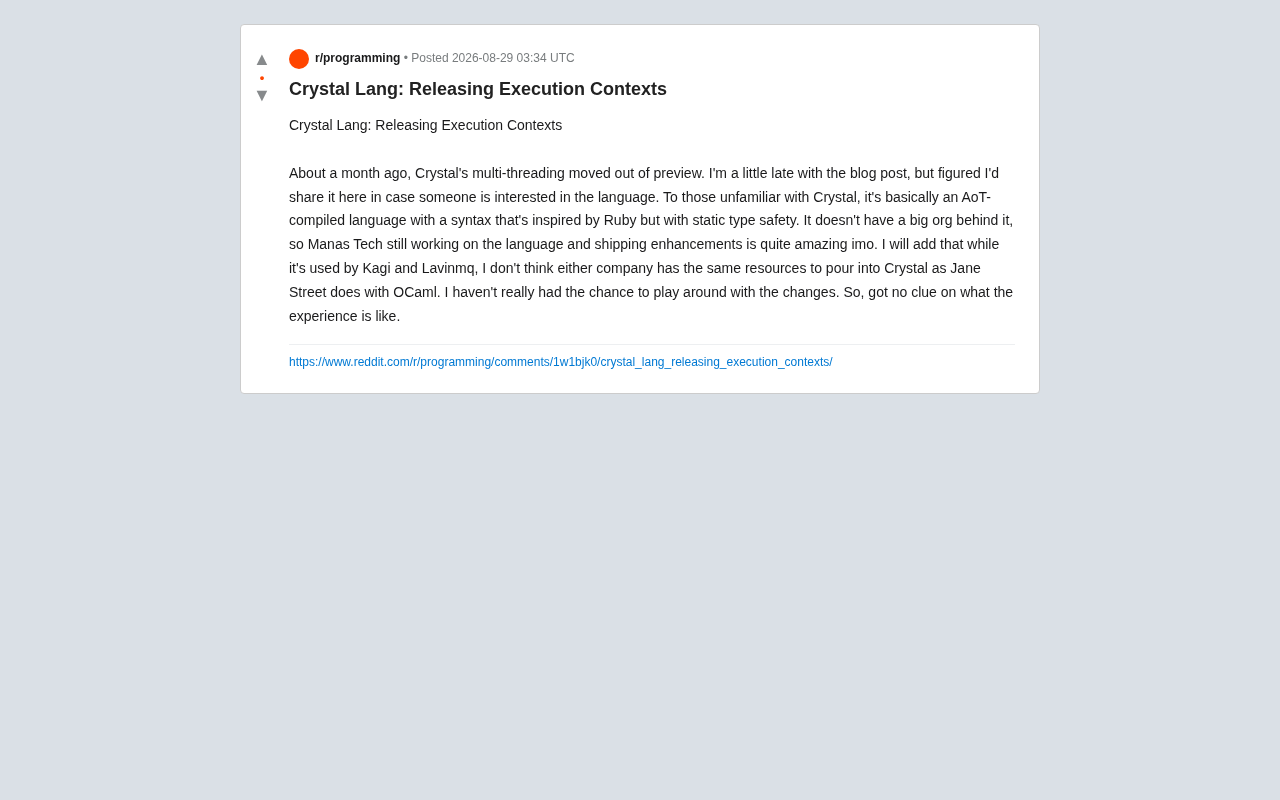
About a month ago, Crystal's multithreading support officially moved out of preview, marking a critical step forward in concurrency capabilities for this elegant compiled language. For developers already familiar with Crystal, this is undoubtedly a major update worth paying attention to.
For those unfamiliar with Crystal, here's a quick introduction: Crystal is an AoT (Ahead-of-Time) compiled programming language heavily inspired by Ruby's syntax—elegant and concise to write—but unlike Ruby, it features static type safety. Developers get to enjoy a Ruby-like writing experience while catching a wide range of type errors at compile time and achieving near-C runtime performance.
What Are Execution Contexts?
The core concept behind this update is "Execution Contexts." In Crystal's concurrency model, the language has always used lightweight Fibers as its concurrency primitive. Previously, Crystal's concurrency was largely limited to single-threaded cooperative scheduling—while this was efficient for I/O-bound tasks, it couldn't fully leverage the power of modern multi-core CPUs.
From Single-Threaded Scheduling to Multithreaded Parallelism
The introduction of the Execution Contexts mechanism gives developers finer-grained control over how Fibers are distributed and scheduled across multiple threads. In simple terms, an execution context defines the "environment" in which a group of Fibers run. Multiple execution contexts can run in parallel on different OS threads, enabling true parallel computation—not just concurrency.
The key significance of this design is that it preserves Crystal's original clean Fiber-based concurrency model while providing explicit control mechanisms for scenarios that need to squeeze out multi-core performance. Developers can organize execution contexts based on task characteristics—CPU-bound vs. I/O-bound—striking a balance between performance and controllability.
Continuous Evolution Under a Small Team
What's particularly noteworthy is the development force behind Crystal. Unlike many languages backed by large corporations or foundations, Crystal is primarily maintained and driven forward by Manas Tech, a single company. The fact that the team can consistently deliver heavyweight features like multithreading without the backing of tech giants is quite impressive in itself.
The Reality of Crystal's Ecosystem and Resources
Crystal is already being used in some production environments—for example, the search engine Kagi and the message queue LavinMQ both use the language. However, it's important to be realistic: the resources these companies invest in Crystal are nowhere near the scale of what Jane Street invests in OCaml.
This reflects a common challenge faced by niche programming languages: the technical design may be excellent, but ecosystem growth and long-term sustainability are often constrained by the resources behind them. That Crystal has made it this far is largely thanks to community enthusiasm and the core team's perseverance.
Real-World Multithreading Experience Remains to Be Seen
It should be noted that as a feature that has just exited the preview stage, real-world experience with Crystal's multithreaded execution contexts still lacks substantial practical feedback. The original author also candidly admitted they haven't yet had the opportunity to deeply test these new changes, so they couldn't offer an assessment of the actual development experience.
For developers interested in trying Crystal's multithreading, here are a few key areas to watch:
- Stability: The multithreading feature was just officially released, and edge cases may still need polishing
- Debugging experience: Troubleshooting in multithreaded environments is typically far more complex than in single-threaded ones—toolchain maturity is worth monitoring
- Performance gains: Actual parallel speedup needs to be validated against specific workloads
Conclusion
The official release of Crystal's multithreading is a significant milestone in the language's evolution. It fills in the gap of modern multi-core parallel computing capabilities on top of Crystal's existing foundation of "Ruby's elegance + C's performance + static type safety."
Although Crystal's ecosystem scale and resource investment can't compare with mainstream languages, the Manas Tech team's continued commitment proves that this language is still moving steadily forward. For developers seeking both development efficiency and runtime performance, Crystal remains a choice worth watching. As for how the new Execution Contexts concurrency model actually performs in practice—that's something that needs more developers to explore and provide feedback on.
Related articles

Python 3.15 New Feature: Is the sentinel Type Better Than None?
Python 3.15 adds the sentinel type, using named unique sentinel objects to replace None and bare object(), resolving confusion among missing values, explicit emptiness, and invalid input while avoiding type hint failures.

Deep Learning's Three Architectures and the Universal Approximation Theorem: A Complete Guide to MLPs, CNNs, and Transformers
Explaining the inductive bias differences among MLP, CNN, and Transformer, the existence meaning of the Universal Approximation Theorem (UAT), and the role of Taylor expansion in approximation analysis, while clearing up common misconceptions.

GitLab Emergency Patch Release: Analysis of Critical Security Fixes
GitLab releases critical patch 19.5.1, sparking 355 points of discussion on Hacker News. This article analyzes the background, upgrade steps for self-hosted instances, and verification points to help DevOps teams respond quickly to security updates.