Cube Studio Deep Dive: Tencent's Open-Source Cloud-Native AI Platform — A Complete MLOps Workflow Guide

Cube Studio is Tencent Music's open-source cloud-native MLOps platform covering the full AI lifecycle with domestic hardware support.
Cube Studio is a one-stop AI platform open-sourced by Tencent Music, built on cloud-native architecture. It covers the complete MLOps workflow including data labeling, Notebook development, visual Pipeline orchestration, multi-framework distributed training, large model SFT/RLHF fine-tuning, VGPU virtualized inference deployment, and computing power management. Key highlights include support for nearly ten mainstream distributed training frameworks, integration of vLLM/Ollama/MindIE inference engines, and comprehensive adaptation to domestic hardware ecosystems like Huawei Ascend CPU/GPU/NPU — making it ideal for enterprises with AI platform building, Xinchuang compliance, and private LLM deployment needs.
What is Cube Studio? A One-Stop MLOps Platform Overview
In the wave of AI engineering implementation, efficiently managing the entire workflow from data labeling and model training to inference deployment remains a core challenge for enterprises. MLOps (Machine Learning Operations) was born precisely to address this systemic problem — it brings DevOps principles into the machine learning domain, aiming to bridge the gap between models in the lab and production environments. According to Gartner, over 85% of AI projects fail to reach production, largely due to the lack of systematic engineering management processes.
Cube Studio, open-sourced by Tencent Music, targets exactly this pain point — it's a one-stop machine learning/deep learning/large model AI platform built on cloud-native architecture, covering the entire MLOps algorithm pipeline. It has earned nearly 5,000 Stars on GitHub.
This article will thoroughly dissect the technical value and practical use cases of this open-source project from multiple dimensions including architecture design, core features, domestic hardware adaptation, and ecosystem compatibility.
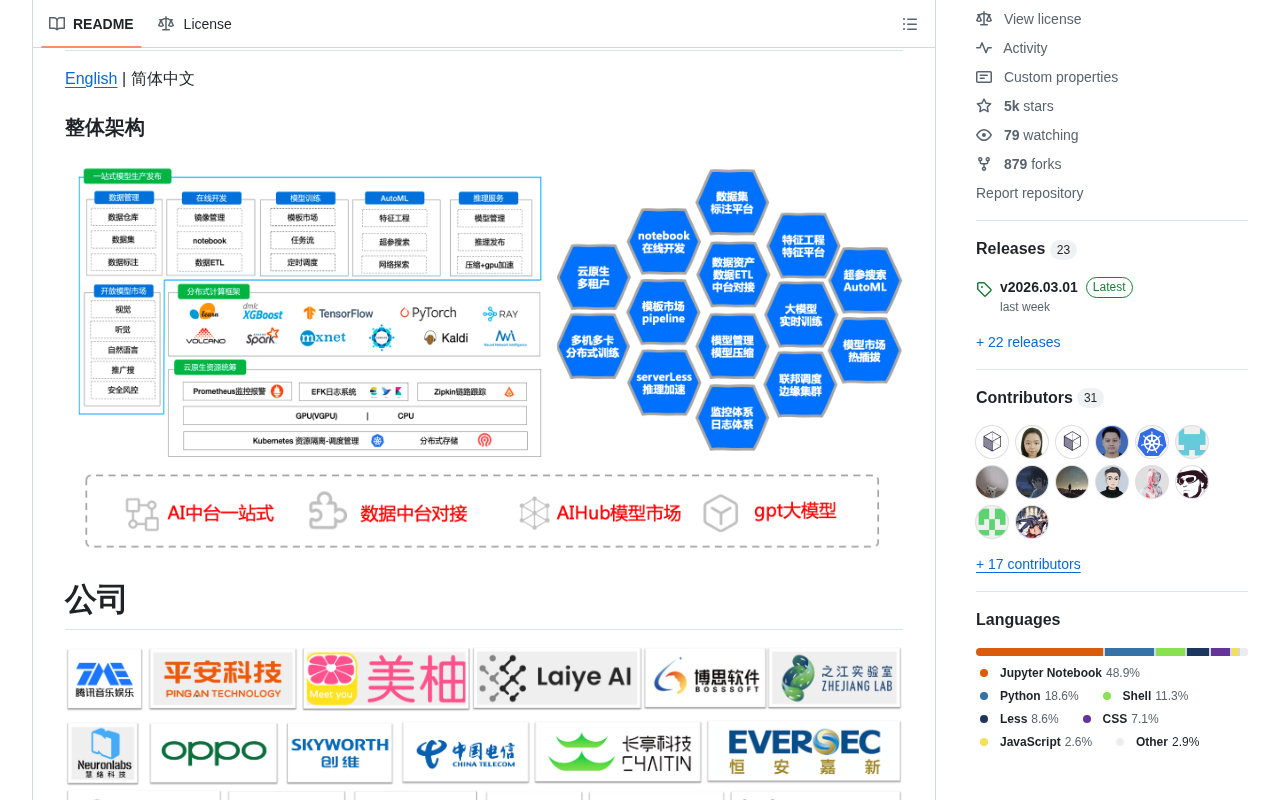
Core Features Deep Dive
Notebook Online Development: Out-of-the-Box AI Development Environment
Cube Studio provides an out-of-the-box Notebook online development environment. Developers can write, debug, and experiment with code directly in the browser without configuring complex GPU drivers and deep learning frameworks locally. This is especially friendly for environment consistency management in team collaboration scenarios and significantly lowers the barrier to entry for AI development.
Drag-and-Drop Pipeline: Visual Workflow Orchestration
The platform supports visual Pipeline orchestration, allowing users to build complex data processing and training pipelines through drag-and-drop operations. This low-code orchestration approach lets algorithm engineers focus on the algorithms themselves rather than infrastructure setup and maintenance. For experimental workflows requiring frequent iteration, the reusability and traceability of Pipelines are particularly valuable.
Multi-Node Multi-GPU Distributed Training: Supporting Nearly Ten Mainstream Frameworks
At the model training layer, Cube Studio provides powerful distributed training capabilities, supporting multi-node multi-GPU training and automated hyperparameter search. Distributed training is an essential technology in the large model era, with the core challenge being how to efficiently distribute computation and data across multiple GPUs/nodes. Current mainstream parallelism strategies include Data Parallelism, Model Parallelism (Tensor/Pipeline Parallelism), and Expert Parallelism.
Cube Studio demonstrates comprehensive framework compatibility — supporting PyTorch, TensorFlow, MXNet, DeepSpeed, PaddlePaddle, ColossalAI, Horovod, Ray, Volcano and other mainstream distributed training frameworks, covering virtually all mainstream technology stacks in the industry:
- DeepSpeed: Developed by Microsoft, famous for its ZeRO optimizer that significantly reduces memory consumption
- ColossalAI: Developed by HPC-AI Tech, providing user-friendly multi-dimensional parallelism interfaces
- Horovod: Open-sourced by Uber, implementing efficient gradient synchronization based on the Ring-AllReduce algorithm
- Ray: A more general-purpose distributed computing framework, suitable for hyperparameter search and reinforcement learning scenarios
It also supports RDMA high-speed network communication, ensuring communication efficiency for large-scale distributed training. RDMA (Remote Direct Memory Access) is a technology that bypasses the OS kernel to transfer data directly between network adapters. Compared to traditional TCP/IP protocol stack latency at the microsecond level, RDMA (such as InfiniBand or RoCE protocols) can reduce latency to sub-microsecond levels with bandwidth reaching 200Gbps or even 400Gbps, making it the standard network solution for training clusters with thousands of GPUs or more.
Large Model SFT Fine-Tuning and RLHF Training: Complete Large Model Engineering Pipeline
Keeping pace with large model era requirements, Cube Studio integrates complete support for DeepSeekAd and other large models' SFT (Supervised Fine-Tuning), reward model training, and RLHF training.
Large model training typically consists of three stages:
- Pre-training: Learning language knowledge from massive corpora
- Supervised Fine-Tuning (SFT): Fine-tuning the base model with high-quality instruction-response pair data to enable instruction-following capabilities
- RLHF (Reinforcement Learning from Human Feedback): First training a Reward Model to simulate human preference judgments, then optimizing generation strategies through reinforcement learning algorithms like PPO
This workflow was first systematically proposed by OpenAI in the InstructGPT paper and has become the mainstream paradigm for alignment technology. Enterprises can perform customized fine-tuning on open-source large models with private data to build industry-specific large models without building training infrastructure from scratch.
VGPU Virtualized Inference and Multi-Engine Deployment
For inference deployment, the platform supports VGPU virtualization technology, enabling fine-grained partitioning of physical GPU resources to improve GPU utilization and reduce inference costs.
Many inference services have GPU utilization below 30%, causing severe resource waste. VGPU technology allows the compute resources and memory of a single physical GPU to be partitioned on-demand into multiple virtual instances assigned to different containers. Mainstream solutions include NVIDIA MPS, NVIDIA MIG (only supported on A100/H100), and the domestically open-sourced k8s-vgpu-scheduler by 4Paradigm. Through VGPU technology, enterprises can run multiple inference services on the same GPU simultaneously, boosting utilization to over 70%.
Meanwhile, Cube Studio integrates three large model inference engines with different positioning:
| Inference Engine | Developer | Core Features | Use Cases |
|---|---|---|---|
| vLLM | UC Berkeley | PagedAttention technology, continuous batching | High-concurrency online inference services |
| Ollama | Community | Minimalist experience, based on llama.cpp | Development testing, lightweight deployment |
| MindIE | Huawei | Ascend NPU-specific optimization, CANN operator library | Domestic AI inference deployment |
Data Labeling and Edge Computing
The platform also includes a built-in labeling platform with automated labeling capabilities, effectively reducing the labor costs of data annotation. Additionally, edge computing support enables model deployment on edge devices, expanding AI application scenarios.
Computing Power Management and Domestic Hardware Adaptation
Computing Power Leasing and Unified GPU Resource Scheduling
Cube Studio is not just an AI development platform — it also functions as a computing power leasing platform. Enterprises can build internal GPU computing power sharing and scheduling systems based on this platform, achieving unified management and efficient utilization of computing resources while avoiding computing power silos.
Full Adaptation for Domestic CPU/GPU/NPU: Core Advantage for Xinchuang Scenarios
In the context of Xinchuang (信创, Information Technology Application Innovation) and domestic substitution policies, a major highlight of Cube Studio is its comprehensive support for the domestic hardware ecosystem — compatible with domestic CPU, GPU, and NPU, particularly deep adaptation to Huawei's Ascend ecosystem.
Huawei Ascend is currently the most mature AI computing ecosystem in China, encompassing the Ascend 910/310 series chips, CANN heterogeneous computing architecture, MindSpore deep learning framework, and the MindIE inference engine as a complete technology stack. Additionally, domestic vendors including Cambricon (Siyuan series), Hygon (DCU), Moore Threads, Biren Technology, and Enflame Technology are continuously making progress.
Xinchuang policies require critical industries to gradually achieve domestic software and hardware substitution. An AI platform's adaptation capability for domestic chips has become a core consideration factor for government and enterprise customers. This makes Cube Studio an important option for domestic enterprises building domestically-produced AI infrastructure.
Ecosystem Integration and Extensibility
Private Knowledge Base and RAG Application Development
The platform integrates private knowledge base functionality, combined with large model inference capabilities, enabling rapid development of enterprise-grade RAG (Retrieval-Augmented Generation) applications.
RAG is the mainstream technical solution for addressing large model knowledge timeliness and hallucination issues. Its core approach is to retrieve relevant document fragments from an external knowledge base before generating answers, injecting them as context into the Prompt to guide the large model to generate answers based on factual information. A complete RAG system includes document parsing, text chunking, embedding (vectorization), vector database storage, similarity retrieval, and answer generation. Compared to full fine-tuning, RAG solutions are lower cost, faster to update, and traceable in results, making them particularly suitable for enterprise private knowledge base scenarios.
Meanwhile, the AI model marketplace design enables team model assets to be accumulated, shared, and reused, forming a virtuous model ecosystem cycle.
Cloud-Native Architecture: Kubernetes-Native Deployment
Built on cloud-native architecture, Cube Studio inherently possesses elastic scaling, resource isolation, and high availability capabilities. In AI platform scenarios, cloud-native architecture advantages are particularly prominent:
- Kubernetes Pod scheduling: Naturally suited for dynamic GPU resource allocation
- Containerization: Ensures training environment reproducibility
- Operator pattern: Encapsulates complex distributed training orchestration logic as Custom Resources (CRDs)
Currently, mainstream AI platforms in the industry such as Kubeflow and MLflow all adopt cloud-native architecture, which has become the de facto standard for AI infrastructure. The Kubernetes-native deployment approach enables Cube Studio to seamlessly integrate into existing enterprise cloud infrastructure, reducing operational complexity.
Project Data and Community Activity
As of now, Cube Studio has 4,984 Stars and 877 Forks on GitHub, with the project primarily developed in Python. In terms of feature coverage, it is one of the most functionally complete one-stop AI platforms in the domestic open-source community, forming a complete closed loop from data labeling to model training, from inference deployment to computing power management.
Summary: Who Is Cube Studio For? How to Use It?
The core value of Cube Studio lies in its systematic integration of all stages in the AI development workflow, with leading capabilities in domestic hardware adaptation and large model support. It is particularly suitable for the following scenarios:
- Enterprises building AI middle platforms or MLOps systems: Provides a feature-rich, architecturally mature open-source foundation
- Government and enterprise customers with Xinchuang and domestic substitution requirements: Comprehensive adaptation to Ascend and other domestic hardware ecosystems
- Teams requiring large model fine-tuning and private deployment: Integrated complete SFT/RLHF training and multi-engine inference capabilities
However, as a platform with such extensive functionality, deployment and operational complexity should not be overlooked. It is recommended that interested teams start with core modules, gradually expand usage scope, and conduct thorough evaluation before full production deployment.
Related articles
 Product Reviews
The Programmer's Desk Setup Guide: Building a Workspace That Feels Like Home
Discover how programmers build productive, comfortable workspaces. From multi-monitor setups to ergonomic design, explore the desk philosophy that drives focus and flow.
 Product Reviews
Qoder vs Cursor Real-World Comparison: Which $20/Month AI IDE Is Better?
Hands-on comparison of Qoder vs Cursor AI IDEs: Agent autonomy, human interaction count, and architecture decisions. Qoder needed only 2 interactions vs Cursor's 8.
 Product Reviews
Cursor Cloud Agent Demo: Eliminating Bottlenecks Across the Entire Software Development Lifecycle
Deep analysis of Cursor's Cloud Agent demo showing how cloud VMs, automated test artifacts, and a full-chain control plane systematically eliminate human bottlenecks across the software development lifecycle.