Stylome Bot Slammed as Useless Junk: Why Do AI Detection Tools Keep Failing?

Reddit user's field test exposes Stylome's inaccurate detection, questioning its dual power over data and moderation.
A Reddit user publicly slammed the AI detection bot Stylome, noting it frequently flags comments as AI-generated while confidence remains consistently low. The user ran a controlled test by having Gemini rewrite their own comments—all rewritten texts were judged "human-written" by Stylome, and even the critique post itself was an AI rewrite that went undetected, forming an ironic loop. The article analyzes the technical predicament of AI text detection amid heavy distribution overlap with human writing in short, colloquial scenarios, noting low confidence should trigger "no verdict" rather than disturbing users. Meanwhile, Stylome's dual role as detection tool and subreddit moderator raises privacy and governance concerns about a private company owning all comment data and blurring power boundaries, ultimately pointing to a credibility crisis and questions of transparency, data ownership, and misjudgment redress before communities adopt such tools.
A Public Challenge from Reddit
Recently, a user in the Reddit community posted a scathing critique of a bot called Stylome, calling it "useless junk" and calling for its removal. According to the user's observations, the Stylome bot has been appearing frequently in comment sections lately, claiming to detect whether comments are AI-generated. Yet every time the bot pops up a notice, users who check its confidence level find it consistently low.
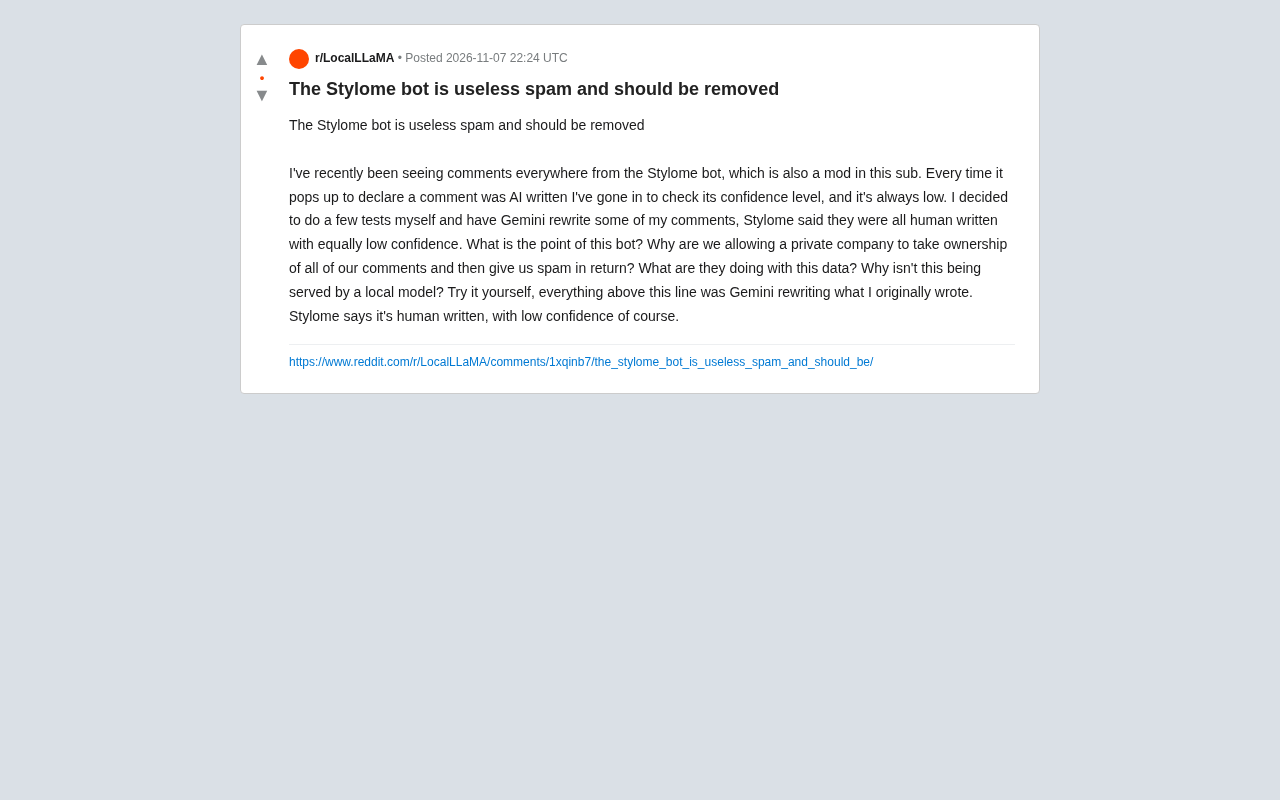
What's more suspicious is that Stylome is also a moderator of the subreddit. This dual identity raises the question: by what right does a detection tool developed by a private company both hold community management privileges and collect all comment data?
Field Test: Gemini-Rewritten Text Ruled "Human-Written"
To verify Stylome's accuracy, the user ran a controlled test: using Gemini to rewrite their own original comment, then having Stylome detect it. The result was unexpected—all rewritten texts were judged "human-written," again with low confidence.
The kicker: the user then had Gemini rewrite the entire critique post. In other words, the very article readers see denouncing Stylome is itself an AI-rewritten product. And Stylome still considers it human-written. This forms a rather ironic closed loop: an AI detection tool that can't even recognize an obvious AI-rewritten text.
The Technical Predicament of AI Text Detection
This is no isolated case. AI-generated text detection has long faced a fundamental challenge: the output distribution of large language models overlaps heavily with human writing, and distinguishing them is extremely difficult—especially in short texts and colloquial comment scenarios. Stylome's persistently low confidence precisely exposes the model's own uncertainty—it isn't sure, yet it still chooses to pop up a notice.
From a product design perspective, low confidence should trigger "no verdict" rather than "disturbing users." Stylome's approach essentially converts the model's hesitation directly into community noise, and the user experience is naturally terrible.
Confidence and Threshold Decisions
The "confidence" output by AI detection tools usually refers to the model's estimated probability that a given text is AI-generated. Sound engineering practice is to set a decision threshold (e.g., 0.8 or 0.9), giving a definitive conclusion only when confidence exceeds the threshold, and returning "undetermined" below it. Stylome's problem is that it still pops up notices when confidence is persistently low—a classic case of improper threshold setting in classifier design: treating low-confidence probability outputs directly as actionable verdicts, causing both false positive rates and disruptive experiences to rise in tandem.
Distribution Overlap and Detection Principles
Mainstream AI text detectors mostly rely on statistical features (such as perplexity and burstiness) or trained classifiers to distinguish human from machine text. Their fundamental assumption is that AI output and human writing have separable differences in word frequency distribution and sentence complexity. But after reinforcement learning from human feedback, modern large language models' outputs are already highly close to human writing in style, word choice, and rhythm—especially in short texts, where the discriminative signal available is extremely limited, distribution overlap is severe, and detectors struggle to distinguish reliably. This is precisely the technical root of Stylome's frequent low-confidence results in comment scenarios.
Dual Concerns: Data Privacy and Community Governance
The posting user raised two pointed questions: Why allow a private company to "own" all comment data? What is this data used for? Why not run detection with a local model?
These questions strike at the core of AI detection tools' business model. Cloud-based detection means all comments must be uploaded to third-party servers, and community members neither know about it nor have a choice. When the detection tool also holds moderator status, the boundaries of power become even blurrier—it can both judge content and enforce management.
Cloud Detection vs. Local Models
The question "why not use a local model" points to the detection tool's deployment architecture. Cloud detection means every checked comment must be transmitted to and retained on third-party servers, and community members can neither audit the data flow nor opt out. By contrast, local (on-device) models can perform inference on user devices or community-owned servers, keeping comment data within the domain and significantly reducing privacy risk. But local models typically have smaller parameter counts and more limited detection accuracy, and deployment and maintenance costs fall on the community—which makes commercial detection services lean toward cloud solutions. The training benefits and commercial value brought by centralized data are precisely what conflict with the community's demand for data sovereignty.
The Credibility Crisis of Detection Tools
The Stylome incident reflects a broader trust problem. When a detection tool frequently misjudges and its confidence stays low for long periods, users' trust in its results quickly erodes. And once the tool is used for content governance, the cost of misjudgment is no longer just "inaccurate notices"—it may affect real users' right to speak.
The user's demand is direct: remove this bot. But the more worthwhile question is whether communities should first answer questions about transparency, data ownership, and misjudgment redress mechanisms before introducing any AI detection tool. Otherwise, similar "useless junk" criticisms will only keep repeating.
Related articles
 Tech Frontiers
When AI Becomes a Productivity Divide: Clarity or "AI Psychosis"?
A civil engineer's deep use of agentic AI boosted efficiency but bred contempt for peers who refuse to learn. Is this clarity or AI psychosis? An analysis of the cognitive and psychological challenges behind the AI productivity divide.
 Tech Frontiers
Opus 5.5 Benchmark Scores Climb, Community Says Its "Weights Are Blessed"
Reddit community discusses Opus 5.5's rising scores on the Benchmaxxing Bench, with users describing its performance as "weights are blessed." This article interprets the community reaction and cautions against conflating benchmark scores with real capability.
 Tech Frontiers
Gemini Omni 1.2 Flash: AI Video Moves Toward Draft-Style Editing
Google's Gemini Omni 1.2 Flash update enables conversational, draft-style editing of the same video—swap scenes while keeping products, adjust lighting while keeping characters. Clips up to 15s, 720p costs 30% less than the previous Flash—ideal for e-commerce ads, previs, and short-asset production.