CUE Framework: Making AI User Simulators Truly Reflect Real User Failure Patterns

CUE encodes real user sessions into embeddings to calibrate simulator failure distributions without any model training.
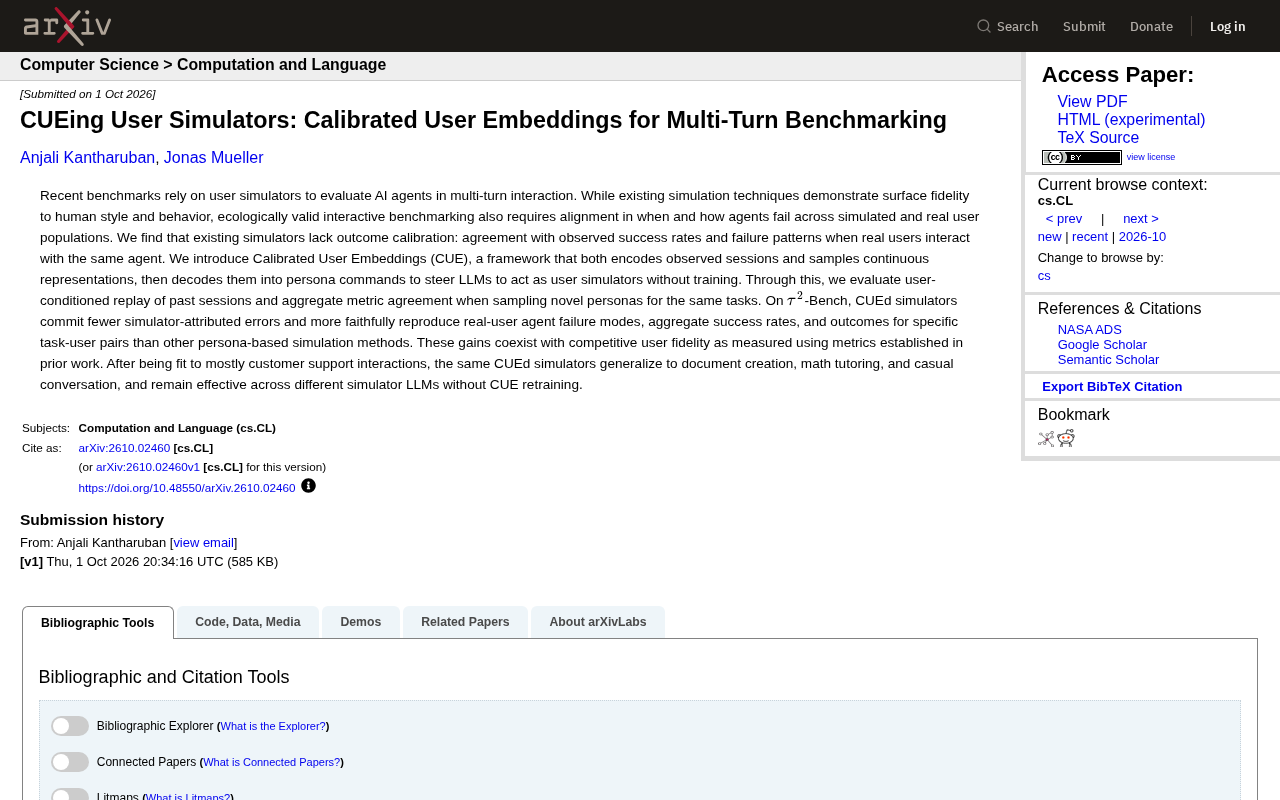
Existing user simulators can mimic human speech but lack outcome calibration — failing to reproduce agent failure patterns that real users trigger, causing benchmark scores to diverge from deployment reality. The CUE (Calibrated User Embeddings) framework encodes real interaction sessions into continuous user embeddings, samples from them, and decodes persona commands to drive off-the-shelf LLMs — all without fine-tuning. On τ²-Bench, CUE reduces simulator-introduced false failures, more faithfully replicates real user failure patterns, and aligns aggregate success rates closely with real data. Fitted on customer service interactions, it generalizes to document creation, math tutoring, and casual conversation, and transfers across base models with no retraining.
Why User Simulators Need "Calibration"
In multi-turn dialogue settings, AI agent evaluation increasingly relies on user simulators — large language models playing the role of real users, repeatedly interacting with the agent under test to measure its performance. Existing simulation techniques perform reasonably well on the surface: they can mimic human speech patterns and behavioral traits, appearing convincingly realistic.
But a new arXiv paper identifies a long-overlooked problem: these simulators lack outcome calibration. That is, while simulators may "seem human," they fail to make agents fail in the right places and in the right ways. The success rates and failure patterns that emerge when real users interact with the same agent simply don't match what simulators produce.
This gap matters enormously. A benchmark with genuine ecological validity must do more than make simulated users sound human — it must ensure that the distribution of agent failures matches what happens in the real world. Without that, impressive benchmark scores tell us little about how a model will actually perform in deployment.
Ecological validity is a concept borrowed from psychology and experimental design, referring to how well a measurement tool or experimental environment mirrors real-world scenarios. In the context of AI evaluation, it demands that benchmarks not only produce sensible results under lab conditions, but accurately predict model behavior in actual deployment. For user simulators, a lack of ecological validity means that even if a simulator passes every "looks human" metric, the agent weaknesses it surfaces may be systematically different from the problems real users actually encounter — causing development teams to invest resources optimizing the wrong things, while the issues that truly affect user experience remain hidden.
How the CUE Framework Works
The paper introduces the Calibrated User Embeddings (CUE) framework. The core idea is to encode real observed interaction sessions into continuous user representations, sample from these representations, and decode them into "persona commands" that guide an LLM to play the role of a user.
The standout feature of the entire process is that it requires no training — it doesn't rely on fine-tuning the simulator's base LLM, but instead drives off-the-shelf LLMs directly through an embedding-and-decoding mechanism. This significantly reduces both deployment costs and the overhead of transferring to new settings.
Specifically, CUE supports two evaluation modes:
User-Conditioned Session Replay
User characteristics from past real sessions are encoded into embeddings, allowing the simulator to "replay" a specific user's behavior on a specific task — used to verify whether the simulator can reproduce the outcomes of real interactions.
Metric Consistency Under New Persona Sampling
Fresh personas are sampled for the same tasks, and the question becomes whether aggregate-level metrics (such as overall success rate and failure pattern distribution) remain consistent with real user populations. This step measures statistical "population calibration" rather than the realism of any single conversation.
Embedding and decoding are key concepts for understanding how CUE works. Embedding refers to compressing high-dimensional, discrete information (such as a conversation log) into a continuous low-dimensional vector space, where similar user behaviors cluster together and dissimilar ones are pushed apart. Decoding is the reverse: taking a vector from this continuous space and translating it into natural language descriptions (i.e., persona commands) that a large language model can act on. What makes CUE innovative is that this embedding-decoding pipeline requires no parameter updates (fine-tuning) to the underlying LLM — it modifies the model's behavior by manipulating its context input. Engineered this way, it amounts to "zero training cost behavior injection," which is also why it maintains effectiveness across different simulator base models.
Experimental Results on τ²-Bench
The paper validates CUE on τ²-Bench, a benchmark designed for multi-turn interactive evaluation. Compared to other persona-based simulation methods, CUE-calibrated simulators demonstrate several key advantages:
- Fewer simulator-introduced errors: fewer "false failures" introduced by the simulator itself, producing cleaner evaluation results;
- More faithful reproduction of agent failure patterns caused by real users;
- Aggregate success rates closer to ground truth: overall metrics align more closely with real user interaction results;
- More accurate outcomes on specific task–user pairings.
Importantly, these gains come without sacrificing surface-level realism — measured by the user fidelity metrics established in prior work, CUE simulators remain competitive. In other words, they are both "human-like" and "calibrated."
τ²-Bench is an evaluation benchmark designed specifically for multi-turn task-oriented dialogue. The τ² (tau-squared) in its name alludes to its two-layer interaction structure: the agent under test must simultaneously handle the simulated user's natural language requests and the underlying task completion objectives. Unlike single-turn QA benchmarks, τ²-Bench records complete dialogue trajectories and uses task success (rather than single-step answer quality) as its core metric. This gives "failure distribution" consistency a directly measurable operational definition on this benchmark, which is precisely why CUE's calibration objectives can be rigorously validated here.
Generalization Across Domains and Models
Another compelling result from CUE comes from generalization tests. The framework was primarily fitted on customer service interaction data, but the same CUE simulator was transferred directly to several quite different domains:
- Document creation
- Math tutoring
- Casual conversation
The simulator remained effective across all these new domains. Going further, it maintained its performance when switched between different simulator base LLMs, without any retraining of CUE. This suggests that the user representations CUE captures have a degree of generality — this is not a toy solution overfit to a specific domain or a specific base model.
Value and Limitations of This Work
From a methodological standpoint, CUE shifts the evaluation community's attention away from "does the simulator seem human?" toward a more fundamental question: can the simulator reproduce failures in the right places? For any team relying on synthetic users to evaluate dialogue agents, this is a perspective worth internalizing — surface-level realism is not the same as evaluation validity.
The no-training, cross-model-transferable nature of CUE also makes it more attractive for engineering deployment. As agent products increasingly enter multi-turn interaction domains like customer service, education, and productivity, the value of an evaluation tool that can reliably predict real-world failure rates is self-evident.
It is worth noting that the paper's experiments are still primarily conducted on τ²-Bench, with fitting data centered on customer service interactions. Whether CUE can calibrate equally well on long-tail user behaviors in more extreme or specialized domains (such as medical or legal applications) remains to be validated. As a newly released preprint, its conclusions also await broader community replication.
Related articles

RAG Getting Started in Practice: From Principles to Building an Enterprise Knowledge Base
Bilibili RAG course highlights: from retrieval-augmented generation principles, document chunking and vectorization, to five accuracy factors and enterprise knowledge base boundaries, with fine-tuning vs RAG selection advice.

AI Model Selection Guide: DeepSeek vs. Qwen3 in Practice
How should AI developers choose models? Based on a Bilibili tutorial, this article breaks down the Function Calling differences between DeepSeek V3 and R1, Qwen3's programmatic thinking mode switching and agent capabilities, and outlines a multi-model learning path and practical selection logic.

Anchoring, Loss Aversion, and Nudges: 5 Psychological Tactics Retailers Use to Make You Spend
Behavioral economics reveals how retailers use anchoring, framing, loss aversion, and nudge theory to manipulate your spending decisions. This article breaks down 5 common psychological tactics and offers counterstrategies like slowing down decisions and setting your own anchors to see through the pricing design behind discounts.