Culpa: A Cost Analysis Tool That Traces Every AI Dollar Back to a Specific Conversation

Culpa traces every AI dollar back to the exact conversation that generated it.
Culpa is an AI cost observability tool that attributes every dollar of LLM spending to specific users, features, conversations, and retry loops. It offers cost prediction for pre-launch estimation and uses a local-first architecture to keep prompts within your infrastructure. Designed for AI product teams, engineers, and pricing leaders who need to diagnose cost spikes and make data-driven decisions.
When AI Bills Become a Black Box
As large language models become deeply embedded in products and workflows, more and more companies face a thorny problem: AI bills keep climbing, but no one can clearly explain where the money is actually going. A sudden cost spike might stem from a specific user, a particular feature, a lengthy conversation, or even a retry loop triggered by failures—but traditional cost monitoring tools can only provide a vague total.
To understand the severity of this problem, you need to understand how current LLMs are priced. Today's mainstream large language models (such as OpenAI's GPT series, Anthropic's Claude, and Google's Gemini) all use token-based pricing. A token is the smallest unit of text the model processes—one English word typically corresponds to 1-2 tokens, while each Chinese character usually maps to 1-2 tokens. The cost of each API call is determined by both input tokens (prompt) and output tokens (completion), with massive price differences between models—for example, GPT-4 can cost tens of times more than GPT-3.5. This means a seemingly simple feature change (like increasing system prompt length or switching model versions) could cause costs to multiply.
The recently launched tool Culpa, which debuted on Product Hunt, targets exactly this pain point. Its tagline cuts straight to the heart of the matter: "Find the exact conversation behind every AI dollar." After launch, it received 45 upvotes and 9 comments, ranking #18 for the day, and was categorized under Analytics, Developer Tools, and Artificial Intelligence.
Culpa's Core Capabilities: From Guesswork to Precise Attribution
Conversation-Level AI Cost Tracing
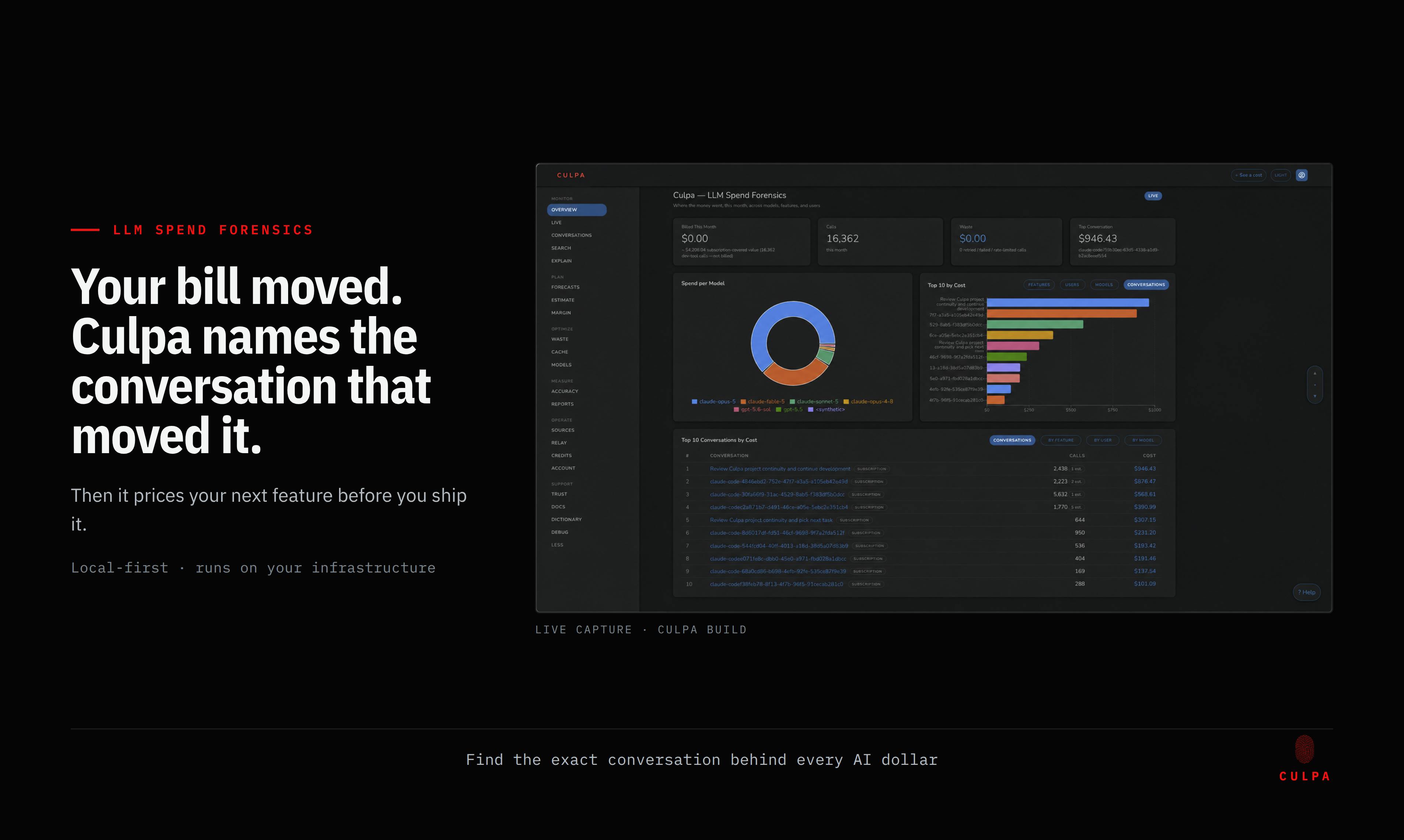
Culpa's core value proposition is refining AI spend granularity from "totals" down to "individuals." According to official descriptions, it can trace every AI dollar back to specific users, features, conversations, and retry loops. This means when bills show abnormal fluctuations, teams no longer need to investigate blindly—they can directly pinpoint the "culprit" (which is also the semantic origin of the product name Culpa).
For LLM applications billed by API call volume, this capability is particularly important. An unoptimized prompt or a repeatedly retried failed request can, at scale, snowball into a staggering cost black hole. In production environments, LLM API calls can fail due to rate limits, timeouts, outputs not meeting expected formats, and other reasons. To maintain user experience, developers typically implement automatic retry mechanisms (such as exponential backoff strategies). But if retry logic is poorly designed—for example, lacking maximum retry limits, not properly handling specific error codes, or infinitely looping calls when output validation fails—it creates what's known as a "retry storm." In high-concurrency scenarios, a runaway retry loop can generate thousands of extra API calls within minutes, causing costs to skyrocket. Culpa's approach is to make these hidden costs "visible," transforming "guessing AI spend" into "fixing AI spend."
Cost Prediction: Calculate the Bill Before a Feature Ships
Beyond after-the-fact tracing, Culpa also provides forward-looking cost prediction capabilities. It can estimate the potential AI costs of a new feature before it actually runs. This functionality is highly significant for product and business teams—it makes "pricing with data rather than intuition" possible.
In the commercialization of AI products, pricing is often the hardest piece of the puzzle. The fundamental reason AI product pricing is difficult lies in the high uncertainty of marginal costs. Traditional SaaS products have near-zero marginal costs (the server cost of serving one additional user is negligible), so they can adopt simple per-seat or per-feature pricing. But every inference in an AI product incurs actual model call fees, and these costs vary enormously based on user behavior (input length, conversation turns, usage frequency). Some "power users" may consume tens or even hundreds of times more resources than average users, making uniform pricing models highly prone to losses. Many AI companies have therefore shifted to usage-based pricing, but this requires an extremely precise understanding of cost structures.
If the marginal cost of a new feature can't be estimated in advance, pricing becomes guesswork, easily leading to the predicament of "the more you sell, the more you lose." Culpa aims to provide data support, helping teams identify which customers and workflows are "burning margin," and then make more rational product and pricing decisions.
Local-First Architecture: A Differentiated Data Security Proposition
Among the many observability and cost analysis tools available, Culpa particularly emphasizes its Local-first architecture. The company explicitly states: "Your prompts never leave your infrastructure."
Local-first is a software architecture philosophy whose core principle is that data storage and processing happen first on the user's own devices or infrastructure, rather than relying on remote servers. Unlike the traditional SaaS model (where data is uploaded to the service provider's cloud for processing and storage), Local-first architecture typically deploys Agents or SDKs within the customer's environment to collect and analyze data, sending only aggregated, anonymized metadata (such as call counts, token consumption, latency, etc.) to the cloud for visualization. This architecture has natural advantages in meeting data compliance requirements like GDPR and HIPAA, while also avoiding the risk of exposing prompts containing sensitive business logic to third parties.
This design addresses a core concern of enterprise users. Prompts and conversation content in AI applications often contain large amounts of sensitive business logic, user data, and even trade secrets. Sending this data to a third-party SaaS platform for analysis is itself a compliance and security risk. Culpa's local-first approach lets enterprises gain fine-grained cost insights without worrying about data leakage—this is the key differentiator that sets it apart from purely cloud-based analytics tools.
Who Needs an AI Cost Management Tool Like Culpa?
From a product positioning perspective, Culpa's target users fall into several categories:
- AI product teams: Need to understand the true cost structure of every feature and every user, preventing profits from being silently eroded by hidden consumption.
- Developers and engineering teams: Need to diagnose the technical root causes of cost spikes, such as runaway retry loops or inefficient prompt designs.
- Business and pricing leaders: Need to estimate costs before features ship, using data to drive pricing strategy.
In essence, Culpa serves teams that have already deployed LLMs in production and are starting to feel anxious about substantial AI bills. For projects still in the prototype stage with minimal call volumes, this kind of granular cost tooling may be premature.
AI Cost Observability Is Becoming an Independent Category
Culpa's emergence reflects a rapidly maturing trend: AI Cost Observability is becoming a standalone product category. When model calls move from experimentation to production at scale, cost management is no longer a post-hoc finance exercise—it becomes a real-time capability that needs to be embedded into engineering and product decision-making processes.
AI cost observability is an emerging field that evolved from traditional cloud infrastructure cost management (FinOps) and application performance monitoring (APM). As LLM applications enter production environments, multiple related tools have appeared on the market: Helicone focuses on LLM call logging and cost tracking, LangSmith provides full-chain observability for LLM applications, and Portkey focuses on AI gateways and cost control. Together, these tools form an important part of the LLMOps (Large Language Model Operations) ecosystem. Culpa's differentiation lies in its conversation-level cost attribution combined with prediction capabilities and local-first architecture, attempting to establish a unique position in this rapidly crowding space.
From tracing to prediction, from technical root causes to business pricing, Culpa aims to connect the entire AI cost management pipeline while addressing data security pain points with its local-first architecture. As a newly launched product, its actual effectiveness, integration difficulty, and compatibility with mainstream LLM platforms still await validation from more real-world users. But the direction it points toward—making every AI dollar transparent and controllable—will undoubtedly be an indispensable part of future AI infrastructure.
Key Takeaways
Related articles

DeepCell: One-Click AI Generation of Documents, Spreadsheets, and Slides
DeepCell tops Product Hunt with one-click generation of documents, spreadsheets, and slides, using the .deepcell format for linked updates, designed for System 2 tasks like modeling and sales reviews.

Doneas: 15-Minute Daily Accountability Calls That Keep Indie Developers From Procrastinating
Doneas is a daily accountability tool for indie developers: plan tasks on Monday, join a 15-minute call with five builders each day, and log deliveries on a public progress page. This article analyzes its core mechanics, effectiveness, and potential issues around retention and matching.

Fastlane 2.0: Fully Automated AI Ad Campaigns, From Creative to Optimization
Fastlane 2.0 is an AI ad automation tool: enter your website and it learns your brand, generates video and image ads, and runs and optimizes them on Meta, TikTok, Instagram, and YouTube.