Cura: The AI Travel Agent That Plans, Books, and Adapts on Your Behalf

Cura is an AI travel agent that plans, books, and acts on your behalf — not just recommends.
Cura is an AI travel agent that ranked second on Product Hunt, built around the idea that AI should execute the full travel workflow — itinerary planning, flight and hotel booking, check-in, and rebooking — not just surface information. It learns user preferences over time and aims to handle entire trips from a single prompt. Human advisors step in for complex edge cases. Its fundamental difference from platforms like Expedia is acting as an execution agent, not an information aggregator. Key adoption hurdles remain around payment security, identity data authorization, and legal liability.
Travel planning has always been a love-hate experience — you're drawn to the destination, but drained by the endless price comparisons, ticket bookings, and rebooking headaches. Cura, an AI product that landed second place on Product Hunt, aims to solve these pain points with a single unified intelligent agent. It's not just another search tool — it positions itself as a personal travel assistant that can actually get things done.
An End-to-End Experience: From Planning to Execution
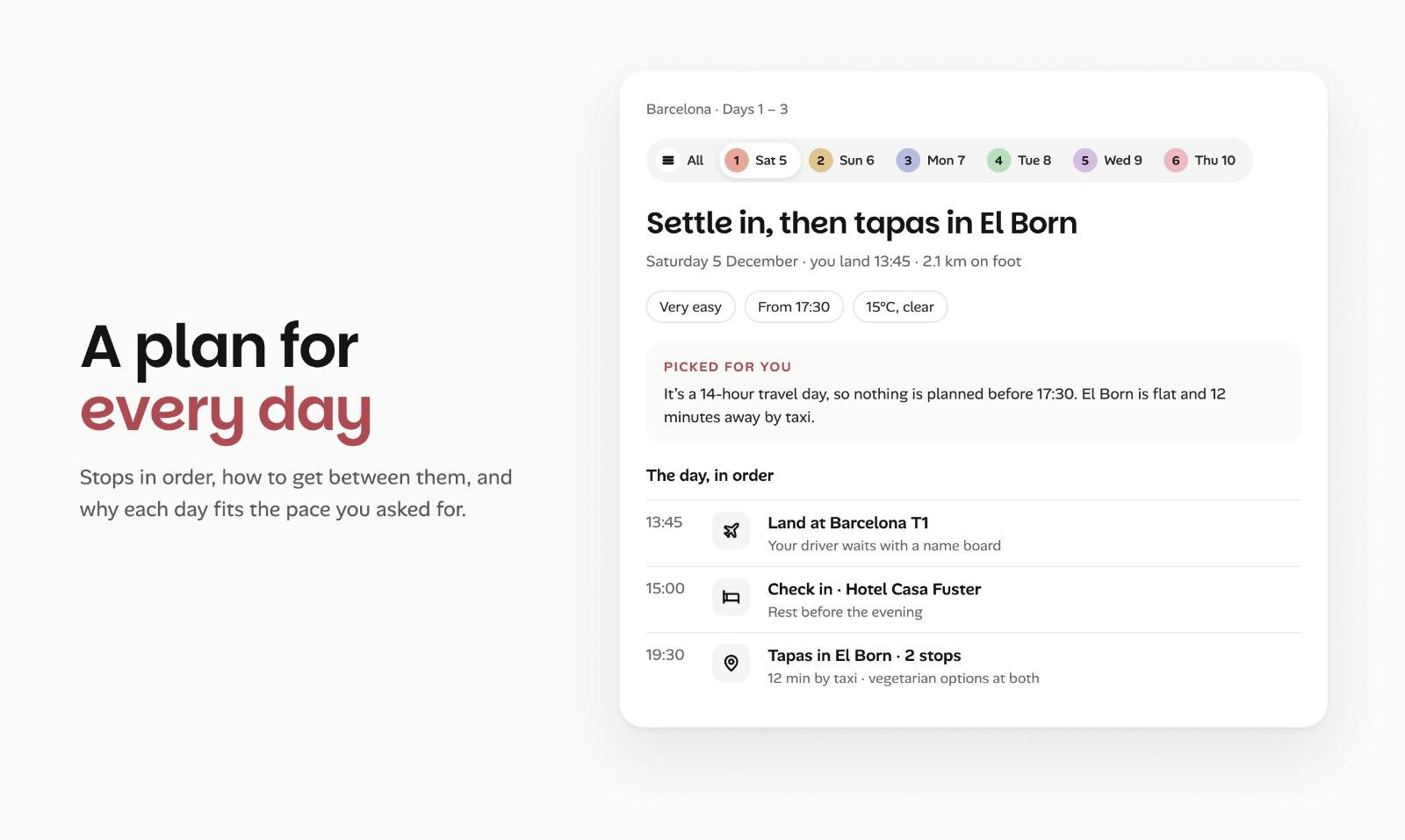
Cura's core proposition can be summed up in one sentence: tell it where you want to go, and leave the rest to it. According to the official description, users simply state their destination, and Cura automatically builds an itinerary, filters relevant flights and accommodations, and provides clear reasoning for each recommendation. This "recommendations with reasoning" approach is what sets it apart from traditional price-comparison sites — it doesn't just surface options, it explains why a particular option suits you.
Going further, Cura takes over tedious tasks like check-in and itinerary changes. For travelers frequently hassled by rebookings and delays, this automation is just as valuable as the upfront planning. The product is categorized on Product Hunt under Productivity, Travel, and Artificial Intelligence — three labels that neatly capture its positioning: using AI to turn travel into a stress-free productivity task.
A Personalization Engine That "Learns" You
Cura's most notable design feature is its claim to learn users' travel habits. As usage accumulates, the system gradually understands your preferred airlines, hotel tiers, travel pace, and budget range. The team says that future itinerary planning could eventually be completed with a single sentence.
This progressive personalization is logically compelling. Travel preferences are inherently personal and relatively stable — some people chase value, others prioritize location, and some are fiercely loyal to airline frequent flyer programs. If AI can internalize these implicit preferences over time, it could meaningfully reduce the decision-making overhead of every trip. That said, the "gets smarter the more you use it" promise is one that users will need to verify through long-term experience.
A Hybrid Model: AI Plus Human Travel Advisors
Cura's design sensibly keeps a practical fallback in place: when things get complicated, human travel advisors step in. This is a clever product decision. Pure AI solutions often struggle with visa complications, multi-leg complex itineraries, and last-minute cancellations, while fully human-powered services can't scale. Cura's hybrid model — AI as the foundation, humans as the safety net — preserves the efficiency of automation while offering reliable human support at critical moments.
This positioning also reflects the team's clear-eyed understanding of the travel industry's complexity. Travel isn't a standardized SaaS workflow; there will always be edge cases the AI can't handle. Keeping a human channel actually builds user trust rather than undermining it.
The Fundamental Difference from Traditional Booking Tools
One point the team emphasizes repeatedly: unlike booking tools, Cura takes action on your behalf. This statement cuts to the heart of the market gap it's trying to fill. Whether it's Expedia, Booking.com, or any flight price comparison platform, these are essentially information aggregators — they present options, but the clicking, form-filling, and confirming is still done by the user.
Cura's ambition is to evolve from an "information assistant" into an "execution agent." This aligns squarely with the current wave of AI Agent technology: enabling AI to go beyond conversation and recommendations to autonomously invoke tools and complete real-world tasks. In the travel domain — where decision chains are long and operational steps are numerous — a capable, well-executed agent genuinely has the potential to reshape user habits.
What Is an AI Agent? AI Agent is one of the core directions for deploying large language models in the real world. Unlike traditional chatbots that can only "talk," agents can autonomously plan task steps and execute real-world operations by calling external tools — such as search engines, payment APIs, and calendar interfaces. Travel is a classic testing ground for agents: a single trip involves a dozen or more discrete actions — flight search, price comparison, seat selection, hotel booking, itinerary reminders — exactly the kind of multi-step workflow that benefits from AI orchestration. The industry term for this capability is "Tool Use" or "Function Calling": the AI identifies an operation to perform mid-conversation, automatically triggers the corresponding API request, and integrates the result back into its response — all without human intervention. OpenAI, Anthropic, and Google have all opened up these interfaces on their flagship model platforms, forming the technical foundation that makes vertical agent products like Cura possible.
Market Reception and Real-World Considerations
By the numbers, Cura received 218 upvotes and 44 comments on Product Hunt, finishing second on the day's leaderboard. That level of traction suggests the "AI travel agent" concept has struck a chord with real demand.
However, there's still a gap between vision and execution. Acting on behalf of users means Cura must touch payments, personal identity information, and deep integrations with airline and hotel systems — all of which raise questions around security, authorization, and liability. Whether users are willing to hand over their credit card details and ID information to an AI agent for automatic booking remains a critical threshold for the product's ability to scale. Additionally, the objectivity of its recommendations, the response speed of human advisors, and the underlying cost structure will all shape its long-term reputation.
Overall, Cura represents a valuable attempt to deploy AI Agents in a vertical consumer scenario. It integrates planning, booking, and adaptability into a single learning-capable agent, with human advisors as a backstop for complex situations. The strategic direction is clear — but whether it can deliver on the promise of "arrange an entire trip in one sentence" ultimately depends on its real-world execution.
Authorization and Safety in Travel AI Agents The authorization and security challenges facing travel AI agents are known in the industry as "principal-agent risk": when a user grants an AI permission to operate payment systems and handle ID documents, questions of liability in the event of mis-bookings, data breaches, or refund disputes lack mature legal or product-side precedent. Two approaches are commonly used today: the first is a "sandbox confirmation model," where the AI generates an action plan and the user approves each step before execution; the second is partnering with licensed travel agencies or payment institutions to transfer legal liability to a regulated third party. Cura's inclusion of human advisors as a fallback partly serves this liability-isolation function. This challenge is not a technical one — it's a matter of trust and regulation, and it's the key variable that determines whether such products can expand beyond early adopters to the mass market.
Related articles

Cursor Can Now Control Your Computer: AI Agents Can Drive Desktop Apps for Testing
Cursor adds desktop control: AI agents can drive desktop apps like the iOS Simulator to test their own features. We analyze the impact on dev workflows, possible technical approaches, and reliability concerns.

Vibecoding a Custom Inference Engine: High Hopes, Harsh Reality
A Reddit developer shares the real experience of vibecoding a custom inference engine: running GGUF Q4 models in the browser with WebGL2 and GLSL, only to fall into tokenizer debugging hell. This article analyzes the engineering challenges of browser-side LLM inference and why cloning llama.cpp is the more rational choice.

How High Are Anthropic's Early Investor Paper Returns Ahead of IPO?
Anthropic's early investor paper returns draw attention ahead of IPO. This article analyzes sources of book gains, capital structure, pre-IPO games and risks, and implications for the AI startup ecosystem.