Curate: An Anti-Algorithm Taste Space for Tracking Films, Books, and TV

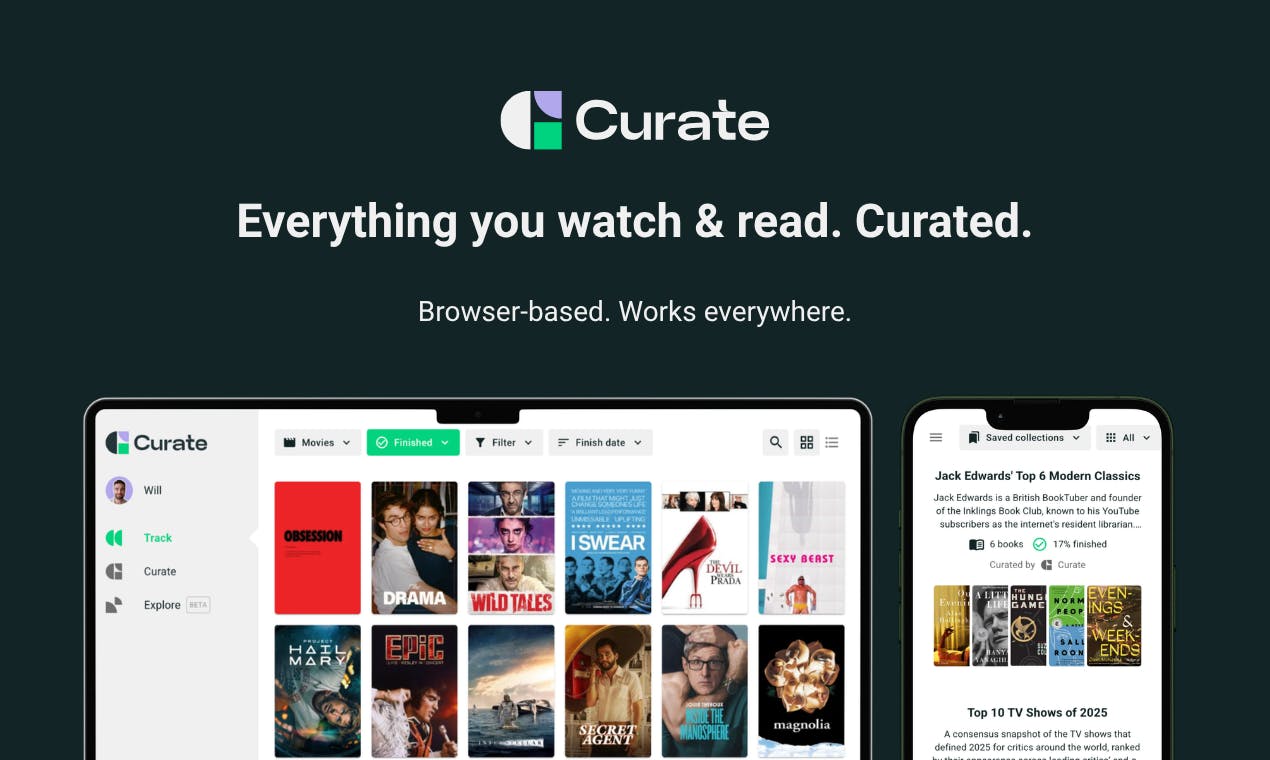
Curate is an ad-free, algorithm-free tool for tracking films, books, and TV through real human taste.
Curate is a new content tracking tool that lets users log movies, books, and TV shows in one place — without ads or algorithmic recommendations. Part of the growing "slow software" movement, it differentiates itself from Letterboxd and Storygraph by unifying cross-media tracking. Key challenges include cold-start network effects, metadata completeness, and subscription-based monetization.
An Anti-Algorithm Content Tracking Tool
In an era overflowing with streaming services and e-books, we consume more content than ever, yet less and less of it gets recorded or revisited. Curate, recently launched on Product Hunt, aims to solve this problem — it's an all-in-one tracking tool for movies, books, and TV shows, built around one clear principle: no ads, no algorithms deciding what you should like.
According to its Product Hunt page, Curate was built by Will Blacklock and is categorized across "Productivity," "Social Media," and "Entertainment." On launch day, it received 11 upvotes and 6 comments, landing at #20 on the daily leaderboard. While the numbers aren't eye-catching, its product philosophy stands out in a landscape dominated by recommendation algorithms.
"Real Human Taste" as the Core Value Proposition
Curate's tagline is straightforward and restrained: "Track everything you watch and read." But what truly defines the product is its rethinking of content discovery.
Rejecting Algorithmic Recommendations, Returning to Human Judgment
Today's mainstream content platforms — whether Netflix, Goodreads, or Douban — all rely on algorithms for content distribution to varying degrees. The core technology most of them employ is Collaborative Filtering, which works on a simple principle: if User A and User B have historically liked highly overlapping content, then something A liked but B hasn't seen yet gets recommended to B. This technique was first deployed at scale by Amazon in the 1990s for product recommendations and was later pushed to academic prominence by Netflix through its million-dollar Netflix Prize competition in 2006. Collaborative filtering is highly efficient, but the trade-off is the so-called "Filter Bubble" — a concept formally introduced by internet activist Eli Pariser in 2011, describing how personalization algorithms continuously reinforce users' existing preferences, trapping them in familiar content circles and gradually eliminating exposure to diverse perspectives and unfamiliar domains. The more you watch, the more the system feeds you similar content, steadily narrowing your taste boundaries.
Curate explicitly states its mission to "Discover movies, books and TV through real human taste." This means it hands the reins of content discovery back to people — through friends' lists, real user ratings, and curated collections, rather than cold collaborative filtering algorithms.
Thoughtfully Built for People Who Take Content Seriously
One line from the product copy carries real attitude: "a thoughtfully built space for people who take what they watch and read seriously." This precisely targets its intended audience — not passive binge-watchers or casual readers, but deep users who want to systematically manage their cultural consumption and derive meaning from it.
The "Slow Software" Philosophy: No Ads, No Algorithms
Curate's positioning reflects a product trend that's become impossible to ignore: the anti-algorithm, noise-free "Slow Software" movement.
The concept of "Slow Software" draws inspiration from the Slow Food Movement, which originated in Italy in 1986 as a pushback against fast food culture's erosion of food quality. Similarly, the slow software movement questions the tech industry's long-standing "growth above all" logic: to maximize user engagement and ad revenue, platforms relentlessly optimize for algorithmic "stickiness" rather than genuinely serving users' long-term interests. This movement gained broader public attention after the 2020 documentary The Social Dilemma.
From Letterboxd (a social platform for cinephiles) to Storygraph (an indie alternative to Goodreads), a growing number of independent developers are challenging big platforms' algorithmic dominance. Letterboxd was founded by a New Zealand team in 2011 and, with its beautifully designed review community and algorithm-free chronological timeline, experienced explosive user growth during the pandemic, now boasting over 100 million registered users. Storygraph was created by indie developer Nadia Odunayo in 2019 as an alternative to Amazon-owned Goodreads, allowing users to discover books based on mood, pacing, and themes rather than pure algorithmic matching. These products tend to be small in scale but enjoy high user loyalty, because they offer a "pure" experience — no algorithmic manipulation, no ad interruptions, just focus on the tool's inherent value.
Curate clearly belongs to this camp. Its attempt to unify films, books, and TV shows into a single platform is its key differentiator compared to Letterboxd (films only) and Storygraph (books only). For heavy cultural consumers who simultaneously watch series, films, and read books, unified cross-media tracking genuinely reduces the friction of switching between tools.
Challenges and Opportunities Facing Curate
That said, Curate faces equally obvious challenges.
First, building network effects. Since the product emphasizes discovery through "real human taste," its value is highly dependent on user scale and social network density. Network effects are a core concept in platform economics, first analyzed by economists studying telephone networks: a network's value is proportional to the square of its user count (Metcalfe's Law). This means social products face a brutal "critical mass" threshold — below a certain number of users, the product offers limited value to each individual. During the cold-start phase with few users, the "human taste recommendation" experience can hardly compete with mature platforms.
Second, data completeness. Tracking films, TV shows, and books requires a vast and accurate metadata database (titles, cast, crew, publication details, etc.), which is a significant engineering burden for an indie developer. The industry standard approach is to integrate third-party open data sources: for movies and TV, TMDb (The Movie Database) provides a community-maintained free API that serves as the data backbone for platforms like Letterboxd; for books, Open Library and Google Books API are common options. However, these sources still have notable gaps in non-English content coverage, data consistency, and update timeliness. Whether users can smoothly search and log their viewing and reading records directly determines retention.
Third, the monetization puzzle. Having promised "no ads," Curate will most likely need to pursue a subscription model. How to get users to pay continuously for a content tracking tool is a shared commercialization challenge for all such products. Letterboxd offers a reference case: its free tier covers core features, the Pro tier (~$49/year) provides analytics, custom posters, and other advanced features, while the Patron tier adds exclusive content and priority support. Whether this tiered subscription model can work for a more niche product like Curate remains to be proven.
A Return to Small and Beautiful Values
Curate may not become the next breakout app, but it represents a product philosophy worth paying attention to — in a world where algorithms dominate everything, some developers still believe that "human taste" and "distraction-free experiences" deserve to be taken seriously.
For users tired of being algorithmically spoon-fed and wanting to reclaim control over their cultural consumption, tools like Curate offer a quiet, restrained alternative. Whether it can carve out a place in the fiercely competitive content tracking space remains to be seen, but the product philosophy itself is already a meaningful statement.
Related articles

MIT PhD Takes You from Scratch to Build DeepSeek: A 25-Hour Hardcore Course
MIT PhD Raj Dandekar launches a 25+ hour Bilibili course building DeepSeek from scratch—MoE, MLA, GRPO, hand-written code plus math derivations, aiming to reproduce mini R1.

DeepSeek Harness in Practice: From Installation to Plugin Ecosystem, Building a Fully Automated AI Workflow
Based on a hardcore Bilibili tutorial, this guide systematically covers DeepSeek Harness installation, three plugin installation methods, and real-world use cases to help developers quickly build customizable AI Agent workflows.

DeepSeek Harness in Practice: From Installation to Automated Workflows
Hands-on DeepSeek Harness tutorial covering Mac/Windows installation, login, workspace binding, model & permission setup, and minimal closed-loop verification for AI automation workflows.