Cursor Account-Cycling Tools Compared: The Real Difference Between Native Accounts and Proxy Wrappers

Modelsphere claims native Cursor Pro accounts with no proxy relay, but compliance and stability remain unverified.
Modelsphere is a Cursor account-cycling tool differentiating itself with three claims: genuine official Pro accounts instead of proxy wrappers, pay-per-use billing with non-expiring balances, and a plugin that only handles account rotation and billing without modifying the native client. Priced at roughly 25% of official rates via a bulk account pool, it targets a Pro-equivalent experience. However, all claims come solely from the vendor's own promotional video — account procurement compliance, pool health, and billing accuracy against Cursor's official backend remain independently unverified. Users are advised to start with a small top-up to validate core functionality before committing.
The Proliferation of Account-Cycling Tools
Developers who've used Cursor have almost certainly encountered various so-called "account-cycling tools." The typical playbook involves automated account switching offered as monthly or quarterly subscriptions, with many vendors selling trial accounts that last only a few days. For users accustomed to an official Pro experience, these tools generally suffer from poor stability and limited functionality.
A product called Modelsphere has been promoted on Bilibili through videos that attempt to distinguish it from mainstream account-cycling tools. Its core selling point can be summed up in one sentence: it provides genuine official Pro accounts, charges per usage, keeps your balance permanently valid, and doesn't route traffic through any third-party proxy. This article breaks down the product based on its public promotional materials — all conclusions should be independently verified by users.
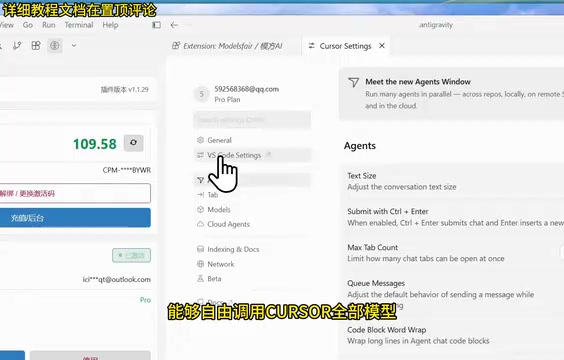
Business Model: Pay-Per-Use with Permanent Balance
Most traditional account-cycling tools follow a "time-limited subscription" logic — you buy a monthly or quarterly plan, and any unused quota simply expires. This product claims to operate on a fundamentally different model: pay-per-use, with balances that never expire.
According to its promotional materials, credits topped up by users have no expiration date. Even if you top up 100 RMB and only use 30 RMB, the remaining 70 RMB will still be available a year or two later. Pricing is benchmarked at roughly 25% of official rates (some promotional copy mentions as low as 15%), and the token consumption and official billing amounts per API call are said to be verifiable in real time.
The advertised value proposition goes like this: a 100 RMB top-up yields approximately 1,000 RMB worth of official quota — equivalent to roughly $137 in official usage at a 7.3 exchange rate. This calculation assumes that bulk account procurement costs are far lower than what individuals pay for single subscriptions, with the platform claiming to take only a reasonable margin.
Technical Approach: Native Client vs. Proxy Wrapper
This is the differentiating point the product repeatedly emphasizes — and the core competitive advantage it's trying to establish.
Many tools on the market modify the Cursor client or set up proxy relays, meaning users' actual API calls pass through a redirected or even tampered intermediary. This can result in "degraded output quality," "model substitution," or "sluggish responses." This product claims:
- It provides genuine official Pro accounts with no third-party relay whatsoever
- It does not modify any of Cursor's native code
- Its plugin retains only two functions: intelligent account rotation and billing record tracking
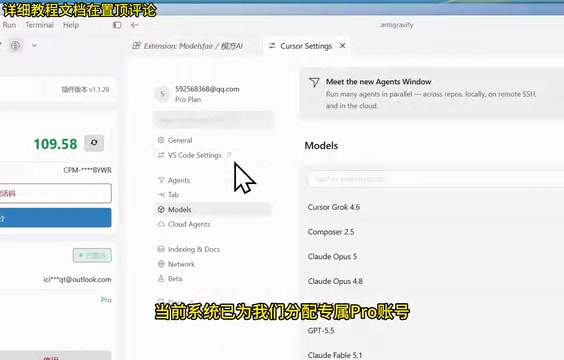
Because the native client is left untouched, users can theoretically update to the latest official version of Cursor at any time without waiting for plugin compatibility updates. In the settings interface, users can verify a Pro account's status, and the full list of officially supported models — including high-capability models like Sonnet and Opus as well as various lower-cost base models — is said to be fully unlocked and freely switchable.
A "proxy relay" refers to inserting a self-hosted server between the user's client and Cursor/Claude's official servers, with that server forwarding API requests and responses. The problem with this architecture is twofold: the relay server can intercept request content (i.e., your code and conversations), and it can silently substitute the actual model being called — for example, routing a Claude Sonnet request to a smaller, cheaper model while the client interface still displays "Sonnet," giving users degraded inference quality without their knowledge. "Machine-code locking" is another common restriction tactic: the tool binds to a device's unique identifier, making the account unusable after switching computers or reinstalling the OS, forcing users to repurchase. A native direct-connect approach bypasses both of these risk points — but it also means the platform must hold a sufficient supply of genuine Pro accounts, which is central to both its cost structure and compliance discussions.
Breaking Down the Three Core Claims
Full Access to Premium Models
The product claims to preserve the original Cursor client workflow, requiring no changes to users' existing habits. Native accounts combined with a direct official connection are meant to avoid the functional limitations imposed by proxy wrappers.
Privacy and Security Boundaries
Data does not pass through any third-party relay, and privacy mode is enabled by default. For developers who hand their code off to a tool, the risk of data interception or tampering at a relay node is a genuine concern — so this claim addresses a real pain point.
Full Billing Transparency
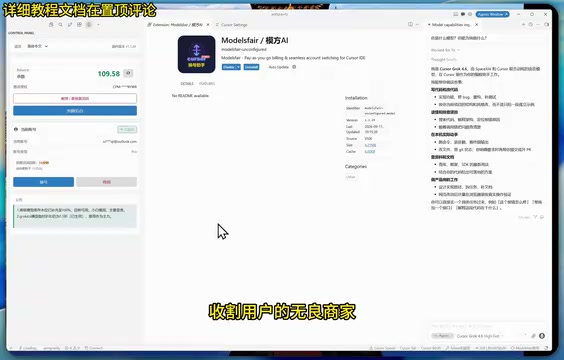
Every consumption event is recorded: remaining balance, the official billing rate for each request, output token count, and timestamp are all said to be verifiable, with real-time reconciliation supported.
How the Intelligent Account Rotation Mechanism Works
Automatic account rotation is the technical cornerstone of tools like this. According to the promotional materials, the system maintains a large-scale account pool. When it detects that an account has been idle for an extended period, it automatically releases that account; when a user returns, it instantly reassigns a fresh Pro account; and if the current account's quota runs out, the system automatically switches to a new one.

This mechanism aims to achieve "zero waste — you only pay for what you use." Compared to the headaches of individually owned accounts — expiring quotas, manual account switching, bans, and machine-code locks — the account pool model is undeniably more convenient, provided the release and reassignment logic is stable enough.
Account pool rotation faces a technical challenge around session continuity: Cursor's conversation context is typically bound to a specific account's session token, so switching accounts means a new session must re-establish context from scratch. The product's advertised "instant reassignment" doesn't explain how cross-account context continuity is handled — for complex, long-running coding tasks that depend on extended conversations, this is a potential experience breaking point. Furthermore, Cursor's terms of service restrict account sharing. Whether large-scale account pool usage triggers Cursor's anomaly detection (e.g., a single account being called at high frequency from multiple IPs) — potentially leading to mass account bans — is the central uncertainty affecting service stability, and the area where the "black box" nature of this product is most concentrated.
A Balanced Assessment: Risks and Verification
It's worth emphasizing that all content in this article comes from the product's own promotional video — there is no independent third-party verification. A few points worth considering for prospective users:
- Account source compliance: Whether the bulk-purchased Pro accounts are fully compliant is not supported by any verifiable evidence in the promotional materials.
- Stability depends entirely on the account pool: The quality of the rotation experience is wholly contingent on the pool's size and health — a complete black box.
- Billing transparency ≠ absolute trustworthiness: Whether the platform's billing data aligns precisely with Cursor's official backend still requires users to verify themselves.
The product's team states in their video that they "openly welcome scrutiny and testing from all genuine users" and invite users to join their technical community for hands-on trials. For prospective users, the most pragmatic approach is: start with a small top-up to verify model fidelity, billing consistency, and rotation stability before committing to long-term use. Any service involving a third-party account pool should have compliance and account security risks factored into your decision.
Related articles

Chain of Thought Isn't Just for AI: How Humans Can Use CoT to Improve Thinking Quality
Chain of Thought isn't just a prompt trick for large models. Starting from a Hacker News discussion, this article analyzes why CoT works for human thinking too, breaks down actionable ways to transfer it, and highlights the key differences between human CoT and machine CoT.
Cloudflare Teams Up with OpenAI: Closi…
Cloudflare Teams Up with OpenAI: Closing the Loop from Vulnerability Discovery to Defense with AI
Cloudflare uses OpenAI Daybreak to investigate security vulnerabilities and generate reviewable remediation plans, while developers use Codex to boost coding efficiency and quality.

Orca Multi-Agent Orchestration in Practice: A Guide to Parallel Collaboration with Claude and Codex
Orca is Stable AI's free open-source agent workbench supporting 34 agents like Claude Code and Codex in parallel. Learn its Git worktree isolation, multi-model orchestration, and mobile management.