Cursor Agent vs Codex: Which Should Visual AI Developers Choose?

Comparing Cursor Agent Window and Codex for Vision AI developers choosing between IDE-embedded and cloud-autonomous agents.
This article examines a Vision AI developer's decision between Cursor Agent Window and OpenAI Codex, comparing their approaches across four key dimensions: large task handling, multi-file modifications, debugging capability, and long-running work. It explores how AI programming is shifting from code completion to autonomous agent workflows, and provides a decision framework based on work patterns, cost-effectiveness, and migration costs.
A Visual AI Developer's Dilemma
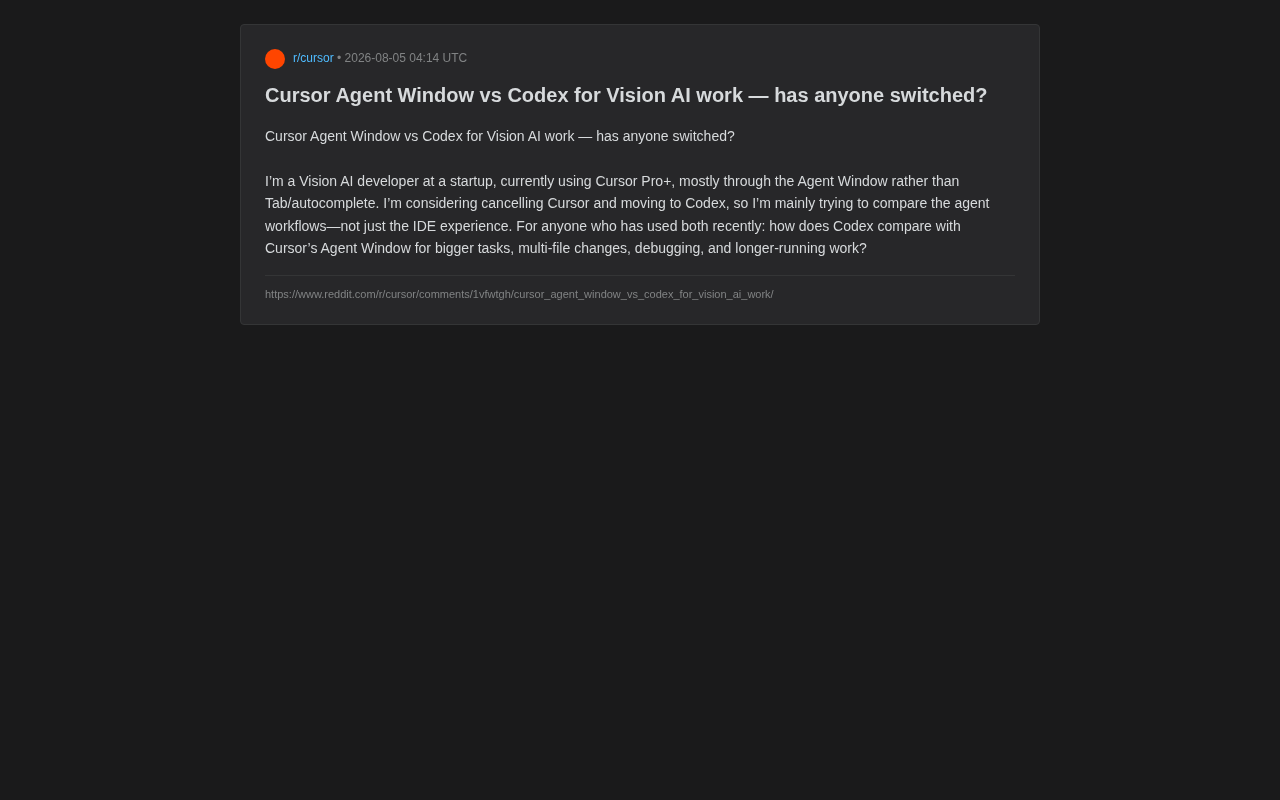
In an era of rapidly iterating AI programming tools, developers face an increasingly practical question: is their current AI coding assistant still the optimal choice? Recently on Reddit, a visual AI (Vision AI) developer working at a startup posed a highly representative question — he was considering canceling his Cursor Pro+ subscription in favor of OpenAI's Codex.
Vision AI is the commercial application of computer vision, encompassing core technologies like object detection, image segmentation, OCR, and video analysis. A typical tech stack includes PyTorch/TensorFlow deep learning frameworks, OpenCV image processing libraries, and inference optimization tools like ONNX/TensorRT. Vision AI developers at startups typically handle model R&D, data engineering, and deployment operations simultaneously, dealing with large codebases with high inter-module coupling — work characteristics that place demands on AI coding assistants far exceeding those of typical web development.
What you might not have noticed is that this developer's focus isn't on traditional IDE experience or Tab-key autocomplete functionality, but rather on the Agent workflow itself. He primarily works through Cursor's Agent Window rather than relying on code autocompletion. This shift in usage habits precisely reflects the deeper changes occurring in the AI programming tool competitive landscape.
From Completion Tools to Agents: A Paradigm Shift in AI Programming
Why Agent Workflows Have Become the Focus
Previously, the core selling point of AI programming tools was code completion — you type a few characters, and the tool predicts and completes the remaining code. GitHub Copilot and early Cursor both won market share with this capability. But today, developer needs are evolving.
An Agent workflow means the AI system no longer merely responds to single queries, but possesses capabilities for autonomous planning, tool invocation, environment interaction, and iterative correction. In programming scenarios, an Agent can independently read files, execute terminal commands, analyze error outputs, and fix code, forming a complete execution loop. This is fundamentally different from traditional Copilot-style code completion — the latter passively responds to user input context, while the former actively decomposes tasks and executes them step by step. This shift from "prompt-complete" to "instruct-execute" is the most important paradigm shift in AI programming.
This Reddit user explicitly stated that he cares about four dimensions of capability:
- Large task handling: Can it understand and execute complex development tasks?
- Multi-file modifications: Coordinated code changes spanning multiple files
- Debugging ability: How intelligently can it locate and fix bugs?
- Long-running work: Sustained, coherent task execution
These four dimensions have moved beyond the scope of simple "code completion" into the territory of "autonomous programming agents." Developers are no longer satisfied with a clever "prompter" — they expect a "collaborator" capable of independently completing tasks.
The Special Needs of Vision AI Development
For Vision AI development, these needs are particularly pronounced. Vision AI projects typically involve extensive model code, data preprocessing pipelines, training scripts, and inference deployment logic, often scattered across multiple files and modules. A single feature iteration might require simultaneously modifying data loaders, model architectures, and evaluation scripts — precisely where "multi-file modification" capability proves its worth.
Moreover, debugging in Vision AI is often far more complex, involving tensor dimension mismatches, data type errors, GPU memory management issues, and more, requiring agents with stronger contextual understanding and reasoning capabilities. Specifically, common debugging challenges include: tensor shape mismatches (e.g., passing NCHW format into a layer expecting NHWC), vanishing or exploding gradients, data normalization range errors (confusion between 0-255 and 0-1), synchronization issues in multi-GPU data parallelism, and the dreaded CUDA out of memory errors. These problems often don't surface at compile time — they only manifest at runtime through cryptic error messages or silent accuracy degradation. Traditional debugging requires developers to print tensor shapes layer by layer and manually inspect data flow. A powerful AI Agent that understands these domain-specific error patterns can dramatically improve debugging efficiency.
Core Comparison: Cursor Agent Window vs Codex
Cursor Agent Window's Advantages
As an IDE built specifically for AI programming, Cursor's Agent Window is deeply integrated into the editor environment. This means the agent can directly access the project's file structure, terminal output, and codebase context. For Vision AI development that requires frequent switching between code and execution results, this tight integration delivers a fluid workflow experience.
Cursor's Agent can read the entire codebase, understand project structure, and perform coordinated multi-file modifications on that basis. Its Pro+ subscription (approximately $200/month) provides unlimited access to more powerful models, including Claude Sonnet/Opus, GPT-4o, and other frontier models, along with longer context windows suitable for handling complex development tasks. This "IDE-embedded agent" architecture allows developers to complete the full cycle of asking questions, modifying code, and running tests within the same interface, reducing the cognitive burden of context switching.
Codex's Potential Appeal
OpenAI's Codex (the 2025 release) represents a different approach — a "cloud-based autonomous agent" architecture. Unlike Cursor's IDE-embedded model, Codex runs in an independent cloud sandbox environment, capable of cloning code repositories, automatically installing dependencies, running test suites, and submitting final results as Pull Requests. As a programming agent that can run independently, Codex has a unique design for handling long-running autonomous tasks. It can receive a higher-level task description, then autonomously plan, execute, and verify, forming a relatively complete work loop.
For developers who want to "assign a task and wait for results," this more autonomous working mode may better fit their needs. Particularly when task boundaries are clear and can be executed asynchronously, Codex-style agents can free developers from continuous interaction. For example, a Vision AI developer could submit a task like "write unit tests for the new data augmentation strategy and verify pass rates" before leaving work, and review the generated PR the next morning — this workflow pattern can significantly increase development throughput in ideal conditions.
How to Make a Rational Migration Decision
Clarify Your Core Work Scenarios
From this case, we can extract a general decision framework. First, ask yourself: What is my primary work scenario?
If your work is primarily interactive and incremental, requiring frequent examination of intermediate results and direction adjustments, then the deeply IDE-integrated Cursor Agent Window may be more suitable. This scenario is very common in Vision AI — for instance, when adjusting model architecture, you need to repeatedly check training loss curves and inspect feature map visualizations, with each step depending on feedback from the previous step to determine the next direction.
If your tasks better suit a "submit-wait-accept" batch processing mode — such as writing a set of standardized data processing utility functions, refactoring existing modules to conform to new interface specifications, or adding test cases to existing code — then a more autonomous Codex agent might improve efficiency.
Focus on Actual Cost-Effectiveness
Subscription costs are also a factor that cannot be ignored. Cursor Pro+ isn't cheap (approximately $200/month), and for startup developers, tool costs directly affect team resource allocation. Before making a migration decision, it's worth conducting a real-scenario trial comparison — executing the same set of tasks on both tools and comprehensively evaluating them across completion quality, time spent, and interaction costs.
Notably, cost calculations shouldn't only consider the subscription fee itself. For Vision AI projects, GPU training time is often the larger cost item. If a more powerful AI coding assistant can reduce wasted training cycles caused by code errors, then even with higher subscription fees, the overall return on investment might actually be better.
The Hidden Costs of Migration
It's important to note that tool migration itself carries costs. Familiar workflows, keyboard shortcuts, and configuration habits all need to be re-adapted. Unless the new tool has significant advantages in core scenarios, frequent tool switching may actually reduce overall productivity.
For Cursor users, there's another often-overlooked factor: project-level .cursorrules configuration files and accumulated context memory. These customized settings help the Agent better understand your project specifications and coding style. Migrating to a new tool means this tacit knowledge needs to be rebuilt, and you may experience noticeable efficiency drops during the transition period.
Conclusion: Industry Trends Behind Tool Competition
This Vision AI developer's dilemma essentially reflects the profound transformation AI programming tools are undergoing — moving from "assistive completion" toward "autonomous agents." Whether it's Cursor or Codex, both are evolving toward the goal of becoming "AI collaborators capable of independently completing complex development tasks."
From a broader industry perspective, the participants in this competition extend far beyond Cursor and Codex. Products like GitHub Copilot Workspace, Devin, and Windsurf (formerly Codeium) are all entering the "programming agent" track, each choosing different architectural approaches and product forms. IDE-embedded, cloud-autonomous, and hybrid solutions are evolving simultaneously, and the market has not yet converged on a dominant paradigm. This competitive landscape is good news for developers — it means tool capabilities will improve rapidly in the short term.
For developers, rather than agonizing over a single tool choice, it's better to stay attuned to this trend and flexibly choose based on your actual working patterns. After all, in this rapidly iterating field, today's optimal choice may be surpassed by new breakthroughs in just a few months. The real competitive advantage lies in whether you can effectively integrate these agent tools into your development workflow, letting AI handle repetitive implementation details while you focus on architectural decisions and creative problem-solving.
Key Takeaways
Related articles

Chain of Thought Isn't Just for AI: How Humans Can Use CoT to Improve Thinking Quality
Chain of Thought isn't just a prompt trick for large models. Starting from a Hacker News discussion, this article analyzes why CoT works for human thinking too, breaks down actionable ways to transfer it, and highlights the key differences between human CoT and machine CoT.
Cloudflare Teams Up with OpenAI: Closi…
Cloudflare Teams Up with OpenAI: Closing the Loop from Vulnerability Discovery to Defense with AI
Cloudflare uses OpenAI Daybreak to investigate security vulnerabilities and generate reviewable remediation plans, while developers use Codex to boost coding efficiency and quality.

Orca Multi-Agent Orchestration in Practice: A Guide to Parallel Collaboration with Claude and Codex
Orca is Stable AI's free open-source agent workbench supporting 34 agents like Claude Code and Codex in parallel. Learn its Git worktree isolation, multi-model orchestration, and mobile management.