Cursor AI in Action: Building a RAG-Powered AI Customer Service WeChat Mini Program Store from Scratch

Build a RAG-powered AI customer service WeChat Mini Program store from scratch using Cursor AI and LangChain.
This article walks through a complete hands-on project for building a WeChat Mini Program e-commerce store with RAG-powered AI customer service, using Cursor AI as the development assistant. The stack covers LangChain, FastAPI, Vue3, and native WeChat Mini Program, demonstrating how to integrate retrieval-augmented generation into a real-world full-stack application.
Project Overview: A Real-World Full-Stack AI Application
As large language model technology accelerates into production, integrating frameworks like LangChain and RAG into real business systems has become a key challenge for many developers. This article is based on a complete hands-on project tutorial that walks through building a WeChat Mini Program e-commerce store with AI-powered customer service from scratch — all with the help of Cursor AI.
The tech stack is highly representative of modern AI application development: core AI capabilities are powered by the LangChain framework, the intelligent customer service uses a RAG (Retrieval-Augmented Generation) architecture, the backend runs on FastAPI, the admin dashboard frontend uses Vue3 + Vite, and the mobile client is a native WeChat Mini Program. This combination covers the most mainstream technology choices in AI application development today, making it a strong reference for anyone looking to level up their full-stack AI skills.

One important detail worth noting: the author emphasizes that prerequisite knowledge is critical — you need a solid foundation in both FastAPI and LangChain, or you'll find the development process quite frustrating. This is a reminder that AI application development isn't just about generating code with tools; a deep understanding of the underlying frameworks remains essential.
System Features: Admin Dashboard and Mini Program
The system is divided into two main parts: a web-based admin dashboard for operations teams, and a WeChat Mini Program storefront for end users.
Admin Dashboard Features
After logging in (demo account: admin), users are greeted with a data dashboard showing key metrics like total users, order count, and total revenue, along with visualizations including daily order trends, sales curves, product category breakdowns, order status distributions, and a Top 5 sales leaderboard.
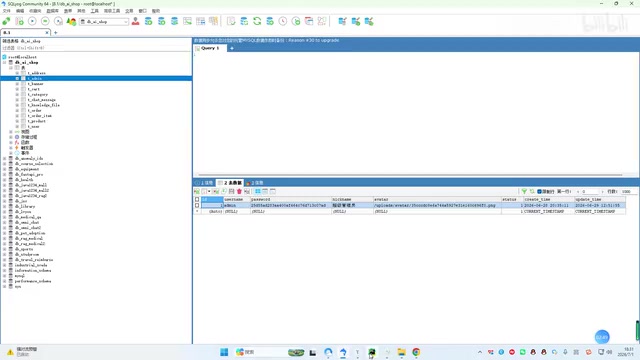
The dashboard also includes a full suite of e-commerce management modules: product management, category management, order management, user management, banner management, and the project's standout feature — Knowledge Base Management. The knowledge base serves as the data source for the RAG-powered customer service. Admins can maintain documents here to enhance retrieval quality, directly impacting the accuracy and relevance of customer service responses.
WeChat Mini Program Features
The Mini Program delivers a complete e-commerce shopping experience: homepage banners and featured products, category browsing, shopping cart management, multiple shipping address support, simulated payment checkout, order viewing and management, and a personal center (avatar/nickname editing, password changes, and address management).
The key differentiating feature for users is the built-in AI customer service.
RAG-Powered Customer Service: The Technical Core
The AI customer service is the technical centerpiece of the entire project, providing a complete demonstration of the RAG retrieval-augmented generation pipeline.
RAG Background: RAG (Retrieval-Augmented Generation) is an architectural paradigm formally introduced by Meta AI Research in 2020. Its core idea is to decouple and coordinate two modules: information retrieval and text generation. Before answering a question, the system first retrieves relevant document chunks from an external knowledge base, then injects those chunks as context into the large model's prompt, guiding it to generate well-grounded responses. This design effectively addresses two major pain points of purely generative models: the knowledge cutoff problem (training data has a time limit) and hallucination (models tend to fabricate plausible-sounding but incorrect content). In enterprise deployments, RAG is especially well-suited for building Q&A systems based on private documents — organizations have full control over the knowledge base content without needing to retrain or fine-tune the model, keeping deployment costs extremely low.
How Vector Search Works: The vector retrieval step in a RAG system relies on two key technologies: text embeddings and vector databases. Text embeddings convert natural language into high-dimensional numerical vectors, where semantically similar texts are closer together in vector space — enabling semantic similarity search rather than traditional keyword matching. Documents uploaded to the knowledge base are split into text chunks, each converted into a vector and stored in a vector database (such as Chroma, Pinecone, or Milvus). When a user asks a question, it's also converted into a vector, and cosine similarity is used to quickly retrieve the most relevant knowledge chunks.
When a user asks a question (e.g., "What happens if a product I bought goes on sale afterward?"), the system processes it as follows:
- Vector Retrieval: Retrieve the most relevant entries from the vector database (4 entries in the demo);
- Prompt Construction: Combine the user's question with the retrieved knowledge chunks to form a complete prompt;
- LLM Generation: Pass the prompt to the large model to generate an accurate answer grounded in the knowledge base.
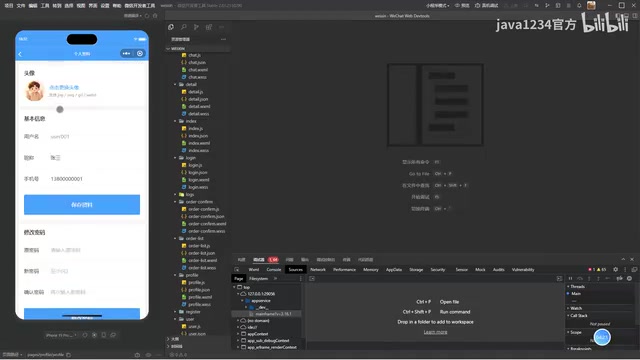
This pipeline is the classic RAG paradigm — using external knowledge retrieval to "augment" the large model's responses. It solves the problem of general-purpose models lacking domain-specific business knowledge while also reducing hallucinations. Compared to calling a large model directly, the RAG architecture keeps customer service responses tightly aligned with the company's own knowledge base, making it far more suitable for real-world commercial deployment.
LangChain and FastAPI: The Backbone of AI Applications
LangChain's Role and Value: LangChain is an open-source LLM application development framework released in October 2022, and has since become one of the most influential infrastructure projects in AI application development (with over 90,000 GitHub stars). Its core value lies in providing a standardized "chain" abstraction layer that encapsulates common operations — prompt templates, model calls, output parsing, memory management, tool use, and vector retrieval — into reusable components. In RAG scenarios, LangChain provides out-of-the-box document loaders, text splitters, vector store interfaces, and retrieval chains, significantly lowering the barrier to building RAG systems. That said, LangChain's abstraction layer can introduce additional learning overhead and debugging complexity, which is one of the key reasons the author stresses having a solid foundation.
Why FastAPI Fits: FastAPI is a leading modern Python web framework, known for high performance, ease of use, and automatic documentation generation — making it a popular backend choice for AI applications. Built on the Starlette async framework, it natively supports async/await, making it ideal for I/O-intensive tasks like calling large model APIs. FastAPI also supports streaming output via SSE (Server-Sent Events), enabling real-time token-by-token streaming from the model to the frontend for a smoother conversational experience. In this project, FastAPI serves as the HTTP service layer for the LangChain application, wrapping AI capabilities into standard RESTful APIs consumed by both the WeChat Mini Program and the admin dashboard.
Cursor AI-Driven Development Workflow
One of the most distinctive aspects of this project is how it was built: entirely with the help of Cursor AI.
About Cursor: Cursor is an AI-native code editor launched by Anysphere in 2023, built as a deep fork of VS Code, and widely regarded as the benchmark product in the AI-assisted coding space. Unlike plugin-based solutions like GitHub Copilot, Cursor deeply integrates AI capabilities into the core editor interaction flow, offering several differentiated features: Tab completion (predictive code continuation), Cmd+K (inline code generation and editing), Chat (context-aware conversational programming), and Agent mode (autonomously planning and executing multi-step programming tasks). Agent mode allows the AI to independently read project files, run terminal commands, fix errors, and iterate on code — representing a qualitative leap from "code completion tool" to "autonomous programming agent." Cursor's annual recurring revenue reportedly surpassed $100 million in 2024, reflecting the strong developer demand for AI coding tools.
The development workflow described by the author includes:
- Using Plan mode for requirements analysis and task breakdown;
- Creating directory structures for the backend project, Vue3 frontend project, and WeChat Mini Program project;
- Leveraging Cursor's Agent capabilities to generate project code, fix bugs, and iteratively improve features.
This approach — "AI-assisted coding with human architectural oversight" — represents an important trend in modern software development. Developers no longer write code line by line; instead, they advance projects through iterative discussion and planning with AI. That said, the quality of AI-generated code depends heavily on the developer's ability to clearly articulate requirements and understand the underlying technology — once again reinforcing why a solid foundation matters.
Learning Recommendations and Summary
In terms of course structure, the first seven lessons (covering the process of generating a complete project with Cursor AI) are free, while the subsequent ~23 lessons offering in-depth source code and architecture analysis are paid. For developers looking to get started with full-stack AI applications, the free portion is already sufficient to walk through the complete workflow from requirements analysis to project generation to feature implementation.

Overall, this project provides a highly representative template for deploying AI applications in the real world:
- Mainstream tech stack: LangChain + RAG + FastAPI + Vue3 + WeChat Mini Program covers the hottest technology combination right now;
- Practical scenario: E-commerce + intelligent customer service is one of the most commercially viable AI application directions;
- Cutting-edge development paradigm: Cursor AI-centered assisted programming showcases a possible future for software development.
For developers looking to strengthen their AI application development skills, hands-on reproduction of a complete project like this is far more valuable than studying individual frameworks in isolation. Truly mastering full-stack AI development means understanding four dimensions together: the retrieval principles behind RAG, the chain abstraction in LangChain, the async mechanisms in FastAPI, and the task planning logic of Cursor Agent.
Key Takeaways
Related articles
PGP-Clinical-TimeKAN: A Detailed Guide to the Multivariate Physiological Indicator Joint Prediction Framework
An in-depth analysis of the PGP-Clinical-TimeKAN framework for joint probabilistic prediction of multivariate physiological indicators, covering trajectory-first paradigm, KAN message passing, MIMIC-IV validation, and ablation studies.
CriticGen: A New Framework That Transforms AI Evaluation into Actionable Improvement Feedback
CriticGen proposes a generation-aware evaluation framework that transforms AI assessment from passive scoring to an active optimization loop, achieving 73.17% answer improvement and 93.28% non-degradation rate.
Vercel AI SDK workflow-harness Update Analysis
Deep analysis of Vercel AI SDK workflow-harness 1.0.107 update: architecture design, engineering practices, and developer value for building reliable AI apps.