Cursor Auto Pricing Adjustment Explained: Is Per-Model Pricing a Hike or a Discount?

Cursor's Auto mode shifts to per-model pricing with higher limits—net impact depends on your usage level.
Cursor is changing its Auto mode from a flat rate to per-model pricing, meaning most requests will cost more per unit. However, the company is also increasing included plan limits immediately. For light users, the higher quota may offset the price change; for heavy users exceeding plan limits, costs will likely rise. The change reflects an industry-wide shift from subsidized pricing to sustainable cost-reflective models.
Background: A Pricing Adjustment Email from Cursor
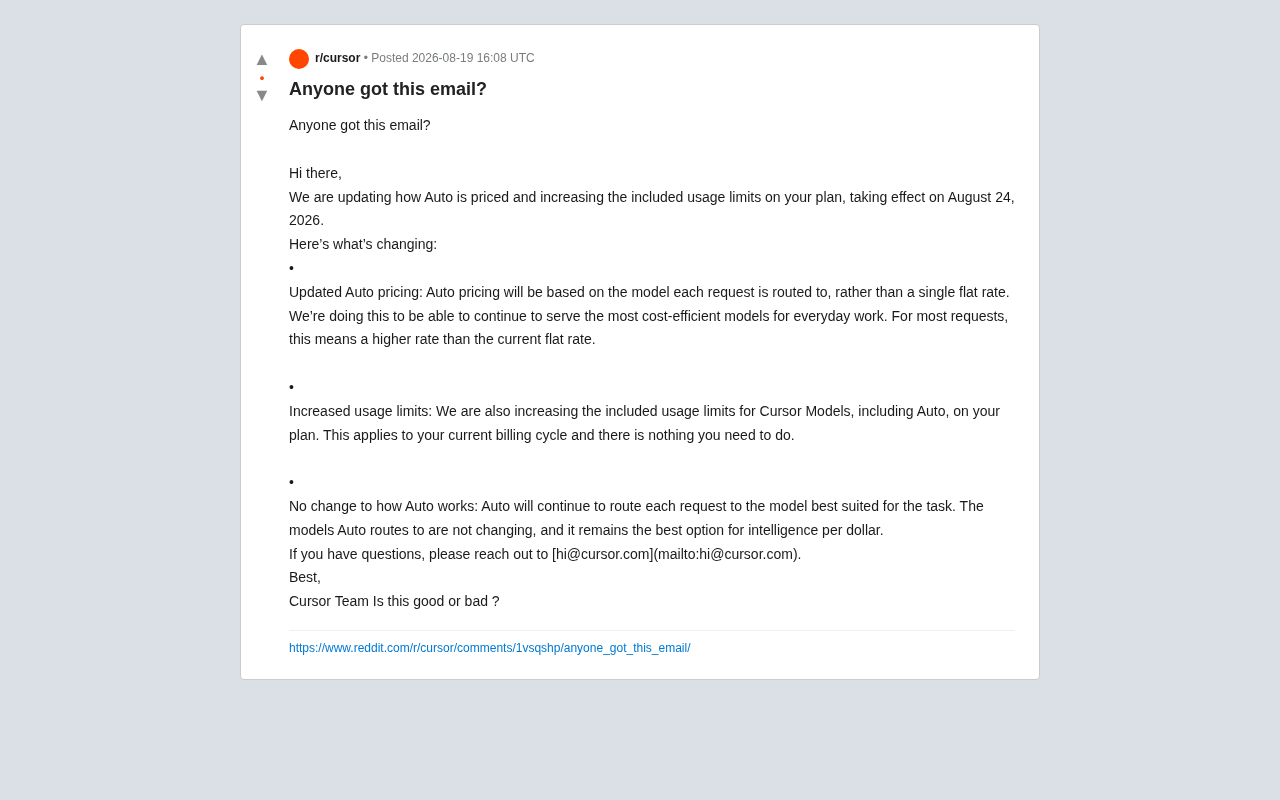
Recently, many Cursor users received and discussed an official email from the Cursor team on Reddit, centered around a pricing adjustment to its core feature—Auto mode. The email clearly states that the changes will take effect on August 24, 2026, involving two key aspects: a change in Auto's pricing mechanism and an increase in plan usage limits.
Cursor, developed by Anysphere, is built on the VS Code open-source codebase. Since its release in 2023, it has rapidly become one of the leading products in the AI coding tools space. As of 2025, Cursor has completed multiple funding rounds with a reported valuation exceeding several billion dollars. Its core competitive advantage lies in deeply integrating large model capabilities into every interaction within the editor—from Tab completion and inline editing to multi-file Agent mode—rather than merely offering a sidebar chat like traditional plugins. In the intense competition with GitHub Copilot, Windsurf (formerly Codeium), and other products, every pricing adjustment could influence users' migration decisions, which is an important backdrop for the widespread discussion triggered by this email.
For developers who rely on Cursor for daily AI-assisted programming, interpreting this email isn't straightforward—it contains signals that seem like a "price increase" while also offering the benefit of "increased limits." The most common question in the community is: Is this good news or bad news?
Core Change: From a Flat Rate to Per-Model Pricing
A Fundamental Shift in Auto's Pricing Logic
According to the original email, the most significant change concerns Auto's pricing mechanism:
"Auto pricing will be based on the model each request is routed to, rather than a single flat rate."
In other words, Cursor Auto previously used a unified flat rate—regardless of which model your request was routed to on the backend, you paid the same price. After the adjustment, the price will depend on the model each request is actually routed to.
To understand the deeper implications of this change, you need to first understand Auto mode's technical mechanism. In Auto mode, every code completion, refactoring, or Q&A request a user sends is not fixed to a specific large language model (LLM). Instead, Cursor's backend intelligent routing system dynamically selects the most suitable model based on factors like task complexity, context length, and response speed requirements. For example, a simple variable rename might be routed to a lightweight model (like GPT-4o-mini or Claude 3.5 Haiku), while a complex task involving multi-file refactoring might be routed to a more powerful model (like Claude 3.5 Sonnet or GPT-4o). This routing mechanism is designed to achieve an optimal balance between quality and cost.
The official reasoning for this change is to continuously provide the most cost-effective models for everyday work. Cursor candidly acknowledges in the email that for most requests, this means a higher rate than the current flat rate ("For most requests, this means a higher rate than the current flat rate").
This is the most critical piece of information in the entire email. It directly states that from a pure per-unit price perspective, the per-request cost on Auto will increase for most users.
Why Is Cursor Switching to Per-Model Pricing?
From a product operations perspective, the flat rate model has an inherent contradiction: the API call costs of different large models vary enormously. When all requests are charged the same fee, Cursor either loses money on high-cost models or is forced to limit routing to expensive but more capable models.
This contradiction becomes even more vivid with concrete numbers. Referencing current market prices, the cost differences between model API calls are staggering: OpenAI's GPT-4o costs roughly $2.5–5 per million input tokens, while GPT-4o-mini costs only about $0.15—a difference of over ten times; Anthropic's Claude 3.5 Sonnet costs about $3 per million input tokens, while the Haiku series goes as low as $0.25. Under a flat rate, when a user's request is routed to a high-cost model, Cursor is essentially absorbing the price difference at a loss; conversely, if it always routes to low-cost models to control expenses, user experience and output quality suffer.
With per-model pricing, Cursor can more flexibly route requests to models that best match in terms of performance and cost, without sacrificing model selection freedom due to pricing constraints. This is commercially logical—essentially making the cost structure transparent and passing it through to actual usage.
Increased Limits: The Upside That Offsets Per-Unit Price Increases
Plan Included Limits Increase Immediately
The second change in the email is that Cursor has increased the usage limits included in plans, applying to both Cursor Models and Auto:
"We are also increasing the included usage limits for Cursor Models, including Auto, on your plan."
Interestingly, the official communication specifically notes that this limit increase takes effect immediately in the current billing cycle, with no action required from users.
This is precisely why the community feels "mixed emotions." On one hand, per-unit prices may rise; on the other, the available quota within the plan has increased. Therefore, the actual impact on users depends on the net effect of two variables:
- If your usage happens to fall within the new, higher limits, then the increased quota may fully cover or even exceed the impact of per-unit price increases;
- If you're a heavy user who consistently exceeds plan limits, the higher per-unit prices under per-model pricing will directly push up your overage costs.
Auto's Intelligent Routing Mechanism Remains Unchanged
To reassure users, Cursor emphasized what stays the same in the email:
"Auto will continue to route each request to the model best suited for the task."
This means Auto's intelligent routing logic itself hasn't changed, nor has the set of models it routes to. Cursor continues to position Auto as the optimal choice for "intelligence per dollar."
This has practical significance for regular users—your usage experience and result quality won't decline due to this pricing adjustment; only the billing method behind the scenes is changing.
Deep Dive: What Does This Mean for Developers?
A Typical "Pricing Transparency" Move
Taken as a whole, this adjustment is essentially Cursor's migration from "subsidized flat pricing" to "cost-reflective pricing." This is not uncommon across the AI tools industry—as underlying LLM API costs fluctuate and user scale expands, many AI products are re-evaluating the subsidized prices they set during their early growth phases.
In fact, the AI coding tools industry's pricing models are undergoing a broader transformation from "growth-first" to "sustainable operations." Early on, GitHub Copilot offered unlimited code completions at a fixed subscription price of $10–19/month, a strategy that helped it rapidly acquire over a million paying users—but Microsoft CEO Nadella admitted that Copilot was losing money on some users. Similarly, Cursor's Pro plan is priced at $20/month, including a certain number of premium requests and unlimited basic requests. As user scale grows and usage frequency increases, cost pressure under fixed subscription models becomes increasingly significant. GitHub Copilot has already introduced pay-per-use extension options, competitors like Tabnine and Codeium are also exploring tiered pricing, and Cursor's adjustment is a microcosm of this industry trend.
Flat-rate pricing is an effective marketing tool during user growth phases, but as model call volumes surge, long-term subsidization becomes unsustainable. Per-model pricing aligns Cursor's revenue more closely with actual costs, enabling healthier business sustainability.
Impact Analysis for Different User Types
Returning to the community's original question—"Is this good or bad?"—the answer isn't absolute:
- For light to moderate users: The increased limits likely deliver a net positive; daily usage might not even feel noticeably different—this leans favorable.
- For heavy, over-quota users: Per-model pricing means higher costs when calling high-performance models; long-term spending will most likely increase, requiring a reassessment of usage strategies.
- For cost-sensitive teams: It's advisable to monitor your actual model routing distribution and usage before the August 24, 2026 effective date to estimate the true impact.
A Detail About the Effective Date
It's worth noting that the email marks the effective date as August 24, 2026, which is a relatively distant time window (it could also be a typo in the email). Either way, it gives users ample time to observe and adjust, with no need for immediate action.
Conclusion: A Rational View of Cursor's Pricing Strategy Adjustment
Cursor's Auto pricing adjustment is a combined operation of "per-unit price increases" running parallel with "quota increases." It reflects the rebalancing of cost structures as AI coding tools navigate their commercialization journey. For the vast majority of users, the actual impact needs to be assessed based on individual usage patterns, rather than simply labeling it as a "price hike" or "price cut."
For developers who rely on Cursor, the rational approach is: pay attention to subsequent detailed pricing announcements from the official team, track your own model routing and usage data, and complete cost projections and workflow optimization before the effective date. After all, in today's increasingly competitive AI tools landscape, "intelligence per dollar" remains the core metric for measuring a product's value.
Related articles

Chain of Thought Isn't Just for AI: How Humans Can Use CoT to Improve Thinking Quality
Chain of Thought isn't just a prompt trick for large models. Starting from a Hacker News discussion, this article analyzes why CoT works for human thinking too, breaks down actionable ways to transfer it, and highlights the key differences between human CoT and machine CoT.
Cloudflare Teams Up with OpenAI: Closi…
Cloudflare Teams Up with OpenAI: Closing the Loop from Vulnerability Discovery to Defense with AI
Cloudflare uses OpenAI Daybreak to investigate security vulnerabilities and generate reviewable remediation plans, while developers use Codex to boost coding efficiency and quality.

Orca Multi-Agent Orchestration in Practice: A Guide to Parallel Collaboration with Claude and Codex
Orca is Stable AI's free open-source agent workbench supporting 34 agents like Claude Code and Codex in parallel. Learn its Git worktree isolation, multi-model orchestration, and mobile management.