Cursor Composer 2.5 Deep Dive: Matching Claude Opus 4.7's Coding Ability at 1/10 the Cost

Cursor's Composer 2.5 achieves top-tier coding ability at a fraction of the cost
Cursor built Composer 2.5 on top of the open-source Kimi K2.5 model, investing 85% of compute into post-training through innovations like text-feedback-directed reinforcement learning and large-scale synthetic data generation. The model matches the coding capabilities of Claude Opus 4.7 and GPT 5.5 at less than one-tenth the cost, with particularly strong performance in long-task-chain stability, potentially reshaping the AI programming tools market.
Introduction
As AI programming assistants enter the era of long-task-chain Agents, models are no longer just completing a line or two of code — they need to consistently and stably execute dozens of complex operations in sequence. Cursor's latest in-house model, Composer 2.5, achieves coding capabilities on par with Claude Opus 4.7 and GPT 5.5 at less than one-tenth the cost through a unique large-scale post-training strategy, with particularly strong performance in long-task stability. This high cost-efficiency approach may well reshape the AI programming tools market.
Technical Panorama: 85% of Compute Invested in Post-Training, Redefining Model Capability Boundaries
Composer 2.5 was not trained from scratch — its base model is Moonshot's open-source Kimi K2.5. Kimi K2.5 is a large-scale Mixture of Experts (MoE) language model open-sourced by Moonshot AI, with an architecture designed for strong foundational capabilities in code understanding and multilingual programming tasks. The core advantage of the MoE architecture lies in the fact that while the model has a massive total parameter count, only a small subset of "expert" sub-networks is activated during each inference pass, dramatically reducing inference compute costs while maintaining high performance. This characteristic makes it an ideal base for specialized post-training — the vast parameter capacity provides ample storage for domain knowledge, while the sparse activation mechanism ensures inference efficiency. Cursor chose Kimi K2.5 over GPT or Claude series as the base model partly due to the freedom offered by open-source licensing, and partly reflecting their judgment on the potential of MoE architectures in code-specialized scenarios.
But Cursor's ambition goes far beyond a simple fine-tune — the most striking number in the report is: 85% of compute resources were invested in additional continued pre-training and reinforcement learning post-training, while Kimi K2.5's own post-training compute accounted for only 7.5%. In other words, the vast majority of the model's capability improvements come from Cursor's own training pipeline.
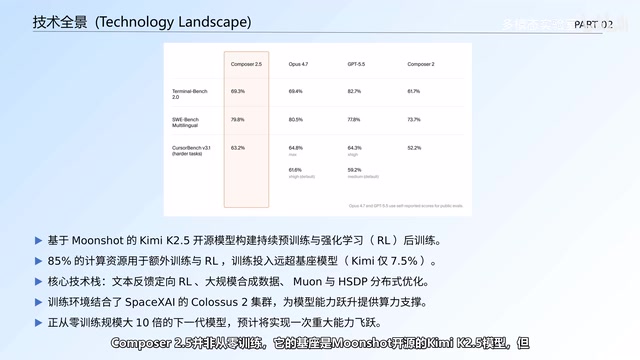
The core technology stack includes text-feedback-directed reinforcement learning, large-scale synthetic data generation, and training infrastructure using the MUON optimizer with HSDP distributed parallelism. Training runs on SpaceX AI's Colossus 2 cluster, providing ample compute for the model's capability leap. Even more noteworthy, they are collaborating with SpaceX AI to train a model ten times larger from scratch, expected to achieve a generational leap.
This isn't just a difference in compute allocation — it reflects a fundamentally different design philosophy: native base models pursue broad knowledge coverage, while specialized models need to pour nearly all resources into shaping and correcting specific behaviors.
Core Innovation 1: Text-Feedback-Directed Reinforcement Learning
In long-sequence rollouts, credit assignment in reinforcement learning is a classic challenge. Credit assignment refers to the problem of determining which specific steps had positive or negative effects on the final outcome when an agent receives a reward signal only after executing a long sequence of actions. In code Agent scenarios, a complete task may involve dozens of tool calls and tens of thousands of lines of context, with trajectory lengths reaching hundreds of thousands of tokens. The sparse reward problem is amplified to an extreme — when an entire trajectory spans hundreds of thousands of tokens with only a single sparse reward at the end, the model struggles to pinpoint which specific action caused a failure.
Composer 2.5 introduces an elegant solution: at positions in the trajectory where the model makes errors (such as incorrectly calling an unavailable tool), the training system inserts a brief local prompt (e.g., a reminder of the available tool list), then treats the model's prediction distribution under this augmented context as a "teacher signal," using an on-policy KL divergence loss to push the original policy's token probabilities toward the teacher distribution. This design essentially transforms the sparse reward problem into a dense local supervision problem, fundamentally circumventing the long-sequence credit assignment dilemma.
The benefits are twofold: it enables precise correction of local errors (confused tool calls, interpretation drift, or code style issues) without disrupting the overall reinforcement learning objective across the complete trajectory. This approach elevates training granularity to an unprecedented level of precision.
Core Innovation 2: Large-Scale Synthetic Data and Reward Hacking Defense
As the model's coding ability continuously improves during reinforcement learning training, simple tasks are quickly "solved"
Related articles
Meta Muse Hits 900K Downloads in Six D…
Meta Muse Hits 900K Downloads in Six Days: The AI Agent Era Has Officially Arrived
Meta's AI agent Muse hit 902K downloads in 6 days, topping US App Store and Google Play charts above ChatGPT and Claude. A deep dive into Muse's capabilities and the AI Agent race.
 Industry Insights
IRS Fully Embraces Claude AI, Accelerating Federal Government's AI Adoption
The IRS is recruiting staff with 24/7 Claude AI access, marking Anthropic's breakthrough into the federal government. Explore the strategic implications and tax use cases.
 Industry Insights
The IRS Mobile App Debate: A Trust Crisis in Government Digital Transformation
The IRS's proposed mobile app has sparked heated debate. This article analyzes the core arguments, exploring data security, privacy, and the trust crisis in government digital transformation.