Cursor Composite vs Windsurf SWE 1.5: Three Rounds of Real-World Testing to Determine the Best AI Coding Model

Windsurf SWE 1.5 outperforms Cursor Composite across three progressive coding benchmarks.
Cursor and Windsurf each released proprietary coding models—Composite and SWE 1.5. Through three rounds of progressive testing (HTML game, e-commerce page, full-stack login system), Windsurf SWE 1.5 won comprehensively in generation speed, feature richness, architectural quality, and code usability. Its edge stems from earlier proprietary model development, a data flywheel from its free-tier strategy, and stronger engineering practices. Despite Cursor's dominant market share, Windsurf currently leads in proprietary model capabilities.
Cursor vs Windsurf: A Head-to-Head Battle of Proprietary Coding Models
Cursor and Windsurf are currently the two hottest AI coding tools in the developer community. Recently, both companies launched their own proprietary coding models almost simultaneously—Cursor's Composite and Windsurf's SWE 1.5. Both models emphasize "fast generation," but which one actually performs better at real programming tasks?
AI coding tools have traditionally relied on third-party large language models (such as OpenAI's GPT series and Anthropic's Claude series) as their underlying engines, with tool vendors primarily playing an "middleware" role—handling IDE integration, context management, and prompt engineering. Developing proprietary coding models means these vendors are now taking control of core AI capabilities, no longer entirely dependent on upstream model providers' pricing, API limitations, and technical roadmaps. The strategic significance of this shift is substantial: on one hand, it enables deep optimization for coding scenarios; on the other, it helps maintain business continuity in the face of supply chain risks (such as the Claude supply disruption incident).
Many developers have speculated after testing that both companies' proprietary models may be fine-tuned from Chinese open-source models (such as Qwen or Zhipu), though neither company has officially confirmed this. This technical approach is very common in the industry: open-source foundation models (like Alibaba's Tongyi Qwen or Zhipu's GLM series) provide powerful general language understanding and generation capabilities, upon which vendors apply Supervised Fine-Tuning (SFT) and Reinforcement Learning from Human Feedback (RLHF) using large volumes of programming-related corpora (such as GitHub repositories, Stack Overflow Q&A, project documentation, etc.), making the models perform better on coding tasks like code generation, bug fixing, and architecture design. The advantage of this approach lies in dramatically reducing the computational costs of training from scratch while quickly obtaining usable programming-specific models.
This article conducts three progressively challenging rounds of real-world testing—from a simple HTML game, to an e-commerce static page, to a complete project with both frontend and backend—to comprehensively compare the actual programming capabilities of both models.
Round 1: HTML Snake Game Generation
The first round features a classic beginner task: generating an HTML Snake game with a simple prompt, focusing on code generation speed and final results.
Generation Speed Comparison
Both models generated code very quickly, with Windsurf SWE 1.5 having a slight edge, finishing its code output first. Cursor Composite followed closely behind, with the speed gap being relatively small.
Game Quality Comparison
Cursor Composite's Snake game runs normally with complete basic functionality, but the interface is quite simple, featuring only the most basic game logic.
Windsurf SWE 1.5's version is noticeably richer—the game itself runs smoothly, and it additionally includes a difficulty selection feature and sound effects. This demonstrates that SWE 1.5 proactively filled in more reasonable functional details when interpreting the "Snake game" requirement.
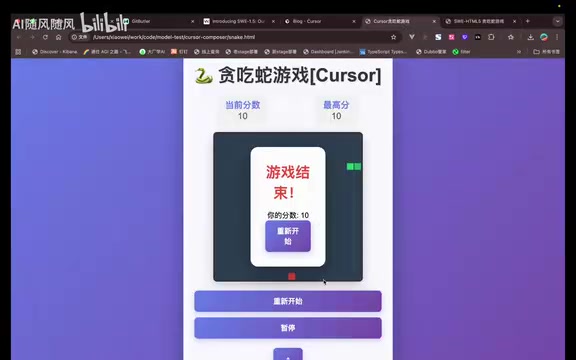
Round 1 Conclusion: Windsurf SWE 1.5 wins. Faster speed, richer features, and better requirement understanding.
Round 2: JD.com E-commerce Static Page Generation
Round 2 escalates to a more complex frontend task: generating a static page resembling JD.com (China's major e-commerce platform), including a search bar, product listings, category navigation, and other core e-commerce elements.
Generation Process and Project Structure
SWE 1.5 finished first again. While Cursor Composite also basically completed the five subtasks, it spent additional time executing code and writing README documentation.
A key difference lies in how projects are launched: Composite's generated project cannot be started through the standard npm install and npm run dev commands—it requires following special instructions in the README to execute directly with node. SWE 1.5, on the other hand, generated a standard Vue project that launches smoothly with conventional commands. Here, npm install and npm run dev represent the most standard project startup workflow in the Node.js ecosystem—the former installs project dependencies, the latter starts the development server. Vue is one of the most popular frontend frameworks today, with mature scaffolding tools and project conventions. Whether an AI model can generate project structures that conform to these standard workflows directly impacts the developer experience and subsequent maintenance costs.
Visual Quality Comparison
Cursor Composite's page includes a search bar, product detail page, and listing page, but the overall design is quite crude, with a visual style reminiscent of web pages from a decade ago.
Windsurf SWE 1.5's page is noticeably more modern:
- Includes JD.com's iconic top navigation bar
- Features specialized modules like a flash sale section
- More refined product listing page layout and styling
- Overall visual effect closer to a real e-commerce website

Round 2 Conclusion: Windsurf SWE 1.5 wins again. Faster generation, more modern page design, and clearly deeper understanding of the "JD.com" scenario.
Round 3: Full-Stack Login/Registration System
Round 3 is the most challenging test: building a login/registration system with both frontend and backend, requiring a real backend service and database interaction. An empty database was prepared for each model before testing—the models needed to handle database table design, backend logic, and frontend pages entirely on their own.
Code Architecture Differences
The two models showed significant differences in architectural design:
- Cursor Composite: Generated a very simple server-side application with a relatively flat code structure
- Windsurf SWE 1.5: Generated a standard MVC architecture with frontend-backend separation, including Controllers, routes, and a complete project structure, with noticeably more code
MVC (Model-View-Controller) is a classic software architecture pattern that divides an application into three core components: Model handles data and business logic, View handles user interface presentation, and Controller receives user input and coordinates interaction between Model and View. Frontend-backend separation is the mainstream practice in modern web development, where the frontend (typically Vue, React, or similar frameworks) and backend (such as Node.js, Spring Boot) are developed and deployed as independent projects, communicating via RESTful APIs. Whether an AI model can generate code conforming to these architectural standards directly reflects its depth of understanding of real software engineering practices—flat code structures may run, but they fall far short of standardized architectural designs in terms of maintainability, scalability, and team collaboration.
Database Handling Capabilities
The differences were especially pronounced in this area. Composite did not automatically create database tables, requiring developers to manually execute migration scripts; SWE 1.5 not only automatically created the database tables but also thoughtfully inserted several mock data records for testing convenience. Database Migration is a standard practice in modern backend development for managing database schema changes through versioned scripts that record each table creation and modification. Auto-inserting mock data (i.e., Seed Data) is a common requirement during development and testing phases, allowing developers to immediately verify system functionality without manually creating test data. SWE 1.5's ability to proactively complete these steps demonstrates a deeper understanding of the complete development workflow.
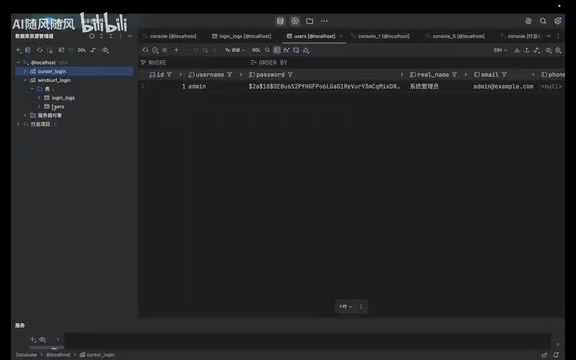
Actual Runtime Results
Cursor Composite's performance was disappointing—the registration function returned a 404 error, the login page's CAPTCHA failed to display properly, and the entire system essentially couldn't function. A 404 error means the API path requested by the frontend was not correctly registered on the backend, typically caused by routing configuration errors or inconsistent frontend-backend interface agreements—a fairly basic engineering problem.
Windsurf SWE 1.5 performed much better:
- CAPTCHA functionality displayed correctly
- Registration flow completed successfully
- Login functionality worked properly
- The only minor issue was a missing page redirect after successful login
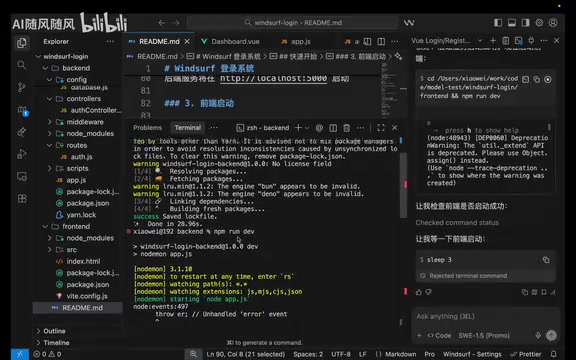
Round 3 Conclusion: Windsurf SWE 1.5 dominates. In the most demanding full-stack project test, SWE 1.5 demonstrated stronger engineering capabilities and higher code usability.
Why Did Windsurf SWE 1.5 Outperform Cursor Composite Across the Board?
After three rounds of testing, Windsurf SWE 1.5 achieved a clean sweep—a genuinely surprising result. In terms of market share, Cursor holds over 60% of the AI coding tool market, far ahead of Windsurf. Moreover, Windsurf recently experienced negative events including its CEO's departure and the Claude model supply disruption.
The current AI coding tool market exhibits a multi-layered competitive landscape. The first tier includes Cursor and GitHub Copilot, occupying leading positions in standalone AI IDEs and plugin-based AI assistants respectively. Windsurf (formerly Codeium), while smaller in market share, has accumulated a large user base through its free-tier strategy. Additionally, there are products from tech giants like Amazon Q Developer, JetBrains AI Assistant, and Google's Gemini Code Assist. Notably, this market is still in a rapid reshuffling phase—technological iteration is extremely fast, user switching costs are relatively low, and a breakthrough model upgrade could significantly alter the competitive landscape.
But upon closer analysis, SWE 1.5's lead is no coincidence:
Earlier Head Start in Proprietary Model Development
Windsurf launched its proprietary coding model earlier than Cursor. Through the iteration process from SWE 1.0 to 1.5, the team accumulated extensive training data and optimization experience for coding scenarios—a first-mover advantage directly reflected in model quality.
Free-Tier Strategy Creating a Data Flywheel
The SWE model series has always been freely available to users, enabling Windsurf to collect more real-world usage feedback and coding scenario data, creating a data flywheel effect that continuously improves model performance. The Data Flywheel is a core growth mechanism for AI products: free product access attracts users → user activity generates massive real-world data and feedback → this data is used for model training and optimization → improved model quality attracts even more users, forming a positive feedback loop. In the AI coding tool space, this flywheel is particularly powerful because every code generation, modification, acceptance, or rejection by a user constitutes extremely valuable training signals. Windsurf's decision to offer the SWE series for free sacrificed short-term revenue but gained access to massive volumes of real coding scenario data, whose diversity and authenticity far exceed artificially constructed training sets—making it the key fuel for continuous model evolution.
Stronger Engineering Mindset
Based on the test results, SWE 1.5 demonstrated a stronger engineering mindset across project structure design, database initialization, and dependency management, generating code that more closely aligns with real-world development best practices. This engineering mindset is reflected not just in whether code can run, but whether code follows industry standards—such as using standard project scaffolding, reasonable directory structures, well-designed APIs, and comprehensive error handling. These details determine whether AI-generated code can truly integrate into a developer's daily workflow, rather than serving merely as a "runs but that's about it" demo.
Summary and Recommendations
| Test Project | Cursor Composite | Windsurf SWE 1.5 | Winner |
|---|---|---|---|
| HTML Snake Game | Basic functionality works | Richer features, includes difficulty selection and sound effects | SWE 1.5 |
| JD.com Static Page | Crude interface, non-standard startup | Modern design, standard Vue project | SWE 1.5 |
| Full-Stack Login/Registration | Registration 404, CAPTCHA broken | All core functions work properly | SWE 1.5 |
It should be noted that this comparison only targets the two companies' proprietary models. In actual use, both Cursor and Windsurf support third-party models like Claude and GPT-4, and the overall coding experience is also influenced by IDE features, context understanding, multi-file editing, and many other factors. Context understanding capability is especially critical—it determines whether an AI tool can accurately comprehend the current project's code structure, existing function definitions, and variable naming conventions, thereby generating code consistent with the project's style rather than producing stylistically inconsistent snippets from scratch each time.
However, in terms of proprietary model coding capabilities, Windsurf SWE 1.5 is currently the stronger option. For developers following AI coding tool developments, this "underdog upset" is worth continued attention—market share leadership doesn't necessarily equate to comprehensive technical superiority, and the competitive landscape of AI coding tools could shift at any moment.
Related articles
 Product Reviews
The Programmer's Desk Setup Guide: Building a Workspace That Feels Like Home
Discover how programmers build productive, comfortable workspaces. From multi-monitor setups to ergonomic design, explore the desk philosophy that drives focus and flow.
 Product Reviews
Qoder vs Cursor Real-World Comparison: Which $20/Month AI IDE Is Better?
Hands-on comparison of Qoder vs Cursor AI IDEs: Agent autonomy, human interaction count, and architecture decisions. Qoder needed only 2 interactions vs Cursor's 8.
 Product Reviews
Cursor Cloud Agent Demo: Eliminating Bottlenecks Across the Entire Software Development Lifecycle
Deep analysis of Cursor's Cloud Agent demo showing how cloud VMs, automated test artifacts, and a full-chain control plane systematically eliminate human bottlenecks across the software development lifecycle.