Cursor Drops Its Unlimited Plan: A Turning Point in AI Coding Tool Pricing
Cursor ends its unlimited plan, marking a pricing turning point for AI coding tools.
Cursor has officially discontinued its unlimited Auto plan, transitioning to tiered pricing as the costs of AI-powered coding tools prove unsustainable. Through a Reddit user's firsthand experience consuming 300 million tokens monthly, this article explores the economic realities behind AI tool pricing, Cursor's product evolution and competitive moat, and the strategic tension between serving professional developers and the growing vibe-coding crowd.
The End of an Era: Cursor's Unlimited Plan Is Officially Gone
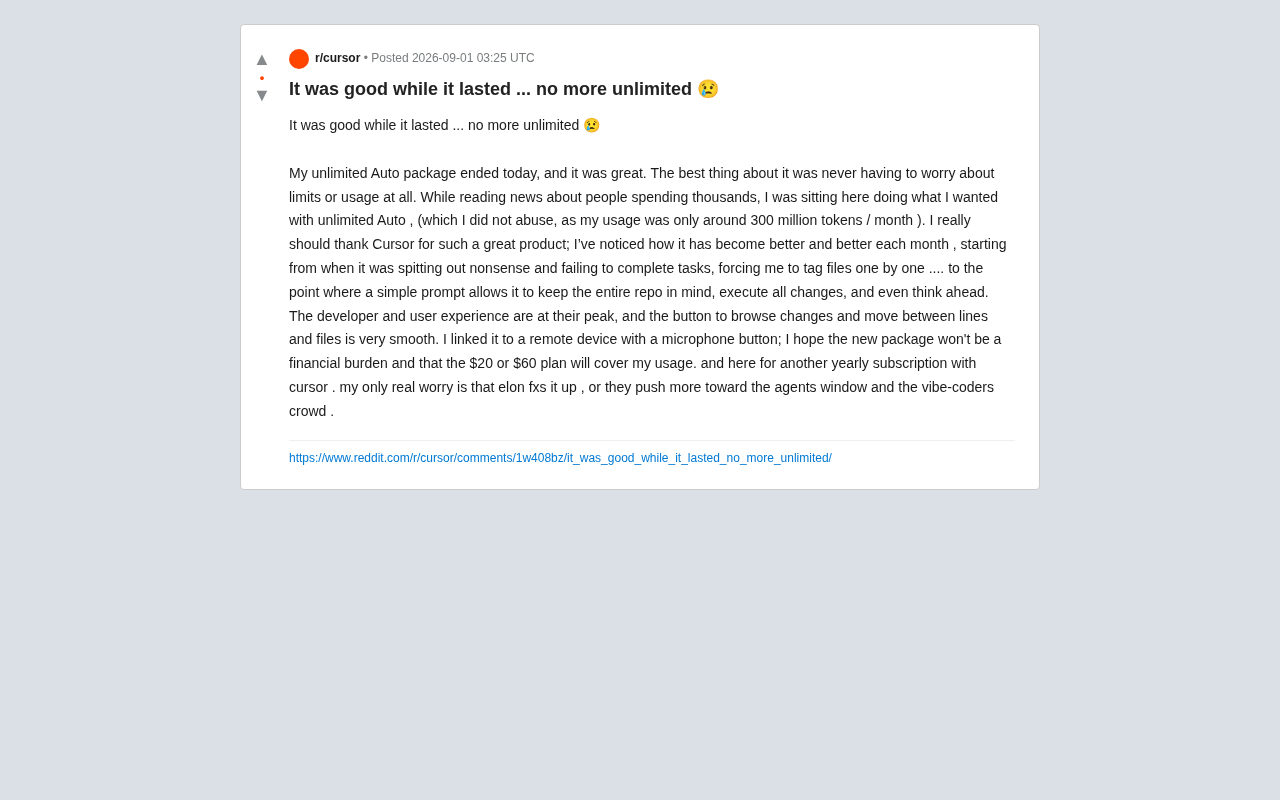
Recently, a heavy Cursor user posted on Reddit to bid farewell to the "unlimited Auto plan." The post was brief but struck a chord: "It was good while it lasted ... no more unlimited."
The user candidly shared that the biggest value of the unlimited plan was "never having to worry about usage limits." While he saw news stories about people spending thousands of dollars a month on AI tools, he could use unlimited Auto to his heart's content — and he emphasized that he wasn't abusing it, consuming roughly 300 million tokens per month on average. For a developer, that's a usage level that's both real and restrained.
In large language models, a token is the smallest unit of text processing. In English, one token corresponds to roughly 4 characters or 0.75 words; in Chinese, a single character typically maps to 1–2 tokens. 300 million tokens roughly equates to processing 225 million English words — about the information equivalent of 750 standard-length novels. But for AI coding tools, token consumption goes far beyond user prompts. It also includes model-generated code completions, context injection from entire codebases, and conversation history across multi-turn dialogues. This means that every time the AI is asked to understand a codebase and offer suggestions, massive numbers of tokens are being consumed behind the scenes. Based on current mainstream model API pricing (e.g., GPT-4o at approximately $2.50 per million input tokens and $10 per million output tokens), the actual cost of 300 million tokens could range from several hundred to over a thousand dollars — far exceeding a fixed subscription fee. This explains why the unlimited plan was never sustainable.
With the cancellation of the unlimited plan, Cursor has officially entered an era of strict tiered pricing. This isn't just a single product's business decision — it reflects a deeper industry-wide tension between costs and business models across the entire AI coding tool space.
Cursor's Product Evolution
You might not have noticed, but this user wasn't simply complaining — he gave Cursor high praise. He reflected on the product's growth trajectory: from the early days of "outputting gibberish, failing to complete tasks, and forcing users to manually tag files one by one," to today's mature state where "a simple prompt lets it remember your entire codebase, execute all changes, and even think ahead."
Cursor is an AI-native code editor developed by Anysphere, built on a deep rework of VS Code's open-source framework. Unlike GitHub Copilot, which functions primarily as a plugin embedded in existing IDEs, Cursor was redesigned from the ground up around AI interaction — deeply integrating large language models into every aspect of the editor, from code completion and bug fixing to cross-file refactoring. In late 2024, Anysphere closed a new funding round led by Thrive Capital, with a reported valuation exceeding several billion dollars. On the competitive front, Cursor faces rivals including GitHub Copilot (backed by Microsoft and OpenAI), Windsurf (formerly Codeium, known for its free-tier strategy), and Google's Gemini Code Assist. The intensity of competition in this space makes pricing strategy a life-or-death decision.
Cursor's Peak User Experience
The user highlighted several feature details that particularly impressed him:
- Change navigation buttons: Smooth jumping between code lines and files
- Remote device integration: He connected Cursor to a remote device with a microphone button, enabling voice interaction
- Contextual understanding: The model can take the entire codebase into consideration, rather than processing individual files in isolation
The ability to "take the entire codebase into consideration" involves a key technology — codebase indexing and Retrieval-Augmented Generation (RAG). Traditional AI coding assistants are limited by the model's context window size (the number of tokens it can process at once) and can only see the currently open file or a small amount of related code. Cursor addresses this by building a semantic index of the entire code repository — splitting code files into semantic chunks and converting them into vector embeddings, stored in a local vector database. When a user asks a question, the system dynamically retrieves the most relevant code snippets and injects them into the model's context. This approach enables the model to "understand" the project's overall architecture, cross-file dependencies, and coding style, rather than processing individual files in isolation. Of course, this also explains why token consumption is so high — each inference may involve injecting a large volume of contextual code snippets.
These improvements in user experience are the core competitive advantage that keeps users on Cursor. The user stated plainly: "The developer and user experience is at its peak." This is an extremely high-value assessment — it means that even with pricing adjustments, the product's intrinsic value is still recognized.
Why the Unlimited Plan Was Unsustainable
The cancellation of the unlimited plan was no accident. The underlying costs of AI coding tools are extremely high — every code completion, every repo-level inference, burns through real computing resources that cost real money. When users consume 300 million tokens per month while paying a flat fee, this business model inevitably becomes unsustainable at scale.
The Heavy User Cost Paradox
Interestingly, even users like the poster who consider themselves "restrained" are reaching staggering usage levels. 300 million tokens may seem moderate, but it's still a significant cost for the platform. And those extreme users "spending thousands of dollars a month" completely destroy the economics of an unlimited model.
For AI tool vendors, unlimited plans are typically an early customer acquisition strategy — lowering the barrier to use in order to rapidly build a user base and brand reputation. But once the product matures and user stickiness is established, transitioning to sustainable tiered pricing is almost inevitable. This follows the same pricing evolution logic seen in cloud computing and the SaaS industry. In the history of SaaS (Software as a Service) development, virtually every successful product has gone through a similar pricing cycle: early-stage customer acquisition through freemium or ultra-low pricing, mid-stage guidance toward upgrades through usage limits, and mature-stage transition to usage-based pricing. Classic examples include Slack moving from free unlimited messaging to charging for message history access, Zoom going from free 40-minute sessions to paid unlimited duration, and AWS evolving from startup credits to pay-as-you-go billing.
But for AI tools, this transition is far more urgent than for traditional SaaS. The reason lies in a fundamentally different marginal cost structure — every API call involves real GPU compute costs, whereas traditional SaaS products have near-zero marginal cost per additional user. This means that AI tool "unlimited plans" are, from an economic standpoint, far more unsustainable than their traditional SaaS counterparts. As the user base grows from thousands to hundreds of thousands, every heavy user's token consumption eats directly into profit margins.
Cursor Users' Hopes and Concerns
This user expressed his intention to continue subscribing to Cursor and was already prepared to renew his annual membership. His only concerns focused on two areas:
Whether Cursor's New Plan Pricing Will Stay Manageable
He hopes the new plans won't become a financial burden and expects that a $20 or $60 tier would cover his usage needs. This reflects the mindset of most professional developers — they're willing to pay for quality tools, but they need a clear, predictable relationship between price and value. Whether his average monthly consumption of 300 million tokens can be accommodated within this price range will directly influence users' decisions to stay or leave.
Whether the Product Direction Will Shift
He also raised two deeper concerns: first, a worry that "Elon might mess it up" (alluding to how capital movements and personnel changes in the industry might affect the product's direction), and second, a fear that Cursor might "lean too heavily toward the agents window and vibe-coders crowd."
Two key concepts deserve explanation here. The "agents window" refers to Cursor's recently emphasized Agent mode. In this mode, the AI no longer passively answers questions or completes code — it can autonomously plan task steps, execute terminal commands, read and write files, run tests, and even automatically debug and fix errors when they occur. In essence, it's an AI programming agent with autonomous action capabilities. This mode aligns with the "computer use" concept proposed by Anthropic and the vision behind products like Devin, the AI programmer.
"Vibe Coding" is a term coined by prominent AI figure Andrej Karpathy in early 2025, describing a programming approach where you "fully surrender to the vibes, embrace exponential uncertainty, and forget that the code even exists." In practice, users simply describe their needs in natural language, let the AI generate and manage all the code, and don't even read what's been generated. While this dramatically lowers the barrier to programming, it has also sparked intense concern among professional developers: it could lead to declining code quality, accumulating technical debt, and developers losing genuine understanding and control of their own projects.
This veteran user's concern is precisely this: if Cursor shifts its product focus toward Agent mode and the Vibe Coding crowd to capture a broader entry-level market, it may sacrifice the depth, precision, and controllability that professional developers value. This is a classic product positioning dilemma — accommodating the lower end risks losing the high end.
Industry Implications: The Commercialization Inflection Point for AI Coding Tools
This small Reddit post precisely captures a critical inflection point in the AI coding tool industry.
The era of free and unlimited is ending. Under the real-world cost pressure of large model APIs, nearly every AI coding tool is exploring sustainable business models. The "unlimited dividends" users have enjoyed are fundamentally a temporary phenomenon — funded by venture capital to buy market share.
Product value determines user loyalty. Despite the cancellation of the unlimited plan, this user still chose to renew. This demonstrates that what truly wins users over isn't price — it's the continuous evolution of product experience. Cursor's advances in contextual understanding and repo-level reasoning have built a sufficiently deep moat.
Balancing user segments is a double-edged sword. There's an inherent tension between serving professional developers and serving entry-level users. How to expand the market without losing core users is a strategic challenge that Cursor — and all AI tool vendors — must confront.
Conclusion
"It was good while it lasted" — this slightly bittersweet farewell actually marks an inevitable step on the path to maturity for AI coding tools. For users, the disappearance of Cursor's unlimited plan means reassessing their return on investment. For vendors, it's a pivotal move from cash-burning expansion to sustainable operations.
The real question isn't whether to charge, but whether the price can match the value, and whether the product direction can maintain the trust of core users. As this user put it, he's willing to renew Cursor for another year — on the condition that it continues to deliver the experience that lets developers "work without constraints." This may well be the ultimate goal that all AI coding tools should aspire to.
Related articles

Python 3.15 New Feature: Is the sentinel Type Better Than None?
Python 3.15 adds the sentinel type, using named unique sentinel objects to replace None and bare object(), resolving confusion among missing values, explicit emptiness, and invalid input while avoiding type hint failures.

Deep Learning's Three Architectures and the Universal Approximation Theorem: A Complete Guide to MLPs, CNNs, and Transformers
Explaining the inductive bias differences among MLP, CNN, and Transformer, the existence meaning of the Universal Approximation Theorem (UAT), and the role of Taylor expansion in approximation analysis, while clearing up common misconceptions.

GitLab Emergency Patch Release: Analysis of Critical Security Fixes
GitLab releases critical patch 19.5.1, sparking 355 points of discussion on Hacker News. This article analyzes the background, upgrade steps for self-hosted instances, and verification points to help DevOps teams respond quickly to security updates.