Cursor Launches Agent SDK: Agent Development Enters the Code-First Era

Cursor's Agent SDK codifies agents as falling model prices and permission governance push them toward production.
Anysphere's Cursor Agent SDK lets developers write prompts in Markdown and tools in TypeScript, version-control and evaluate agents like code, and deploy hosted or self-hosted. OpenAI's GPT-6.1 Terra is now available in GitHub Copilot and Amazon Bedrock for low-cost agentic coding, shifting competition to output per dollar. The roundup also covers agent reliability research, Copilot's LLM-based permission review, and enterprise moves like PitchBook data access and AWS agentic retrieval.
Title
Cursor Launches Agent SDK: Agent Development Enters the Code-First Era
Meta Description
Anysphere, the company behind Cursor, has launched an Agent SDK that lets you write prompts in Markdown and tools in TypeScript, with built-in evals and self-hosted deployment. This article examines the code-first agent trend and rounds up model news including GPT-6.1 Terra and Gemini 4.0 Argon, plus progress in agent safety research.
Article Content
Anysphere has launched an Agent SDK for Cursor that lets developers define agents in code — prompts written in Markdown, tools written in TypeScript — deployable on managed infrastructure or in their own environments. Meanwhile, OpenAI's GPT-6.1 Terra has rolled out across platforms including GitHub Copilot and Amazon Bedrock, positioned for low-cost everyday agentic coding. AI agents are moving from "chat tools" to "programmable infrastructure" — what does this shift mean for how developers work?
Agent SDK: Turning Agents into Version-Controllable Code
The core idea behind Anysphere's newly released Agent SDK is "agents as code." Instead of relying on drag-and-drop configuration in a graphical interface, developers write prompts in Markdown and define tools in TypeScript, bringing agent behavior into version control and code review workflows.
The SDK supports two deployment modes: hosted on Anysphere's infrastructure, or running in the developer's own environment. Built-in evals let developers quantitatively measure every change, enabling continuous iteration on agent quality. This follows the same philosophy as unit testing in traditional software development — agent behavior is no longer a "black box" but something that can be measured and regression-tested.
This design addresses a pain point in current agent development: prompts and tool configurations are scattered everywhere, making them hard to reproduce and collaborate on. Once agents are codified, teams can manage them like any ordinary codebase, lowering the barrier to scaled deployment.
Evals in the agent context refer to methods for quantifying agent behavior quality using a fixed set of inputs and expected outputs (or scoring criteria). Unlike unit tests, evals usually don't require exact matches; instead, rules or models score whether outputs meet requirements. They give every change to prompts and tool configurations a comparable quantitative result, enabling regression testing and continuous iteration.
Model Layer Dynamics: Low-Cost Agentic Coding Becomes the Main Battleground
According to a roundup by AI Daily Brief, OpenAI's GPT-6.1 Terra is now officially available in GitHub Copilot, positioned for "everyday agentic coding and terminal work" at a lower cost than GPT-6.1 Sol. The same model is also generally available through Amazon Bedrock, described as balancing capability, speed, and cost efficiency for everyday workloads.
The competitive focus among model vendors is shifting from "benchmark scores" to "how much real work can be done per dollar." For agent developers, this means the unit cost of building and running agents is falling, making more experimental projects feasible.
On Google's side, Gemini 4.0 Argon is described as the newest and most capable model, able to reason for longer on complex coding, agentic, math, and science tasks. The combination of long reasoning capability and agentic workflows is worth watching — agents need more than single-step answers; they need to maintain reasoning coherence across multi-step tasks.
Anthropic, meanwhile, is focusing on the ecosystem: Claude for nonprofits has expanded, with more than 25,000 nonprofits now using Claude; it also launched new security products powered by Claude mythos and frontier cyber models, backed by hundreds of millions of dollars in credits to help teams find and fix urgent vulnerabilities.
Agent Evaluation and Safety: From "It Runs" to "It's Trustworthy"
The AI Daily Brief roundup includes several research developments related to agent reliability. One study discusses "permission to retry": how a durable agent can resume a consequential operation when its authorization has changed and the external outcome remains uncertain. This touches on a core challenge for agent deployment — when agents perform real actions on behalf of users, authorization boundaries and failure recovery mechanisms must be taken seriously.
Another study points out that existing methods for handling erroneous agents are designed for single-turn tasks, and that current agent failure analyses are mostly used for evaluation and debugging rather than training. This means there are still gaps in agent training methods themselves.
A discussion of "stealing OpenAI reasoning traces via compression smuggling" reveals a safety aspect of reasoning models: OpenAI only shows API users an optional summary of the chain of thought, partly to prevent distillation — that is, using a small model to learn from a large model's outputs. Model safety in the agent era is no longer just about prompt injection; it also includes protecting the reasoning process itself.
Permission to retry refers to the need for a mechanism to decide whether to retry when an agent executes a consequential operation after receiving user authorization but the external outcome is uncertain (e.g., whether a payment succeeded or a request was delivered). The difficulty is that authorization may have changed (the user revoked it or it expired), and repeated execution may cause side effects. Durable agents need to record operation state, confirm external outcomes, and safely resume or terminate — an infrastructure problem that must be solved for agents to move from advisory to executive roles.
Distillation refers to training a small model on a large model's outputs so that the small model gains similar capabilities at lower cost. If a reasoning model's chain-of-thought summaries were fully exposed, they could be used for distillation, so vendors tend to offer only optional summaries or even hide the reasoning process. This is not just about protecting intellectual property but also about safety: chains of thought may contain sensitive reasoning paths or internal strategies, and over-exposure increases the risk of misuse or replication.
Multi-Agent Collaboration: Routing and Negotiation
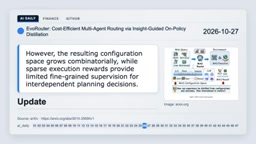
The cost and coordination problems of multi-agent systems are being studied systematically. EvoRouter proposes cost-efficient multi-agent routing through "insight-guided online policy distillation"; another study focuses on how LLM agents perform in negotiation scenarios — agents increasingly negotiate on behalf of individuals and organizations but remain vulnerable to manipulation in repeated multi-party interactions.
These studies point to the same trend: as individual agent capabilities improve, the bottleneck shifts to coordination, trust, and cost control among agents. In enterprise scenarios, how to get multiple agents to divide labor and collaborate under budget constraints will be key to moving from demo to production.
Multi-agent routing refers to distributing tasks among multiple agents (or models) to balance cost, latency, and quality. EvoRouter's "insight-guided online policy distillation" is a form of routing policy learning: the system dynamically adjusts task allocation based on historical execution results, letting cheaper models handle simple requests and stronger models handle complex ones, while distilling the stronger model's experience into the routing policy to reduce overall cost.
Enterprise Adoption: Data, Retrieval, and Compliance
The partnership between PitchBook and North is notable: after authenticating with a PitchBook license, users can equip agents with PitchBook data. This represents a new model — professional data providers offering authenticated access so agents can use high-value data under compliance.
AWS discussed the need for "agentic retrieval," starting from the failure points of ordinary RAG systems. The screenshot shows AWS publishing related technical content, pointing to the evolution of retrieval-augmented generation in agent scenarios.
GitHub Copilot's assisted permissions are now generally available in Copilot CLI, Copilot App, and VS Code: when Copilot requests to run a command, access a file system path, or open a URL, a large language model evaluates the request. This is effectively a "model-managing-model" permission governance approach that gives agents more autonomy while retaining a review layer.
In addition, Amazon WorkSpaces Core managed instances support the Modify Volume API, allowing volume size, type, IOPS, or throughput to be adjusted without unmounting volumes or restarting instances, with volume capacity scalable up to 16,384 GB. For teams running agent workloads, infrastructure elasticity is an unavoidable consideration.
Research Frontiers: From Scientific Discovery to Robotics
OpenAI shared model results on the Keikia conjecture, the exponential time hypothesis, and quantum chromodynamics, and explained how researchers verify and build on them. Such progress in "AI-assisted math and science" is changing researchers' workflows.
In robotics, frontier multimodal large models can control robots without robot-specific training, but their capabilities compared with post-trained vision-language-action models and world-action model policies across different manipulation needs still require thorough evaluation. Another work discusses compositional generalization — "simulation teaches how, pretraining knows what" — where robot policies need to understand what a task requires in a scene and how to move the robot to accomplish it.
More than 600 million people in Sub-Saharan Africa lack electricity; Google has partnered with Ignite Energy Access to use satellite imagery and advanced data models to map remote households and optimize solar hardware delivery. This is a pragmatic application of AI in infrastructure.
Source Notes
Information in this article comes mainly from the AI Daily Brief roundup. Related reports from Reuters, TechCrunch, and The Verge were explicitly labeled in that program as "unofficial information, unverified," including Cadence launching an AI model suite that chipmakers can run internally, OpenAI executives' comments on agent conferences, and OpenAI announcing three scientific discoveries. These items should be treated with caution until officially confirmed.
For developers, the release of the Agent SDK sends a clear signal: agent development is moving from prompt engineering tricks to engineering discipline. Falling model costs, built-in evaluation tools, and gradually maturing permission governance — where these three lines converge is the entry point for agents to truly enter production environments.
One-line Summary
Cursor's Agent SDK codifies agents, while falling model prices and permission governance push agents toward production.
Paragraph Summary
Anysphere has launched an Agent SDK for Cursor that lets developers write prompts in Markdown and tools in TypeScript, version-control and evaluate agents like ordinary code, and deploy them hosted or self-hosted. Meanwhile, OpenAI's GPT-6.1 Terra is generally available in GitHub Copilot and Amazon Bedrock, focused on low-cost everyday agentic coding, as model competition shifts to real output per unit cost. The article also rounds up agent reliability research (permission to retry, multi-agent routing, negotiation manipulation risks), GitHub Copilot's mechanism for using LLMs to evaluate permission requests, and enterprise adoption developments such as PitchBook authenticated data access and AWS agentic retrieval. The core signal: agent development is moving from prompt tricks to engineering, and the convergence of falling costs, built-in evals, and maturing permission governance forms the entry point for agents into production.
Related articles

AI Coding Enters the Team Collaboration Era: Interpreting Three Major Moves from Meta, GitHub, and Mistral
Meta acquires Conductor, GitHub Copilot Fusion becomes available, Mistral opens Large 4 weights—three moves show AI coding shifting from code generation to organizing development workflows. This article explains task orchestration, model collaboration, and cost control for developers.

Building a RAG Assistant with Dify: A Practical Guide to Knowledge Bases, Workflows, and Agent Nodes
How should knowledge bases, workflows, and Agent nodes connect in a Dify RAG assistant? We break down the division of labor and wiring logic for a shippable app.
 Tech Frontiers
The AI Industry Doesn't Lack Marketing—It Lacks Good Products
AI faces market selloffs and public skepticism—is marketing really the problem? This analysis of market signals and product experience argues the core困境 is incomplete products and a gap between promises and experience; the only way to change perceptions is to ship better products.