Cursor Pay-Per-Use Billing Explained: How Account Pool Scheduling Reduces Usage Costs

Technical breakdown of a third-party Cursor solution using account pool scheduling and pay-per-use billing at 65% off.
This article analyzes a third-party Cursor Pro solution that uses clean account pool scheduling instead of client-side cracking, offering pay-per-use billing at 35% of official prices. It explains the technical approach of zero client modification, bulk-purchased legitimate accounts, intelligent quota flow between idle accounts, and transparent verifiable billing, while highlighting compliance, data security, and service continuity risks.
Two Major Pain Points of Using Cursor: Account Bans and Waste
As one of the hottest AI programming tools available today, Cursor's Pro version has attracted countless developers with its powerful capabilities. Cursor is a deeply customized AI-native Integrated Development Environment (IDE) built on the VS Code open-source editor, developed by Anysphere. It embeds Large Language Model (LLM) capabilities directly into the code editing workflow, supporting code completion, cross-file editing, natural language dialogue for code generation, and more. Its Pro version provides access to top-tier models like Claude and GPT-4o at approximately $20/month. While it directly competes with GitHub Copilot, Windsurf, and other products in the AI programming tool space, Cursor has rapidly accumulated a large paying user base thanks to its deep understanding of entire project contexts and autonomous coding capabilities in Agent mode.
However, two pain points are commonly encountered in actual use: First, the market is flooded with cheap trial accounts and shared accounts that are extremely unstable, frequently getting banned by the official system. Second, the official monthly subscription plan represents serious resource waste for most programmers who code "on and off."
Recently, a tech blogger provided a detailed breakdown of the underlying architecture and billing logic of a third-party Cursor usage solution, explaining from a technical perspective how it avoids ban risks while reducing usage costs. This article provides an in-depth analysis of the solution's core mechanisms while reminding readers to evaluate such third-party services rationally.
Technical Root Causes of Cursor Account Bans and Avoidance Strategies
Why Shared Accounts and Cracking Tools Inevitably Get Banned
Most Cursor alternative solutions currently on the market follow two main technical approaches: one is tampering with Cursor's frontend code, and the other is proxying requests through API wrappers to shell models.
API proxy wrapping refers to not using Cursor's official services directly, but instead intercepting user requests and forwarding them to third-party deployed LLM APIs (such as OpenAI API, Anthropic API, etc.). This approach requires modifying the client's request target address and is essentially using other model services to replace Cursor's native model invocation pipeline. Since Cursor's core value lies not only in the models themselves but also in its unique code indexing, context retrieval (RAG), and multi-file collaborative editing engineering capabilities, wrapper solutions can typically only provide basic dialogue and completion functions and cannot reproduce Cursor's complete programming experience.
Both approaches essentially modify client-side data, and Cursor's official enforcement system can directly detect such abnormal behavior — account bans are only a matter of time. Cursor's official enforcement system is typically based on multi-dimensional client fingerprint detection mechanisms, including but not limited to: device hardware fingerprints (such as machine ID, MAC address hashes), client binary integrity verification, network behavior pattern analysis (such as the same account logging in from multiple different IP addresses within a short period), and usage frequency anomaly detection. Once client code tampering or abnormal account usage patterns are detected, the system automatically triggers risk control strategies — ranging from feature restrictions to outright account bans.
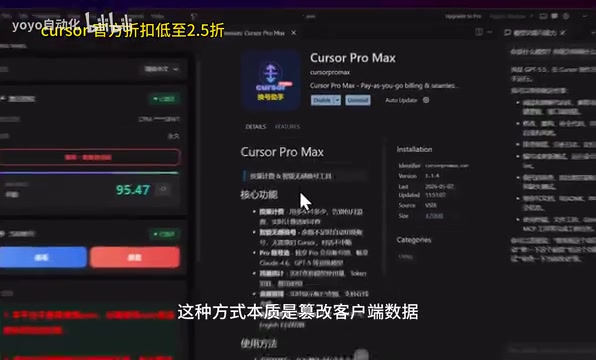
The Technical Approach of Clean Account Pool Scheduling and Distribution
The solution introduced by the blogger adopts a completely different technical approach — clean account pool scheduling and distribution. Its core logic is: never modify Cursor's frontend code, never tamper with any data within the client, and only build an intermediate scheduling channel that connects the user's local client to the backend's official account pool.
Since there are "zero modifications" at the code level, the solution claims to be perfectly compatible with all official Cursor models, including seamless support for new models added in future official updates, with client updates completely unaffected.
From a technical perspective, this approach is indeed more robust than directly cracking the client. However, it should be noted that this "intermediate scheduling" model is still essentially multiple people sharing Pro account resources. Whether this fully complies with Cursor's terms of service is something users need to assess for themselves.
Account Quality: Determining Cursor Service Stability at the Source

Account quality is the key factor determining whether such services can operate stably over the long term. According to the blogger, the account pool completely eschews black market throwaway accounts and trial shared accounts — all accounts are fully purchased official Cursor Pro accounts and enterprise accounts, with no trial-qualified accounts included.
The logic behind this strategy is clear: black market accounts and trial accounts are already under heightened official monitoring, and mass bans are routine. Legitimately purchased Pro and enterprise accounts naturally offer better stability as long as usage behavior doesn't trigger anomaly detection.
However, the claim of "bulk purchasing official accounts" is difficult for ordinary users to verify directly. Users interested in trying the service are advised to start with small deposits and judge service quality through actual experience.
Deep Dive into Cursor's Pay-Per-Use Billing Model
The Cost Logic Behind 35% Pay-Per-Use Pricing
The most core selling point of this solution lies in its billing model. Compared to Cursor's official fixed monthly subscription, it adopts pay-per-use billing, uniformly charging at 35% of the official price (i.e., a 65% discount). In practical terms, an operation that would consume $1 worth of Token quota officially only costs $0.35 through this solution.
Here it's necessary to explain the basic concept of Token billing. Tokens are the fundamental unit of measurement for how large language models process text. In English, one Token corresponds to approximately 4 characters or 0.75 words; in Chinese, one character is typically encoded as 1-2 Tokens. Each interaction with AI consumes Tokens for both the input prompt and the model's generated response. Token pricing varies dramatically between models — for example, GPT-4o's Token price is far higher than GPT-3.5-turbo, and premium models like Claude 3.5 Sonnet are also priced at higher tiers. Cursor Pro's monthly subscription actually includes a certain quota of premium model requests (such as 500 fast requests per month), with throttling or additional charges applied after exceeding the limit. This is the core cost structure that pay-per-use solutions aim to optimize.
According to the blogger, this pricing is possible primarily due to cost advantages from bulk purchasing — wholesale unit prices are far lower than individual retail prices, with the price difference constituting the profit margin.
Intelligent Scheduling Mechanism and Credits That Never Expire
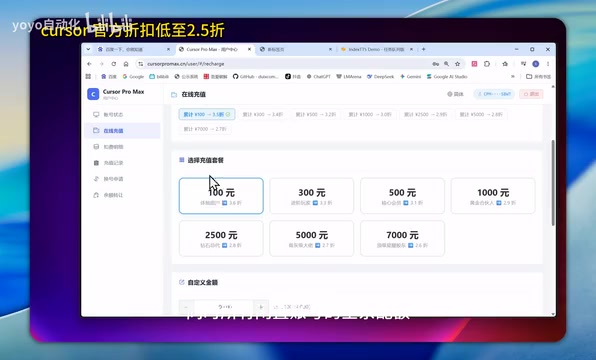
Another key advantage of the pay-per-use model is: no fees are incurred when there's no code operation or Token consumption. This completely solves the "idle waste" problem inherent in monthly subscriptions.
More noteworthy is its "account pool intelligent scheduling" mechanism — all idle accounts' spare quotas automatically flow within the account pool, releasing in real-time, achieving "credits that never expire." This means there's no "expiration and reset" situation as with monthly plans, perfectly matching programmers' intermittent actual usage habits.
From an economics perspective, this is essentially a resource pooling and sharing model: by centrally scheduling the idle quotas of numerous accounts, overall resource utilization is improved, thereby reducing per-user costs while maintaining service sustainability. The theoretical foundation of this model is the Statistical Multiplexing principle — in a large user group, not everyone will reach peak resource usage simultaneously. Taking Cursor Pro accounts as an example, a $20/month account includes 500 fast request quotas, but most individual users' actual monthly average usage may be far below this limit. By centrally managing and dynamically allocating the idle quotas of hundreds of accounts, operators can serve more actual users with fewer total accounts, thereby driving per-user marginal costs down to a fraction of the official retail price. This follows the same business logic as airlines overselling tickets or cloud servers overselling computing resources.
Billing Transparency: Verifiable Consumption Records
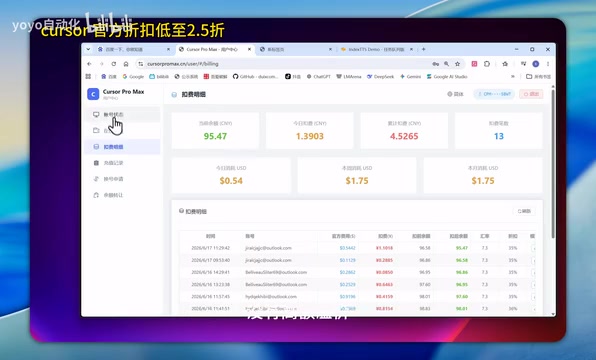
Billing transparency is an important indicator for measuring the credibility of such services. According to the introduction, all billing in this solution is fully open and transparent:
- Consumption details in the user dashboard are fully synchronized and correspond one-to-one with Cursor's official original bills
- Every code generation, every conversation, and every Token consumption's corresponding charge is precisely calculated to three decimal places
- All consumption charges have complete records that can be cross-checked at any time
This "verifiable billing" mechanism is indeed a step ahead of many similar services. Users can cross-reference backend charge records with actual usage to effectively prevent hidden charges.
Usage Risks and Practical Recommendations
Although this solution demonstrates certain rationality in its technical architecture and billing model, as a third-party service, users should still pay attention to the following points:
- Compliance Risk: Whether multiple people sharing account resources violates Cursor's terms of service remains uncertain
- Service Continuity: The long-term stability of third-party services depends on the operator's sustained investment
- Data Security: When using Cursor through an intermediate scheduling channel, code data security deserves attention. When users access Cursor through an intermediate scheduling channel, their written code, project file contents, conversation records, and other data theoretically pass through third-party servers for routing and forwarding. Even if the scheduling party claims not to store user data, there remains a technical possibility of data being intercepted or logged during transmission. This risk is particularly worth noting for code involving trade secrets, proprietary algorithms, or sensitive business logic. Enterprise users are typically subject to stricter data compliance requirements (such as GDPR, classified protection standards, etc.), and using such third-party services may directly violate enterprise security policies. Individual developers should also avoid passing code snippets containing API keys, database credentials, or other sensitive information in conversations.
- Start Small: The blogger himself also recommends starting with a small 100 RMB deposit for trial purposes — this is quite practical advice
Conclusion: Is a Low-Cost Cursor Solution Worth Trying?
The core competitive advantages of this third-party Cursor usage solution lie in three points: the clean account scheduling (non-cracking) technical approach, the flexible pay-per-use (non-monthly) pricing, and the verifiable transparent billing system. For developers with limited budgets who still need Cursor Pro capabilities, this indeed provides an option worth considering.
However, any third-party service carries inherent risks. Users are advised to start with small trial amounts after fully understanding the operating mechanism, and make judgments based on actual results.
Related articles

Disaster and Glory of the Apollo Program: The History We Must Revisit Before Returning to the Moon
From the fatal Apollo 1 fire to Apollo 8's daring lunar orbit to Apollo 11's successful landing—revisiting the disasters, fears, and compromises of the Apollo program and their lessons for today's return to the Moon.

Netflix Trust Exercise Turns Into Firing Trap: Where Are the Boundaries of Corporate Trust?
A Netflix employee was fired after sharing private info in a trust exercise. We analyze the risks of corporate trust exercises and how employees can protect themselves.

AMD CDNA5 Architecture Deep Dive: Technical Evolution and the AI Computing Competition Landscape
Deep analysis of AMD's CDNA5 architecture covering Chiplet packaging upgrades, HBM memory evolution, and low-precision compute optimization, examining how AMD challenges NVIDIA's AI chip dominance.