Cursor Plan Upgrade Guide: Usage Rules and Value Analysis for the $60 Tier

Breaking down Cursor's $60 plan usage rules, token costs, and upgrade value for developers.
This article dissects a common dilemma faced by Cursor users: whether upgrading from the $20 Pro plan to the $60 tier truly delivers 3x the value. It explores token consumption mechanics, the distinction between Cursor's built-in models and third-party API quotas, the hidden costs of token-hungry models like Grok 4.6 Fast, and the broader challenges of billing transparency in AI coding tools. Practical upgrade advice is included for developers.
Starting from a Real-World Dilemma
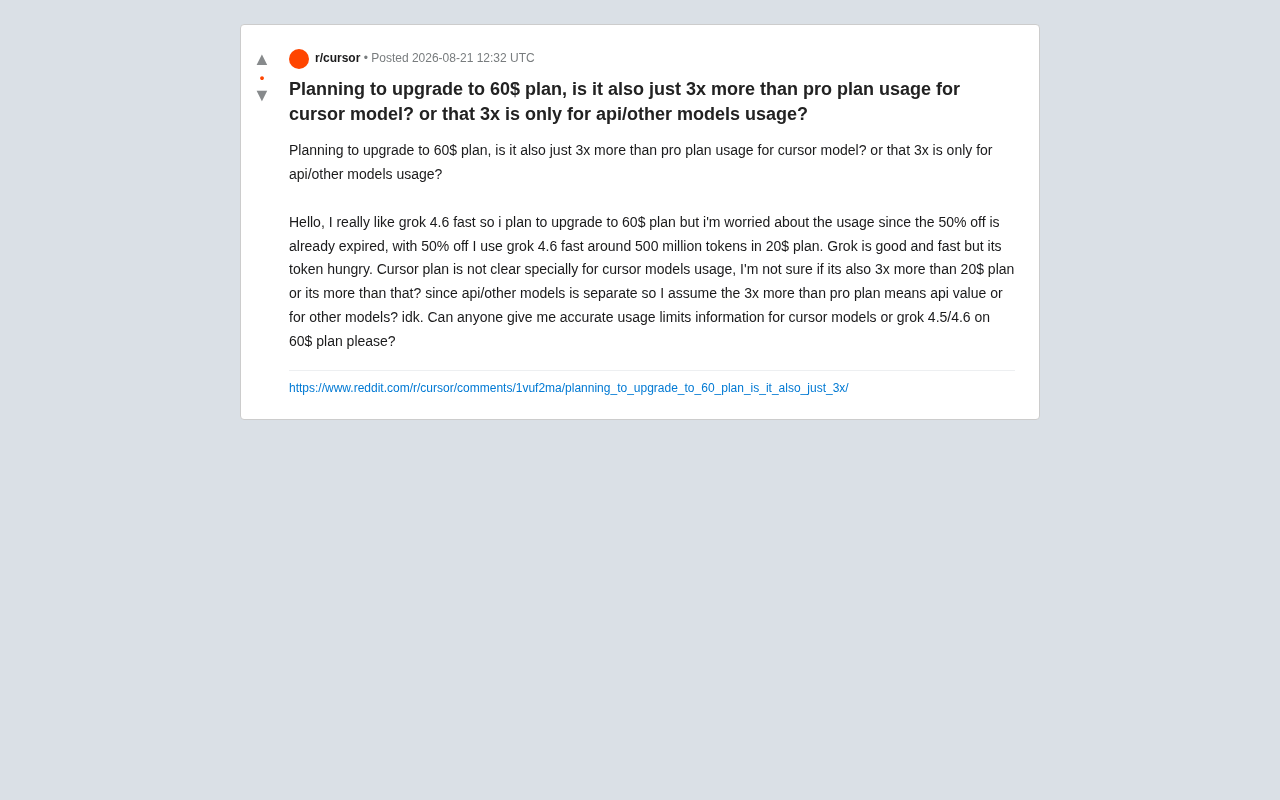
Recently, a Cursor user posted a highly relatable question on Reddit: he was considering upgrading from the $20 Pro plan to the $60 higher-tier plan but was confused about the usage rules — is the usage on the $60 plan really just 3x that of the Pro plan? And does this "3x" refer to Cursor's own model usage, or only to API and third-party model call quotas?
The question may seem trivial, but it touches on a widespread pain point in AI coding tool subscription models: insufficient billing transparency. When users face prices that scale by multiples, what they care most about is "what exactly am I getting for the extra money?"
Cursor is an AI-native code editor developed by Anysphere, built as a deep modification of VS Code's open-source framework. VS Code was released by Microsoft in 2015, built on the Electron framework, with its core code open-sourced under the MIT license. Cursor chose to develop as an independent fork based on VS Code's open-source version (Code - OSS), rather than simply building a plugin. This architectural decision allows it to inherit VS Code's massive extension ecosystem and the usage habits of tens of millions of developers, while deeply integrating AI capabilities at the editor's foundational level — including model invocation pipelines, context management engines, and Agent execution frameworks. Unlike traditional "plugin-style" AI integration (such as GitHub Copilot running as a VS Code plugin), Cursor can directly modify the editor's core interaction logic, enabling tighter AI-editor collaboration, such as native multi-file diff previews and automated file operations in Agent mode at the editor level.
Its core competitive advantage lies in deeply integrating multiple large language models into the coding workflow, supporting code completion, multi-file editing, codebase-level Q&A, and automated refactoring. In the current market, Cursor competes directly with GitHub Copilot, Windsurf (formerly Codeium), Augment Code, and similar products. One of Cursor's differentiation strategies is allowing users to freely switch between multiple models — including OpenAI's GPT series, Anthropic's Claude series, and xAI's Grok series. This multi-model ecosystem increases flexibility but also makes the billing system more complex.
Token Consumption: The Hidden Cost That's Easy to Underestimate
The user specifically mentioned that he loves the Grok 4.6 Fast model, calling it "great and fast." But he also pointed out its weakness with surgical precision — it's extremely token hungry.
It's worth explaining the concept of tokens here. Tokens are the basic units that large language models use to process text, and they don't simply equate to a single word or character. In English, one token corresponds to roughly 4 characters or 0.75 words; in Chinese, a single character is typically split into 1-3 tokens. When an AI coding tool processes code, each request includes input tokens (the code context, instructions, etc. provided by the user) and output tokens (the code, explanations, etc. generated by the model), and their sum constitutes the total consumption per request. For coding scenarios, because large amounts of code files need to be passed to the model as context, input token consumption far exceeds that of everyday conversation — which is why token consumption for coding AI tools is routinely measured in the hundreds of millions.
Grok is a large language model series from xAI, Elon Musk's AI company. The Grok 4.6 Fast mentioned in this article is a speed-optimized version in the series, designed for low-latency, high-throughput inference. Since its founding in 2023, xAI has rapidly scaled its compute resources, with its Colossus supercomputing cluster once called one of the largest AI training clusters in the world. The Grok series excels at programming and mathematical reasoning tasks, but its larger model parameter scale and long context window support also mean more tokens need to be processed per inference — this is the technical root cause of the "token hungry" phenomenon the user described.
According to his actual usage data: with a 50% discount, the $20 Cursor Pro plan could support roughly 500 million tokens of Grok 4.6 Fast calls. This number is quite staggering and reflects just how much context modern large models consume when handling programming tasks.
One important detail: he mentioned that the 50% discount has expired. This means the same $20 now buys significantly less actual usage. This is the core reason for his hesitation about upgrading — if the discount is gone, will the token quota from the $60 plan actually be sufficient to support heavy use?
Why Token Consumption Directly Determines User Experience
For developers who rely on AI-assisted programming, token consumption directly determines how long the tool remains usable. Models like Grok, which are fast and produce high-quality output, often rapidly consume quotas due to frequent context injection (such as reading and analyzing entire codebases).
"Context injection" refers to sending files, function definitions, project structure, dependency relationships, and other information relevant to the current coding task to the model, so it can understand the full picture of the codebase and provide more accurate suggestions. Modern programming projects often contain hundreds or even thousands of files, and a single context injection can consume tens or even hundreds of thousands of tokens. Tools like Cursor typically use code indexing, RAG (Retrieval-Augmented Generation), and intelligent context trimming to optimize this process.
RAG is a technical paradigm that combines information retrieval with generative AI, first proposed by the Meta AI research team in 2020. In traditional large model calls, all context information needs to be stuffed directly into the model's input window, which is both limited by the model's context length and leads to wasted tokens on irrelevant information. RAG's core approach is to first use vector retrieval to find the most relevant document fragments from a knowledge base, then feed these fragments as curated context to the model. In coding tools like Cursor, the codebase is first indexed as vector embeddings. When a user initiates an edit or asks a question, the system retrieves the most relevant code files and function definitions rather than dumping the entire project to the model at once. This approach significantly reduces token consumption per request while improving the relevance and accuracy of the model's responses.
But even with these optimizations, token consumption still surges when users frequently perform cross-file editing, code reviews, or automated tasks in Agent mode. It's worth noting that Agent mode is a major direction in current AI coding tool development — unlike traditional single-turn Q&A, Agent mode allows the AI to autonomously plan task steps, execute code modifications, run terminal commands, check for errors, and iterate corrections, forming a multi-turn automated workflow loop. Cursor's Agent mode, Devin, OpenAI Codex, and similar products all adopt this paradigm. However, each loop step in Agent mode constitutes an independent model call, and each call needs to carry the execution results of all previous steps as context, causing token consumption to grow cumulatively. A complex Agent task might involve 10-50 loop steps, with total token consumption reaching 50-200x that of a single Q&A exchange. This explains why heavy users can easily blow past hundreds of millions of tokens per month.
This creates a real contradiction: the better the model works, the more you use it, and the faster costs climb.
The Gray Areas of Cursor's Billing Model
The root of the user's confusion lies in Cursor's lack of clarity in how it categorizes billing for different types of models. AI coding tool billing currently falls into two broad categories:
- In-house/built-in models: Model services provided directly by the Cursor platform, typically offering fixed "fast request" or usage quotas based on subscription tier.
- API/third-party models: External models from OpenAI, Anthropic, xAI, and others, often billed separately by actual token count or number of requests.
The user's question is precisely this: does the claimed "3x of the Pro plan" apply to which category? His hypothesis is that since API and third-party model usage is calculated separately, the "3x" might only refer to API quota value, not the actual number of calls to Cursor's own models.
Why Billing Transparency Matters
The direct consequence of this uncertainty is that users can't accurately estimate the actual benefits of upgrading, making it difficult to make rational purchasing decisions. When a tool's usage rules require users to repeatedly seek clarification on communities like Reddit, it inherently indicates that the pricing page has significant communication gaps. For high-consumption scenarios billed by token, a few dollars' difference could mean a gap of hundreds of millions of tokens — hardly a negligible issue.
The Deeper Issues with AI Tool Subscription Models
This seemingly ordinary Reddit question actually reflects common challenges that the entire AI application industry faces during commercialization.
The pricing models in the current AI tool industry have roughly gone through three phases: early models of completely free or pure pay-per-API-call, mid-stage fixed monthly subscription plans, and today's popular hybrid model of tiered subscriptions plus overage billing. This hybrid model emerged for deep-rooted reasons — the inference cost of large models (primarily determined by GPU compute) is directly tied to usage volume. Platforms need fixed monthly fees to lower the decision threshold for users while also needing usage caps or overage charges to control their own cost risk.
From a fundamental economics perspective, every model call requires matrix operations on GPUs (primarily NVIDIA's H100/H200 or the newer B200 series), with costs roughly proportional to the total input and output tokens. At current market prices, processing 1 million input tokens with top-tier models (such as Claude 3.5 Sonnet or GPT-4o) costs approximately $3-15, and the per-token price for output is typically 3-5x that of input. For coding scenarios, a heavy user's consumption of hundreds of millions of tokens per month means the platform must bear hundreds or even thousands of dollars in underlying inference costs — far exceeding the $20 or $60 monthly subscription revenue. Therefore, platforms must control costs through rate limiting, usage caps, model routing optimization (diverting simple tasks to cheaper smaller models), and negotiating bulk discounts with model providers. This is the fundamental economic reason why billing systems are becoming increasingly complex.
OpenAI's ChatGPT Plus/Pro, Anthropic's Claude Max, and Cursor's multi-tier plans are all essentially trying to find the balance point between a price users will accept and costs the platform can sustain. But because each provider defines "usage" differently — some by request count, some by tokens, some by "fast request" quotas — users face severe information asymmetry when comparing across platforms or even between different tiers on the same platform.
First, time-limited discounts mask the true cost. Many platforms attract users with 50% or even steeper initial discounts, but only after the discount expires do users truly feel the pricing pressure of heavy use. This user's hesitation is a textbook example.
Second, "multiplier" messaging can be misleading. While promotional language like "3x usage" is intuitive, if it doesn't clearly specify what's being multiplied — own model quota, API call quota, or overall value — it actually makes users more confused.
Third, token metering should be more transparent and visual. Developers, as a professional user base, need predictable, quantifiable usage dashboards and clear billing rules, not vague and generic plan descriptions.
Practical Advice for Potential Upgraders
While there's no official clarification from the community yet, based on common patterns across Cursor and similar tools, here are some recommendations:
- Confirm quota details through official documentation or support before upgrading: Clarify exactly how the $60 plan divides quotas between Cursor's own models and third-party models (like Grok) to avoid making decisions based on guesswork.
- Quantify your monthly token consumption: If your monthly token usage is already in the hundreds of millions, seriously calculate your actual costs after discounts expire and confirm whether the upgraded plan can cover your needs.
- Compare the cost-effectiveness of different models: Grok 4.6 Fast may be fast and high-quality, but if its token consumption is astronomical, it's worth testing other built-in models for their consumption and output quality on equivalent programming tasks to find the sweet spot between effectiveness and cost.
- Keep an eye on updates to the official pricing page: Cursor's plan rules may change at any time. Regularly checking the latest billing details helps you adjust your usage strategy promptly.
Ultimately, this user's confusion reminds us that as AI coding tools become increasingly mainstream, billing transparency has become an important benchmark for measuring a product's maturity. Clear, predictable usage rules not only reduce users' decision anxiety but also form the foundation for platforms to build long-term trust.
Related articles

5.2 Billion Tokens in Practice: One Developer Built a Commercial-Grade RBAC Admin System with Cursor
A developer used 5.2B Tokens with Cursor to solo-build a commercial RBAC admin system. Key lessons on AI constraints, quality engineering, and human-AI collaboration.

1000 PRs a Month: How a Cursor Engineer Manages 100+ Agents Simultaneously
A Cursor Principal Engineer ships 1000+ PRs/month running 100+ AI Agents. Learn his core methods: building Agent trust, hard vs soft constraints, and Agent-friendly codebases.
Is Cheap Cursor Pro Top-Up Reliable? Exposing the Real Risks Behind the Discounts
An in-depth analysis of cheap Cursor Pro top-up services: how account pool sharing works, the risks of bans, data security concerns, and better alternatives.