Cursor Restricts Third-Party Extension Panel Layout, Long-Time Users Consider Switching to Alternatives

Cursor locks right panel for its own Agent, frustrating power users who rely on third-party AI extensions.
Cursor now exclusively reserves its editor's right-side panel for its own Agent feature, preventing third-party extensions like OpenAI's Codex and Anthropic's Claude from being placed there. A two-year veteran user posted on Reddit about their disrupted workflow, questioning Cursor's value as competing models get cheaper and the tool restricts ecosystem openness in favor of commercial interests.
A Seemingly Minor Change Sparks Strong Backlash from Long-Time Users
Recently, a veteran Cursor user posted on Reddit with a complaint: Cursor no longer allows third-party extension panels like Codex and Claude to be placed on the right side of the editor — a position now exclusively reserved for Cursor's own Agent feature.
What seems like a trivial UI layout adjustment has disrupted the core workflow of long-time users. The poster described a two-year habit of having "three Cs side by side": Cursor, Codex, and Claude panels all pinned to the right side of the screen, easily switchable as needed — "simple, smooth, everything in one place." Now, Cursor Agent has "claimed the entire right-side territory, allowing no one else in."
The Codex mentioned here refers to OpenAI's Codex CLI tool or its VS Code extension form, which allows developers to invoke OpenAI's code generation and comprehension capabilities directly within the editor. Claude is a large language model developed by Anthropic, whose editor extension lets users chat with Claude, review code, or generate solutions in a side panel. Many advanced developers install multiple AI extensions simultaneously, flexibly switching between them based on task characteristics (e.g., Claude excels at long-text reasoning, Codex is suited for quick code completion), forming a "multi-model collaboration" workflow paradigm. This usage philosophy itself represents a fundamentally different approach from Cursor's "single Agent" design philosophy.
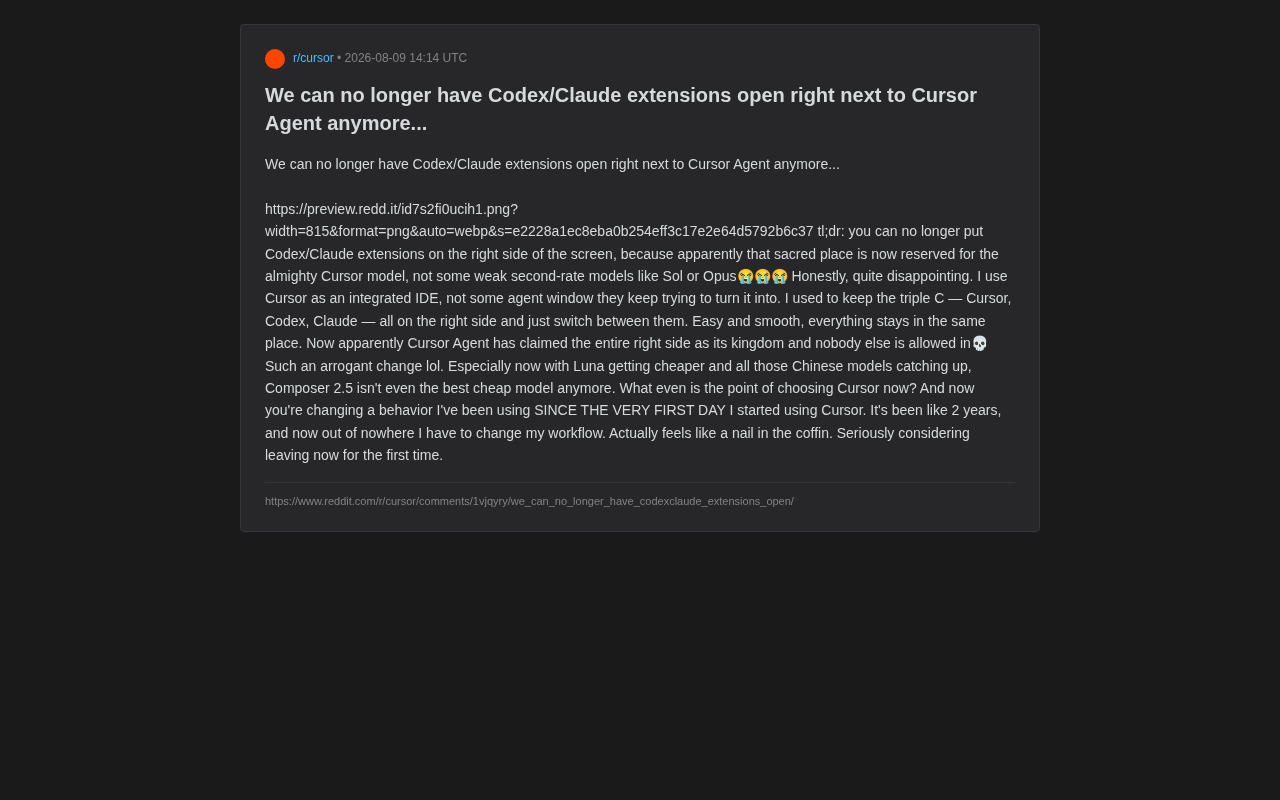
This post resonated not because of any technical complexity, but because it reflects a deeper issue: When a development tool starts force-promoting its own features while squeezing out third-party ecosystem space, how do loyal users react?
From "Integrated IDE" to "Agent Container" — Cursor's Identity Crisis
One sentence from the poster captures the core contradiction: "I use Cursor as an integrated development environment (IDE), not the Agent window they keep trying to turn it into."
This statement reveals the rift between Cursor's product evolution direction and some users' expectations. Built on VS Code, Cursor's earliest selling point was "seamlessly invoking AI capabilities within a familiar editor." Users could freely choose which models and extensions to use — this openness was precisely why many chose it.
It's worth understanding that VS Code itself has a massive extension ecosystem supporting tens of thousands of third-party plugins, with an extensible architecture that allows developers to customize the position and behavior of virtually all UI elements through the Extension API. Cursor inherited this architecture, but as an independent commercial fork, it can override or restrict UI behavior at the code level — this is the technical foundation that enables it to "lock down" the right panel position. This commercial fork model based on an open-source project, while enjoying the benefits of community contributions, also faces potential community criticism for "betraying the open-source spirit."
Openness Is Being Redefined
However, with the launch of Cursor's in-house models (such as the Composer series), the company clearly wants to guide users toward using their own Agent. Exclusively reserving the right panel for Cursor Agent is essentially soft steering through interface design — reducing the accessibility of third-party extensions while elevating the visibility of their own features.
Cursor's parent company Anysphere began rolling out proprietary model capabilities in 2024, with the Composer series being specialized models optimized for code generation and editing scenarios. Cursor's Agent feature is built on top of Composer as an automated programming agent capable of autonomously planning and executing multi-step code modification tasks. In-house models carry significant commercial importance for Cursor: every time a user calls a third-party API (like Claude or GPT-4), Cursor must pay upstream inference costs, whereas using proprietary models keeps profits within the ecosystem while accumulating valuable code interaction data for subsequent model training. It is precisely this commercial logic that drives the product decision to "guide users toward using their own Agent" at the UI level.
For users who have deeply integrated Codex and Claude into their daily workflows, the cost of this change is very real: a habit built over two years, "from day one," has been forcibly disrupted, requiring workflow reconstruction. The poster used a somewhat dramatic metaphor — "it feels like the final nail in the coffin."
Intensifying Model Competition Means Fewer Reasons to Choose Cursor
Another complaint from this user is quite informative and reflects the fierce state of the current AI programming tool market.
They mentioned that as "Luna gets cheaper and various Chinese models are catching up fast," Cursor's own Composer 2.5 is no longer even the best cheap model. This directly raises a pointed question: "What's the point of choosing Cursor now?"
The "Chinese models" here refer to the rapid progress of domestic large models like DeepSeekAd, Qwen, and GLM in the code generation domain. In particular, the DeepSeek-Coder series and Qwen2.5-Coder have approached or even surpassed GPT-4-level performance on multiple programming benchmarks, with inference costs at one-tenth or even lower. This dynamic of "matching performance while crushing on price" puts enormous pressure on tools that rely on model capability differentiation as their core selling point — if users can achieve comparable results with cheaper models, the tool layer's added value must come from other dimensions.
Differentiation Advantages Are Being Diluted
This challenge is worth heeding for all AI tool vendors. Cursor's early moat was built on product experience fluidity and flexibility in model selection. But when:
- Underlying model capabilities are rapidly matched by numerous competitors;
- Cheap and efficient alternative models keep emerging;
- The company is simultaneously tightening freedom within the third-party ecosystem;
These three factors combine to progressively weaken reasons for user retention. When a tool's unique value primarily comes from "I can freely combine the models and extensions I want," yet the vendor actively undermines this freedom, users' switching costs actually decrease as a result.
The Trade-off Logic Behind Product Decisions
From Cursor's perspective, this change may have commercial justification. In-house models are key to building long-term competitive moats and monetization; guiding users to their own Agent increases stickiness, accumulates usage data, and reduces dependence on third-party APIs.
But the problem lies in execution. Forcibly stripping users of existing layout freedom, rather than offering a "recommended but optional" approach, easily provokes resentment. Developers have an almost instinctive attachment to tool control, a psychology rooted in the core values of software engineering culture. From Unix philosophy's "do one thing and do it well" to the extreme customizability of Vim/Emacs, developers have long formed the expectation that "tools should serve my way of working, not the other way around." Any behavior that changes user workflows without explicit consent tends to trigger strong backlash in developer communities — Microsoft's force-pushing Edge browser in Windows 10, JetBrains adjusting default keyboard shortcuts in their IDEs, and similar events have all sparked comparable community storms. This "control sensitivity" is also why open-source tools enjoy natural goodwill among developers.
Losing Loyal Users Is the Hardest to Recover From
A notable detail: the poster is a two-year veteran user who explicitly stated "this is the first time I'm seriously considering leaving." These users are often a product's most steadfast advocates, and their wavering carries more warning significance than new user churn.
Of course, a single Reddit post cannot represent all users' attitudes, and personal workflow preferences may be a factor. But it at least reveals a real tension: In the white-hot competition of AI programming tools, vendors need to weigh more carefully between advancing commercialization and protecting user experience.
Conclusion: Walls Have Never Been What Keeps Users
This small UI controversy is essentially about the age-old question of "openness" versus "walled gardens." In an era where model capabilities are increasingly commoditized, a tool vendor's true competitive advantage may not lie in corralling users into a proprietary ecosystem, but in making users willing to stay even when they have the freedom to choose otherwise.
For Cursor, finding the balance between promoting their in-house Agent and respecting users' established habits will be key to retaining these high-value early adopters. After all, as that user put it — when the reasons for choosing Cursor become unclear, leaving is no longer difficult.
Related articles

RAG Getting Started in Practice: From Principles to Building an Enterprise Knowledge Base
Bilibili RAG course highlights: from retrieval-augmented generation principles, document chunking and vectorization, to five accuracy factors and enterprise knowledge base boundaries, with fine-tuning vs RAG selection advice.

AI Model Selection Guide: DeepSeek vs. Qwen3 in Practice
How should AI developers choose models? Based on a Bilibili tutorial, this article breaks down the Function Calling differences between DeepSeek V3 and R1, Qwen3's programmatic thinking mode switching and agent capabilities, and outlines a multi-model learning path and practical selection logic.

Anchoring, Loss Aversion, and Nudges: 5 Psychological Tactics Retailers Use to Make You Spend
Behavioral economics reveals how retailers use anchoring, framing, loss aversion, and nudge theory to manipulate your spending decisions. This article breaks down 5 common psychological tactics and offers counterstrategies like slowing down decisions and setting your own anchors to see through the pricing design behind discounts.