Cursor's Automatic Model Switching Sparks Controversy: Why Are Users' Manual Selections Being Ignored?

Cursor's automatic model switching overrides user preferences, sparking debate over user control in AI tools.
A Cursor user's Reddit complaint about Grok 4.5 being auto-switched to 4.6 highlights a critical product design flaw in AI coding tools. The post explores why overriding manual model selections violates user trust, examines the tension between vendor recommendations and user autonomy over cost and workflow, and proposes design solutions including sticky preferences, transparent quota info, and separating recommendations from forced changes.
A Reddit Rant That Sparked Deeper Reflection
Recently, a Cursor user posted a frustrated complaint on Reddit with a heated title: "Grok 4.5 auto-switches to 4.6." The post quickly resonated with the developer community, zeroing in on a long-overlooked issue in AI coding tools — the conflict between user intent and default system behavior.
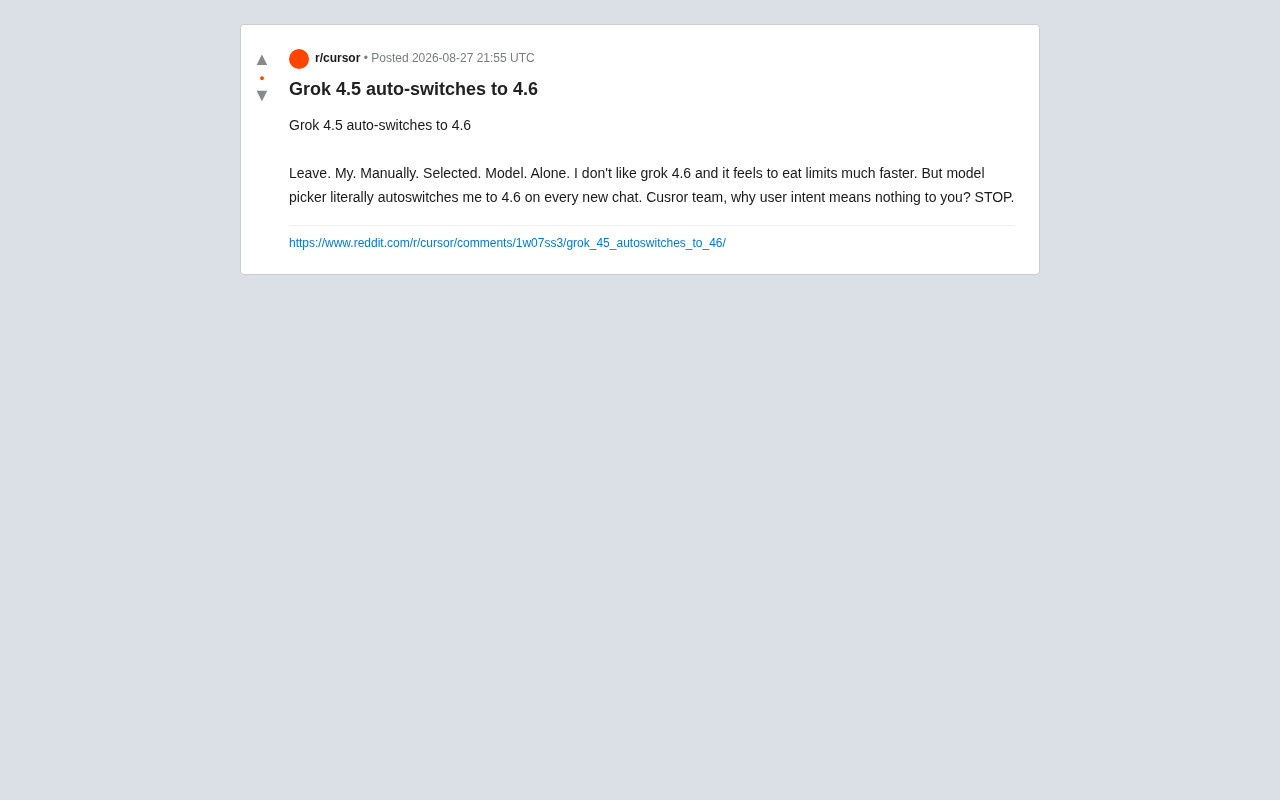
The user's demand was crystal clear, emphasized with deliberate punctuation: "Leave. My. Manually. Selected. Model. Alone." They expressed a clear dislike for Grok 4.6, feeling that it "eats limits much faster," yet every time they started a new conversation, Cursor's model selector would automatically switch them back to 4.6. They angrily challenged the Cursor team: "Why does user intent mean nothing to you? Stop."
The Core Issue: Who Gets to Decide the Default Model
This might look like a minor UI interaction issue, but it actually touches on a fundamental tension in AI tool product design.
To understand the severity of this conflict, you first need to appreciate Cursor's unique position in the current AI coding tool ecosystem. Cursor is an AI-native code editor built on top of VS Code, created by Anysphere. Since its launch in 2023, it has rapidly become one of the hottest AI coding tools in the developer community. Its core advantage lies in deeply integrating large language models into the programming workflow — from code completion and conversational coding to cross-file refactoring, covering virtually every aspect of a developer's daily work. Unlike competitors such as GitHub Copilot, Cursor allows users to freely switch between multiple large language models, including OpenAI's GPT series, Anthropic's Claude series, and xAI's Grok series, among others. This "multi-model" strategy is itself a major selling point for attracting advanced developers — it promises users full freedom of choice. That's precisely why, when this freedom of choice is quietly stripped away by system behavior, the backlash is especially intense.
The Vendor's Perspective: Pushing Users Toward the Latest Model
From Cursor's product team perspective, automatically switching to a newer model version (e.g., from Grok 4.5 to 4.6) often has both business and technical rationale. Newer versions typically represent what the vendor considers superior capabilities, better alignment, or alignment with commercial agreements with partners (such as xAI's Grok series). Vendors tend to want as many users as possible on the latest model to collect more authentic usage feedback, distribute compute costs, or fulfill promotional commitments.
Some background on the Grok model series is helpful here. Grok is a large language model series developed by xAI, Elon Musk's AI company, known for its relatively "candid" conversational style and strong code generation capabilities. Grok 4.5 is a relatively mature version in the series, while Grok 4.6, as the newer release, typically implies a larger parameter count and stronger reasoning abilities — but also potentially higher computational overhead. For platforms like Cursor that integrate third-party models, there are usually commercial partnerships at the API call level with model providers. When a new model launches, the provider often wants more user exposure and usage data, which can directly influence how the platform sets its default model.
The User's Perspective: Stability and Cost Control
However, for power users, model selection is a highly personalized decision. Different models have significant differences in response style, code quality, and quota consumption rate. This user explicitly pointed out that Grok 4.6 "eats limits faster" — under usage-based billing or subscription plans with quota caps, this directly translates to real money. When a user has made a deliberate choice based on their own workflow and cost considerations, and the system "helpfully" overrides that decision with every new conversation, the experience is naturally jarring.
Here it's worth explaining the underlying logic of "quota consumption" in AI coding tools. The computational cost of large language models mainly depends on several key factors: token count (the length of input and output text — models break text into tokens for processing, with each token roughly corresponding to 3–4 English characters), model parameter size (more parameters mean more GPU compute per inference), and context window size (how much text the model can "see" at once). Generally, newer and more powerful model versions mean larger parameter counts and longer context windows, which directly increases the computational cost per request. Under Cursor's subscription model, for example, users typically have a monthly quota of "fast requests," and different models can consume quota at rates that vary by several multiples. A new model with double the parameter count might burn through a month's worth of quota in just two weeks. That's why users are so sensitive to automatic model switching — this isn't a preference issue, it's a budget issue.
Why "Overriding Manual Selections" Is Especially Infuriating
Here's an important detail: the user isn't complaining about the lack of a default setting — they're complaining that "I explicitly chose something, and you changed it anyway." In interaction design, this is a textbook case of "intent violation."
From the perspective of interaction design theory, this issue touches on the classic topic of "default design." Nobel laureate in economics Richard Thaler, in his behavioral economics work, proposed the "Nudge" theory, which points out that default options have a massive influence on user behavior — most users won't proactively change default settings. This is precisely why product designers wield enormous power over default value settings, which comes with corresponding ethical responsibilities. However, Thaler also emphasized that good "choice architecture" should maintain "libertarian paternalism" — guiding without coercing. When a user has already explicitly expressed a preference (through manual action), and the system overrides that preference again, it slides from "nudging" to "forcing," violating the fundamental principles of this design ethic.
Psychologically, users have a stronger sense of "ownership" over choices they've actively made. This phenomenon is a variant of what psychologists call the "IKEA effect" — people assign higher value to things they've participated in creating or selecting. When a manual action is silently or forcibly rolled back by the system, the user feels not just inconvenience but a sense of "loss of control" — the tool isn't treating them as an autonomous decision-maker, but as someone who needs to be guided.
For AI coding tools like Cursor that target professional developers, this sense of lost control is particularly damaging. The developer community places enormous value on tool predictability and configurability — they expect tools to be "obedient assistants," not "presumptuous butlers." This has deep roots in software engineering — from the Unix philosophy of "do one thing and do it well" to the modern DevOps principle of "Infrastructure as Code," a core demand of developer culture is: every behavior should be predictable, traceable, and controllable. A tool that silently changes configurations in the background fundamentally violates this cultural contract.
What Good Product Design Should Look Like
For scenarios like Cursor's automatic model switching, the industry already has several well-established design paradigms worth referencing:
1. Respect "Sticky Selections"
If a user manually switches models, the system should "remember" that choice and use it as the default for subsequent new conversations, rather than reverting to the vendor-recommended version each time. This is the most basic form of respecting user intent. This principle is known as "sticky preferences" in software design and is widely used in scenarios like browser search engine selection and IDE compiler configuration. The core logic is: a user's explicit action should always take priority over the system's implicit default.
2. Distinguish Between "Recommending" and "Forcing"
Vendors are absolutely welcome to recommend new models, but the approach should be notification, not replacement. For example, a note next to the model selector saying "Grok 4.6 is now available — give it a try" hands the decision back to the user, rather than directly altering their configuration. This design pattern has already been proven effective in app store "updates available" prompts and Chrome's "a new version is available" notifications — users stay informed about new options without being forcibly migrated.
3. Provide a Global Default Model Setting
Allow users to lock their default model in Cursor's settings, with an explicit declaration like "always use my selected model unless it goes offline." This kind of explicit preference setting eliminates ambiguity at the root. A similar design can be found in JetBrains IDEs' "default JDK version" settings — users can lock their preferences at both the project and global levels, and the system never changes them unilaterally.
4. Make Quota Consumption Transparent
Since different models consume quotas at significantly different rates, the tool should provide clear information before a model switch, helping users make informed decisions rather than discovering after the fact that their quota was draining "mysteriously" faster. The ideal approach is to display each model's relative consumption rate directly in the model selector (e.g., "Grok 4.5: 1x / Grok 4.6: 2.5x"), or even provide a real-time quota usage dashboard to keep cost information transparent at all times.
From a Single Case to Trust-Building in AI Tools
Although this Reddit post is just one user's complaint (and it should be noted that this is a single source, unconfirmed by official channels), it reflects a universal challenge during the current white-hot competition phase of AI coding tools: how to iterate rapidly on models without undermining user control and trust.
This challenge isn't unique to Cursor. Looking back at tech industry history, similar "battles for control" have played out repeatedly across multiple domains: Windows 10 force-pushing updates that interrupted users' work, Apple throttling older iPhone performance triggering "batterygate," Google Chrome automatically changing default search engine settings — all provoked intense user backlash. These cases collectively illustrate a single truth: even when vendors act with the intention of "helping the user," stripping control without consent is itself a breach of trust. In the AI tools space, this problem is even more acute because models update at an extremely rapid pace — with new versions arriving almost every week.
As one of the hottest AI coding tools today, Cursor's success is largely built on developers' trust. And trust is accumulated through countless "small interactions." A model selector that repeatedly overrides user choices might seem minor, but day after day, it can quietly erode that trust. In a market where competitors (such as Windsurf, Zed, Void, and other emerging AI editors) are watching closely, every tiny crack in trust can become the starting point for user attrition.
For all AI tool vendors, this case is worth heeding: while model advancement is certainly important, respecting user autonomy is equally indispensable to the product experience. Technical "optimality" should not come at the cost of user choice.
Key Takeaways
Related articles

Python 3.15 New Feature: Is the sentinel Type Better Than None?
Python 3.15 adds the sentinel type, using named unique sentinel objects to replace None and bare object(), resolving confusion among missing values, explicit emptiness, and invalid input while avoiding type hint failures.

Deep Learning's Three Architectures and the Universal Approximation Theorem: A Complete Guide to MLPs, CNNs, and Transformers
Explaining the inductive bias differences among MLP, CNN, and Transformer, the existence meaning of the Universal Approximation Theorem (UAT), and the role of Taylor expansion in approximation analysis, while clearing up common misconceptions.

GitLab Emergency Patch Release: Analysis of Critical Security Fixes
GitLab releases critical patch 19.5.1, sparking 355 points of discussion on Hacker News. This article analyzes the background, upgrade steps for self-hosted instances, and verification points to help DevOps teams respond quickly to security updates.